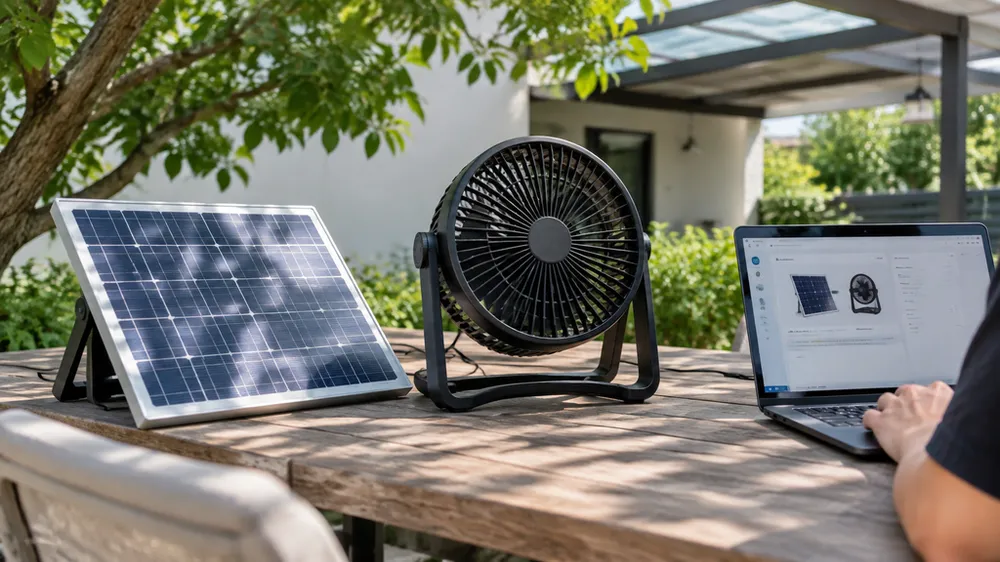
Most outdoor deployment sites don't offer full sun all day. Trees cast moving shadows, building overhangs block afternoon light, awnings shade half the panel during peak hours. Buyers assume "some sun equals some output" — reasonable assumption, wrong physics. Shading even 10–20% of a solar panel's surface can cut total power output by 40–70%, depending on how the cells are wired and whether the charge controller can isolate the shaded串. That gap between expected performance and actual runtime is why you get service calls three weeks after installation, when the battery finally depletes and the fan stops mid-shift.
This matters commercially because underpowered fans don't just annoy end users — they force you to upsize the battery or add supplemental charging, which increases your landed cost and eats margin. If you're specifying solar powered fan outdoor systems for jobsites, event infrastructure, or agricultural operations, shade tolerance isn't an add-on feature — it's the primary filter that determines which panel, battery, and controller configuration you actually need.
Panel Wattage and Motor Draw — The Ratio That Determines Runtime Under Shade
For full-sun operation, a 1:1 wattage ratio works fine. A 20W panel can sustain a 20W motor over an 8-hour day if the sun cooperates. Under partial shade, that balance breaks immediately. You need a 1.5:1 or 2:1 panel-to-motor ratio to maintain net-positive charging, because the shaded hours contribute almost nothing and the battery has to carry the load. The battery acts as a buffer, but if your average daily solar input is less than your motor draw over operating hours, the battery depletes progressively — common failure mode in shaded jobsite deployments where nobody thought to check the tree line before mounting.
Here's the selection logic we use when buyers send us site photos with partial shade:
| Use Case | Daily Runtime | Panel Wattage | Battery Capacity | Motor Type | Notes |
|---|---|---|---|---|---|
| Jobsite ventilation (trailer, tool shed) | 8 hours | 30–40W | 20–30Ah LiFePO4 | Brushless DC | 1.5:1 ratio assumes 4–5 hours effective sun; 2-day autonomy |
| Outdoor event tent | 4 hours | 20–25W | 15–20Ah LiFePO4 | Brushless DC | Lighter duty, shorter runtime; 1-day autonomy acceptable |
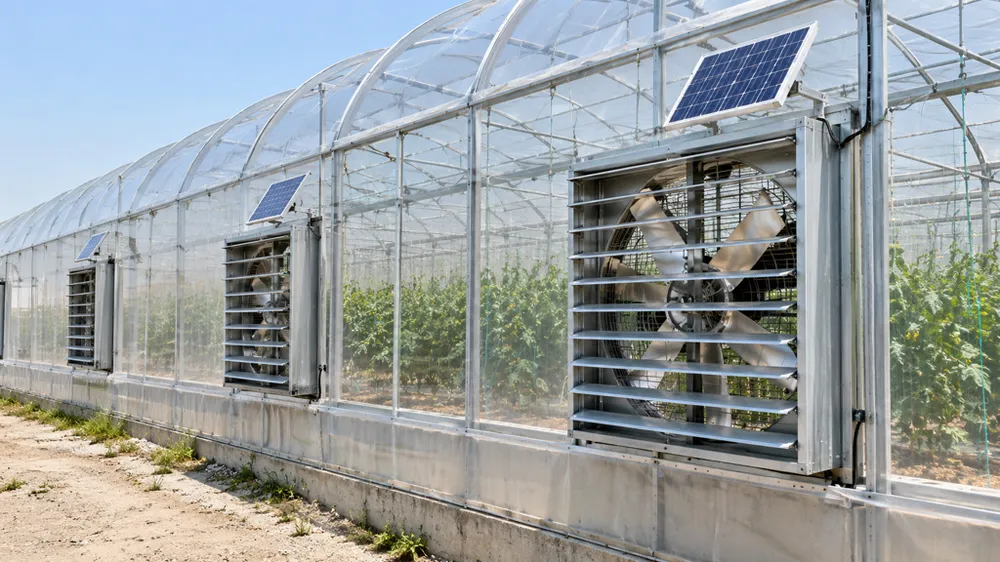
| Greenhouse circulation | 12 hours | 50–60W | 40–50Ah LiFePO4 | Brushless DC | Continuous operation; 3-day autonomy for cloudy stretches |
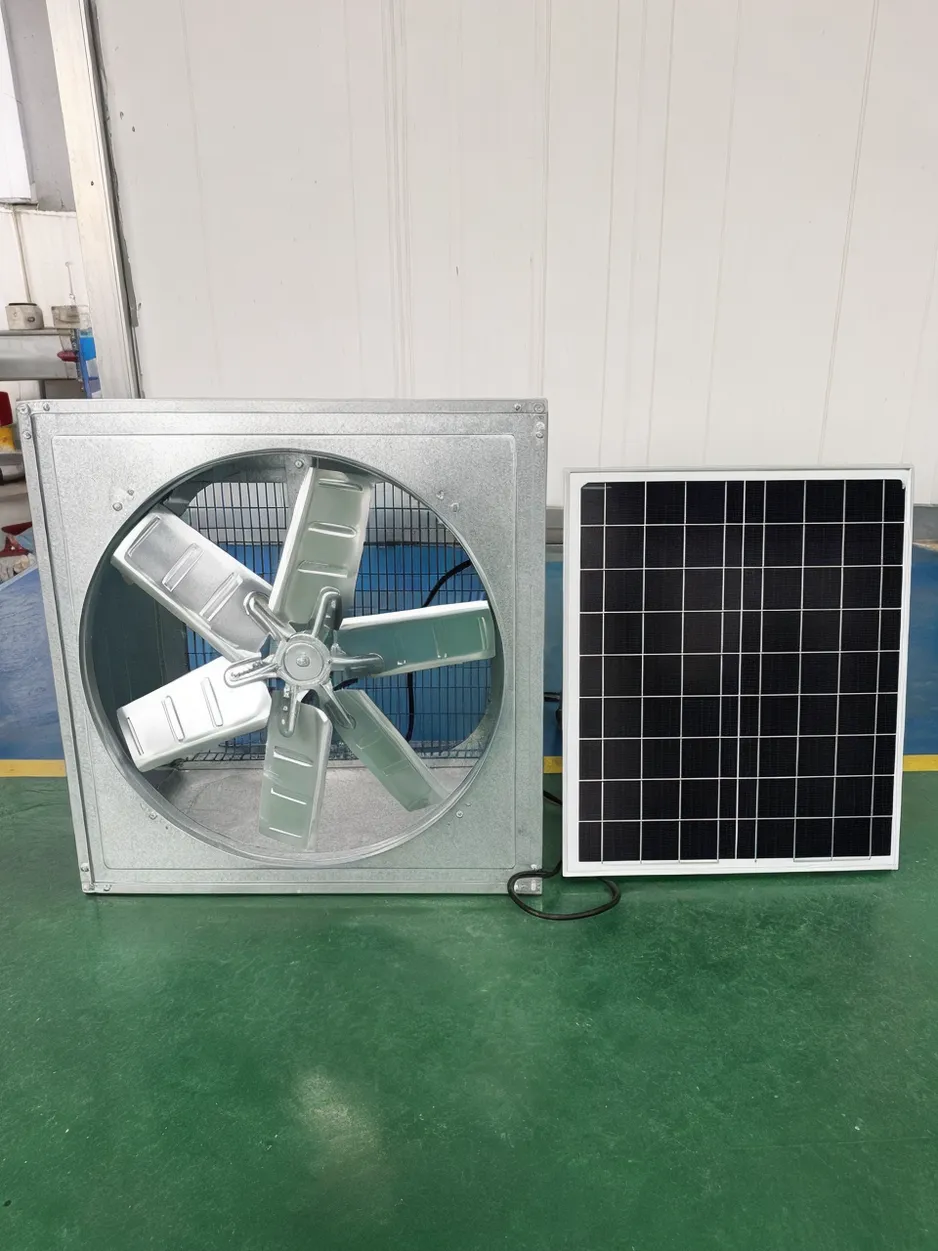
| Remote livestock shelter | 10 hours | 40–50W | 30–40Ah LiFePO4 | Brushless DC | Dust tolerance required; 2-day autonomy minimum |

Brushless DC motors show up in every row because they're 20–30% more efficient than brushed alternatives, which matters when you're already operating on a constrained energy budget. The efficiency gain translates directly to smaller battery requirements or longer runtime — your choice depending on whether you're optimizing for cost or uptime.
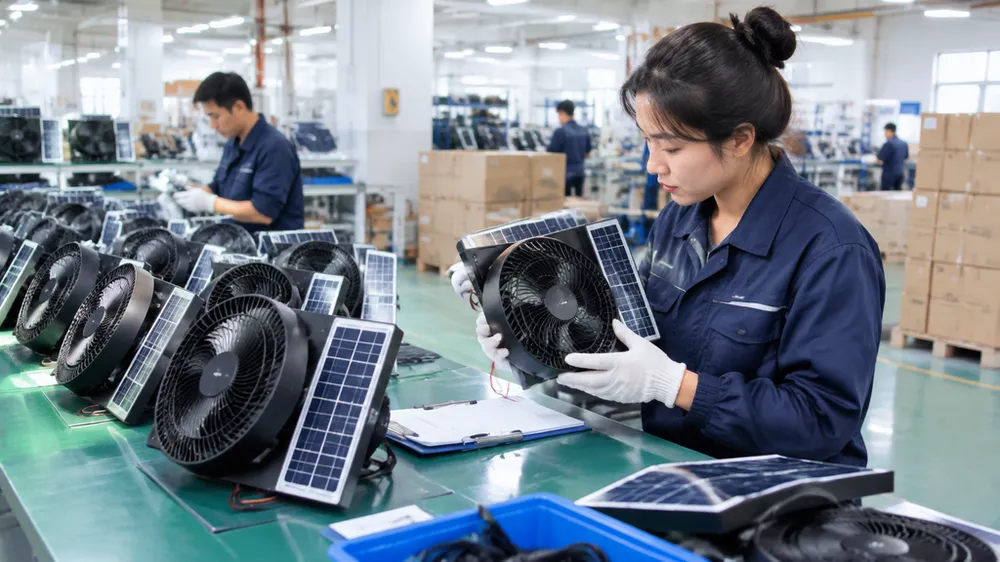
JXSOL's engineering team runs these calculations for buyers who send us deployment latitude, average daily sun hours, and shade percentage. We can spec the panel-to-motor ratio for your specific conditions before production, so you're not guessing based on consumer product datasheets that assume Arizona full-sun installation. Standard consumer solar fans are spec'd for ideal conditions and fail in real outdoor environments — we've tested enough returned units from competitors to know the failure pattern.
MPPT vs PWM Charge Controllers — Why It Matters for Shade Performance
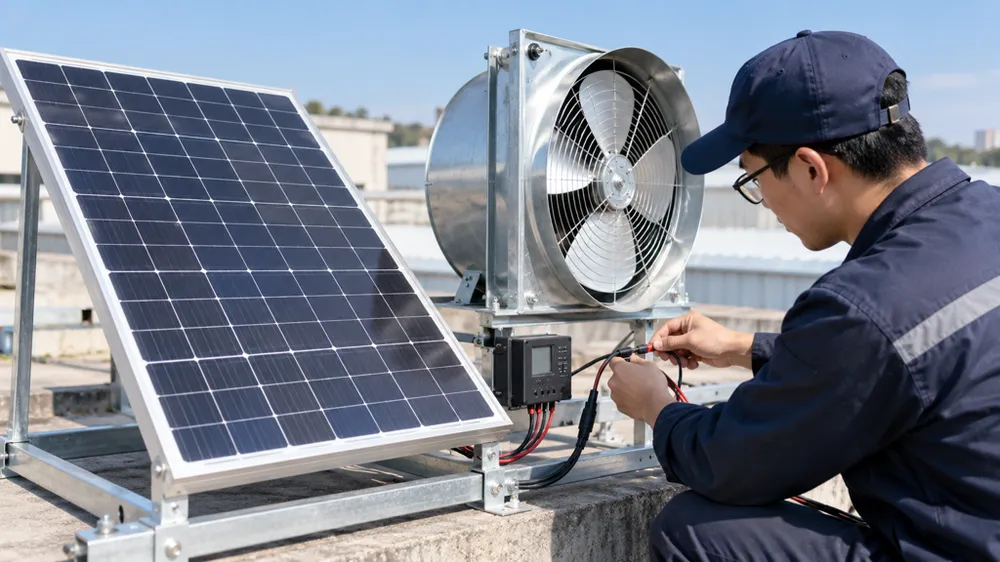
The charge controller sits between the panel and battery, managing voltage conversion and charge rate. Two types dominate the market: PWM (pulse width modulation) and MPPT (maximum power point tracking). PWM controllers are simpler and cheaper — they work by switching the panel on and off rapidly to match battery voltage. When panel voltage significantly exceeds battery voltage (common in partial shade when only part of the panel is producing power), PWM wastes the excess. You're throwing away 20–30% of whatever energy the shaded panel still manages to generate.
MPPT controllers adjust impedance dynamically to extract maximum available power at any given moment, regardless of battery state or partial shading. The cost premium is $8–12 per unit at factory level, but that cost is recoverable. You can either specify a smaller battery (because you're capturing more energy per sun-hour) or extend runtime (because the same battery gets charged more efficiently). For commercial buyers specifying 50+ units, the MPPT option reduces total system cost through smaller battery requirements and cuts field service calls — fewer "fan stopped working after three cloudy days" complaints that eat into your service budget.
We offer both controller types. MPPT is standard on OEM orders above 100 units; for smaller quantities it's a line-item option you can add during quote. The decision comes down to deployment environment. If your installation site has consistent shade patterns (building shadow that moves predictably, tree canopy that blocks the same percentage all day), MPPT pays for itself in the first season. If shade is minimal or you're optimizing purely for lowest unit cost on a pilot order, PWM is defensible — just size the battery accordingly.
Battery Capacity and Autonomy Days — Sizing for Intermittent Sun
"Days of autonomy" is how many consecutive cloudy or heavily shaded days the fan can run on stored battery power before shutdown. Consumer solar products typically spec 1 to 1.5 days because they're designed for weekend patio use where a day of downtime doesn't matter. Commercial outdoor deployments — jobsites, remote events, agricultural operations — need 2 to 3 days to avoid operational gaps. A jobsite trailer ventilation fan that quits mid-week because of two rainy days creates a safety complaint, and an outdoor event supplier whose tent fans die during setup loses the contract.
Battery chemistry matters here. Lithium iron phosphate (LiFePO4) tolerates partial state-of-charge cycling better than lead-acid, which is exactly the condition you get under partial shade where the battery rarely reaches 100% SOC. Lead-acid batteries degrade faster when they sit in the 60–80% range for extended periods; LiFePO4 handles it without meaningful capacity loss. The cost difference is $6–10 per unit at factory level, but the field service cost of replacing a degraded lead-acid battery after one season is 5x that.
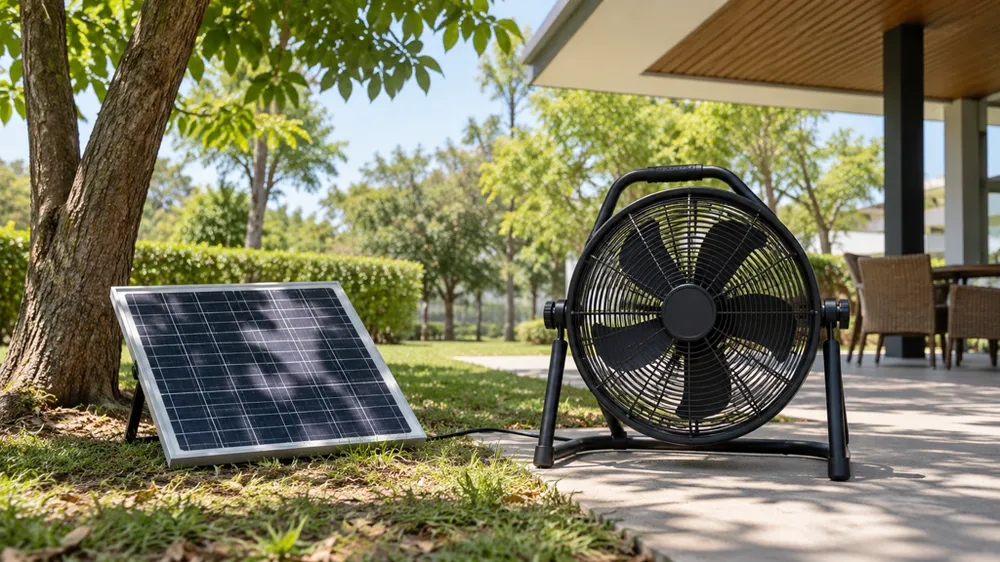
When we size batteries for custom orders, we run charge/discharge cycle simulations under partial-shade profiles — same test protocol we use for outdoor solar lighting, where battery failure after one rainy season was the primary field complaint before we implemented in-house validation. Standard consumer brands skip this step and spec for full-sun only, which is why their warranty claims spike after the first winter. Our battery testing lab is part of the same production facility that assembles the fans, so we can validate autonomy claims before the first production batch ships.
The practical decision for buyers: if your deployment site has variable weather or you can't afford mid-project service calls, upsize the battery by 50% beyond calculated minimum. That buffer adds $6–10 per unit but eliminates the majority of "fan stopped working" complaints. If you're optimizing for absolute lowest unit cost on a controlled-environment trial, you can run tighter to the calculated minimum — just plan for the downtime risk.
Weatherproof Housing and IP Rating — What Outdoor Actually Means
"Outdoor use" in consumer marketing often means "can sit on a patio table under an umbrella." Commercial outdoor means direct rain exposure, dust ingress, temperature swings from -10°C to 50°C, and nobody babysitting the installation. IP65 is the minimum viable rating — dust-tight seal, protected against water jets from any direction. That's the baseline for unprotected outdoor placement. IP67 (submersion-rated to 1 meter) is overkill for most fan applications, but it's relevant if you're deploying in washdown environments like food processing yards or agricultural facilities where equipment gets hosed down weekly.
The IP rating only matters if it's actually tested and documented. Junction boxes and wiring gland seals are the common failure points — a fan motor might be rated IP65, but if the junction box where the panel connects to the controller has a poorly seated gasket, water gets in during the first heavy rain and corrodes the terminals. We apply the same IP65 housing and cable gland standards from our solar lighting line, where field failures from water ingress cost 10x the part cost premium. Every gland gets torque-checked during assembly, and junction boxes go through spray-chamber testing before they're approved for production batches.
Because JXSOL's core product line is outdoor solar lighting (IP65/IP67 standard across the catalog), the same housing tooling, sealing protocol, and test equipment applies to our adjacent solar fan products. That's a sourcing advantage for OEM buyers versus generic fan suppliers who add a "solar version" as an afterthought — they're engineering the weatherproofing from scratch, we're applying thirteen years of field-validated IP-rated assembly to a different product form. Lower NRE cost for you, faster time to market, and fewer expensive surprises during the first rainy season.
Application Scenarios — Which Markets Deploy Solar Fans Outdoors
Jobsite contractors specify solar powered outdoor fans for ventilation in temporary structures — tool sheds, site trailers, portable restrooms, confined-space work areas. Requirements: rugged housing that survives being knocked over or dropped during transport, 2–3 day battery autonomy so the fan doesn't quit during a cloudy week, mounting hardware that works with standard framing without custom brackets. Quiet operation matters less than reliability — a construction site isn't a library, but a fan that stops working mid-shift becomes a safety complaint.
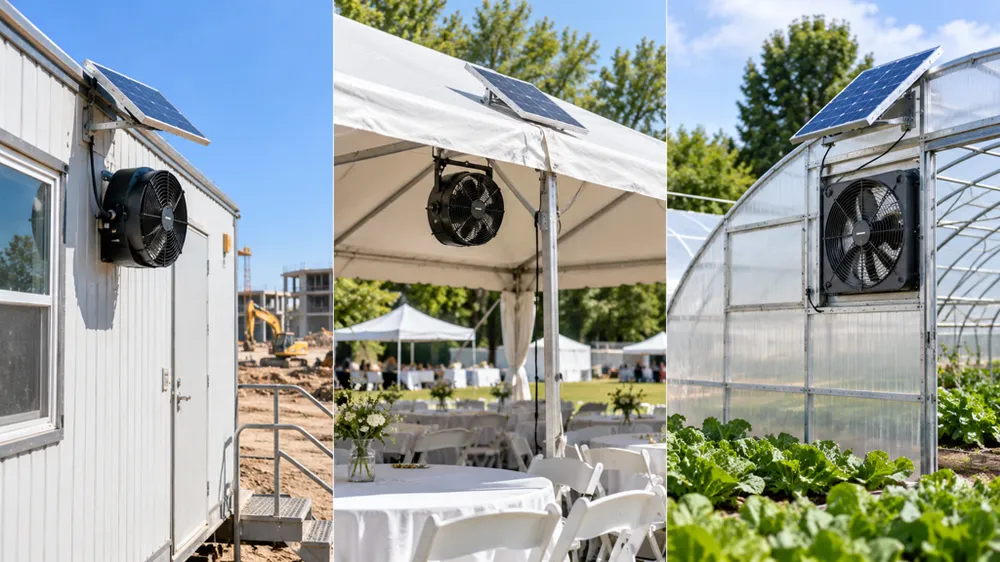
Outdoor event suppliers need solar fan for outdoor use in tents, booth setups, staging areas, food service zones — anywhere temporary power isn't available or generators are too noisy. Requirements: quiet operation (brushless motor mandatory), adjustable airflow for different tent sizes, fast setup and teardown without tools, 1-day autonomy is usually acceptable because events are weather-dependent anyway. Light weight matters because equipment gets moved multiple times per event.
Agricultural and greenhouse operations deploy fans for crop drying, livestock shelter ventilation, remote pump house cooling, and air circulation in hoop houses. Requirements: long runtime (12+ hours per day common), high tolerance for dust and humidity, low maintenance interval because these installations are often in areas without daily oversight, 2–3 day autonomy to survive cloudy stretches without requiring a site visit to recharge. IP65 rating is baseline; operations with washdown protocols need IP67 or at minimum sealed junction boxes that can handle spray.
Each segment maps back to the technical specs from earlier sections. Jobsite contractors need the 1.5:1 panel-to-motor ratio and 2-day autonomy battery. Event suppliers can run tighter on battery (1-day autonomy) but need low-noise brushless motors. Agricultural operations need maximum runtime and dust tolerance, which means oversized panels (2:1 ratio), large-capacity LiFePO4 batteries, and validated IP65 sealing on all electrical junctions.
Manufacturer Sourcing Criteria — What to Verify Before Committing to a Supplier
Integrated versus assembled supply chain: does the factory manufacture solar-powered products in-house, or are they a reseller assembling panels, batteries, and motors from three different suppliers? This matters for reorder consistency and engineering support. If your first order uses one battery supplier and your reorder six months later uses a different one because the original went out of stock, your product specs just changed without your knowledge. Factories with in-house solar lighting production typically have integrated supply chains for panels and batteries because those are core components of their main product line — their solar fan offering uses the same supplier relationships and quality control protocols.
Panel and battery testing capability: ask if they have in-house charge controller testing and battery cycle-life validation. Consumer brands skip this and rely on component supplier datasheets. Factory sources with solar lighting heritage typically have the lab infrastructure already because it's mandatory for their core product line. JXSOL's battery testing lab runs charge/discharge cycle validation under simulated partial-shade profiles — same protocol we developed to eliminate the early battery failures that plagued the solar lighting industry a decade ago. That test capability exists because our main product line demands it; solar fans benefit from the same infrastructure.
Certifications relevant to outdoor solar products: CE and RoHS are baseline (regulatory requirement for export to Europe and North America). IEC 62124 is the international standard for solar lighting products — a factory holding this certification understands photovoltaic product compliance, charge controller behavior, and battery integration at a level that generic fan manufacturers don't. IP ingress protection rating test reports should be available on request; if a supplier claims IP65 but can't produce third-party test documentation, the claim is decorative.
MOQ and OEM flexibility: standard models typically carry 100–500 unit minimums. Custom panel sizing or battery capacity usually requires 500–1000 units to justify engineering time and component procurement. Verify lead time for technical configuration changes (panel wattage, battery chemistry, controller type) versus cosmetic customization (housing color, logo placement) — the former requires electrical validation, the latter is just production line setup. JXSOL runs 100-unit MOQ for standard configurations; OEM panel and battery sizing is available at 500+ units because that volume justifies custom validation testing and component procurement.
Our context: thirteen years manufacturing solar-powered outdoor lighting, same engineering team and production lines support adjacent solar fan products. In-house testing lab for charge/discharge cycle validation and IP rating verification. Six production lines with daily output capacity of 5,000+ units means your reorder doesn't wait behind someone else's backlog. Export compliance infrastructure (CE, RoHS, IEC 62124) is already in place for solar lighting; solar fans inherit the same certification framework and documentation process.
Spec Checklist — What to Confirm Before Placing a Commercial Order
Panel wattage and motor draw ratio: target 1.5:1 minimum for partial shade environments, 2:1 if shade is heavy or site latitude is above 40 degrees. If your supplier can't explain how they calculated the ratio for your deployment conditions, they're guessing.
Battery capacity and chemistry: specify capacity in ampere-hours (Ah), not vague "runtime hours" claims. LiFePO4 preferred for partial state-of-charge cycling under shade conditions; lead-acid acceptable only for full-sun deployments with daily 100% SOC charging.
Charge controller type: MPPT for shade tolerance and maximum energy extraction; PWM acceptable only for full-sun sites where cost is the primary constraint. If the supplier doesn't offer both options, they're not designing for real outdoor conditions.
Days of autonomy: 2–3 days for commercial outdoor use where downtime creates operational or safety issues. 1-day autonomy acceptable only for non-critical applications (events, temporary setups) where a day of downtime is manageable.
IP rating: IP65 minimum for unprotected outdoor placement. Verify that the rating applies to the complete assembly (fan motor, junction box, cable glands, controller housing), not just the motor unit. Request third-party test reports if deploying in harsh environments.
Motor type: brushless DC for efficiency and low acoustic noise. Brushed motors are cheaper but waste 20–30% more power and generate audible brush noise — unacceptable for event applications, marginal for jobsite use.
Mounting hardware and adjustability: verify that mounting brackets work with your deployment environment (standard framing, tent poles, wall mounting) without requiring custom fabrication. Fan head tilt and rotation adjustability matters for jobsite and event use where optimal airflow direction varies by setup.
If your deployment site has variable shade, start with panel-to-motor ratio and autonomy days — those two specs determine whether the system works or becomes a service call three weeks after installation. JXSOL's engineering team can validate the configuration for your site latitude, average daily sun hours, and shade percentage before production, so you're not discovering the problems after you've already committed to a purchase order.