Most solar security light spec sheets list a battery capacity number — 10,000mAh, 20,000mAh — without the context you need to translate that into runtime. You can't calculate autonomy days from milliamp-hours alone, and you can't assess cold-weather suitability without knowing the chemistry. A 20,000mAh lead-acid pack and a 20,000mAh LiFePO4 pack deliver different usable energy, different cycle life, and different performance when temperature drops below freezing.
If you're sourcing solar security lights for parking lots, perimeter fencing, or off-grid commercial sites, you need to verify three battery specs before purchase: chemistry (which determines cycle life and temperature tolerance), capacity in watt-hours (not just milliamp-hours), and cold-weather derating curves (so you can size for northern latitudes). This article walks through the spec comparison, the autonomy-day calculation methodology, and the factory-level QC steps that separate consistent batch performance from runtime lottery.
Battery Chemistry Comparison for Solar Security Lighting
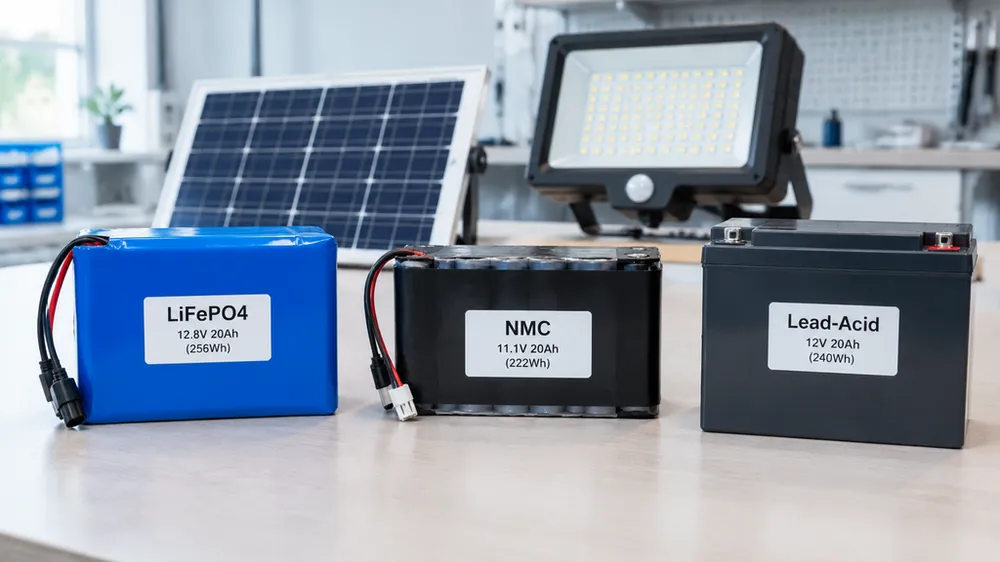
The solar security light battery chemistry determines cycle life, usable depth of discharge, temperature performance, and ultimately your total cost of ownership over a 3–5 year project. Three chemistries dominate the market: lithium iron phosphate (LiFePO4), lithium nickel manganese cobalt (NMC), and sealed lead-acid. Each has a distinct cost-versus-performance trade-off.
LiFePO4 is the factory default for commercial solar security lighting. You get 2,000+ charge/discharge cycles at 80% depth of discharge, a stable voltage curve throughout the discharge (which means consistent lumen output until cutoff), and a safer thermal profile — LiFePO4 cells don't enter thermal runaway under the temperature extremes typical in outdoor enclosures. We spec LiFePO4 for 90% of our security and flood lighting SKUs because the upfront cost premium pays back in warranty exposure reduction. A distributor reordering replacement batteries after 18 months because the lead-acid packs sulfated isn't saving money — they're losing margin to service calls.
NMC offers higher energy density than LiFePO4, so you can fit more watt-hours into a smaller enclosure. That matters if your fixture housing has a tight battery compartment or if you're shipping by air and need to minimize dimensional weight. The trade-off: NMC delivers 1,000–1,500 cycles instead of 2,000+, and it's more sensitive to high-temperature degradation. If your project is in a cooling-dominated climate and enclosure size is a hard constraint, NMC can be the right call. For most outdoor security applications where the fixture sits in direct sun, LiFePO4's thermal stability wins.
Sealed lead-acid still appears in budget SKUs and legacy product lines. The upfront cost per watt-hour is the lowest of the three chemistries, but cycle life drops to 300–500 cycles, and the battery adds significant weight — a problem if you're mounting the fixture on a pole that wasn't sized for it. Lead-acid also sulfates when left in a partial state of charge, which is exactly what happens during extended cloudy periods. You can use lead-acid successfully if your project has very low upfront budget constraints and you have near-zero labor cost for replacement (e.g., fixtures mounted at ground level with tool-free battery access), but total cost of ownership over three years typically favors lithium.
One spec detail that catches buyers: voltage compatibility. LiFePO4 cells have a nominal voltage of 3.2V, so packs are built in series — 6.4V for a 2S pack, 9.6V for 3S, 12.8V for 4S. Lead-acid is 12V nominal. Your charge controller must match the battery chemistry. If you're ordering replacement batteries for an existing fixture, verify the charge controller supports the chemistry you're buying. Cross-chemistry replacement without controller verification leads to undercharging (shortened runtime) or overcharging (fire risk).
Here's the buyer decision heuristic we use when sizing projects: spec LiFePO4 for the lowest total cost of ownership in any project with a 3+ year timeline, use NMC only if enclosure size is a hard design constraint and you've confirmed the fixture has adequate ventilation, and consider lead-acid only if replacement labor is near-zero and you're willing to accept 2-year replacement cycles.

Capacity Specification and Autonomy-Day Calculation
Battery capacity appears on spec sheets in milliamp-hours (mAh), but that's not the usable unit for procurement. You need watt-hours (Wh) — the product of voltage and amp-hours — because different chemistries operate at different voltages. A 10,000mAh LiFePO4 pack at 6.4V nominal delivers 64Wh. A 10,000mAh lead-acid pack at 12V delivers 120Wh. The mAh number alone doesn't tell you how many nights the battery can power your fixture.
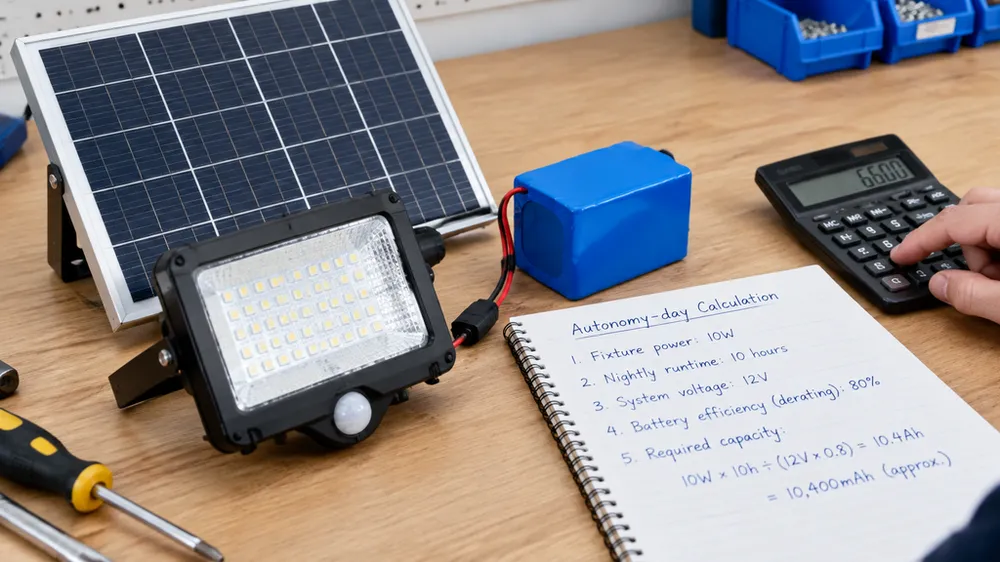
Autonomy days is the metric that matters: the number of consecutive nights the battery can run the light at rated output with zero solar recharge. It's your buffer against cloudy weather and your sizing target when you're speccing for a latitude with long rainy seasons. Here's the calculation.
Start with your fixture power and nightly runtime. A 20W solar flood light running 10 hours per night consumes 200 watt-hours per night. If your battery pack is rated at 600Wh, you might assume 3 autonomy days. That's the theoretical maximum at 100% depth of discharge, but you can't discharge a battery to zero without damaging it or voiding the warranty.
For LiFePO4, safe usable depth of discharge is 80%, so your 600Wh pack delivers 480Wh usable. That's 2.4 autonomy days before the battery management system cuts off to protect the cells. You also need to account for efficiency losses: charge controllers lose 5–10% during the DC-DC conversion, and LED drivers lose another 5–15% depending on driver quality. Apply a combined 15% derating for losses, and your real autonomy is closer to 2 days.
We calculate autonomy with this formula: Autonomy days = (Battery capacity in Wh × Usable DoD × Efficiency factor) ÷ (Fixture wattage × Nightly runtime in hours). For the 20W example with a 600Wh LiFePO4 pack: (600 × 0.80 × 0.85) ÷ (20 × 10) = 2.04 autonomy days. If your project requires 3 autonomy days in the field after 2 years of use, size the battery at 1.4× the calculated requirement to account for aging — batteries lose capacity over time, and you don't want your 3-day spec degrading to 2 days after the first year.
When we receive an RFQ for a parking lot security lighting project, our engineering team calculates the battery size based on your latitude (which determines average daily solar irradiance), your rainy-season duration, and your required uptime percentage. We don't ship a fixed SKU spec — we size the battery for your deployment conditions. A distributor in Seattle needs more autonomy days than a distributor in Phoenix because cloud cover patterns differ by 40+ days per year.
The most common under-spec mistake we see from competing suppliers: listing battery capacity in mAh at nominal voltage without disclosing usable depth of discharge or efficiency losses. A buyer orders a fixture advertised as "3 autonomy days," deploys it, and discovers it runs 2 days in real field conditions. That's not a battery defect — it's a spec sheet that omitted the derating factors. When you're comparing solar security light battery capacity across suppliers, ask for watt-hours, usable DoD, and the aging factor they applied.
Cold-Weather Performance and Capacity Derating
Lithium battery capacity drops when temperature drops, and the effect is significant enough to break your autonomy-day calculation if you're deploying in northern latitudes. LiFePO4 retains approximately 70% of rated capacity at -10°C and 50% at -20°C. If you sized a battery for 3 autonomy days based on the 25°C rated capacity, you're delivering 2.1 days at -10°C and 1.5 days at -20°C. For a project in Minnesota or Alberta, that's the difference between lights that stay on through a winter storm and lights that go dark after the first cloudy night.
NMC handles cold slightly better in terms of discharge capacity, but it still drops to 60–70% at -10°C. The larger problem with NMC in cold climates is that the shorter baseline cycle life (1,000–1,500 cycles) means you're replacing batteries more frequently, and cold-weather discharge stress accelerates degradation. Lead-acid is worse: capacity drops to 50% at -10°C, and if the battery isn't fully charged when temperature falls below -20°C, the electrolyte can freeze and crack the case.
The procurement implication: if you're sourcing solar security lights for deployment above 45°N latitude, specify 1.5× the calculated capacity to maintain your target autonomy days through winter. A project requiring 3 autonomy days in moderate weather needs a battery sized for 4.5 days to deliver 3 days consistently at -10°C. That's not over-engineering — it's accounting for physics.
Cold weather also degrades charge acceptance. When the battery is cold, its internal resistance increases, so it accepts charge more slowly from the solar panel. Solar charging efficiency drops 20–30% in freezing conditions, compounding the discharge capacity loss. If your fixture location sees extended sub-zero periods, you need both oversized battery capacity and a solar panel sized for reduced charging efficiency. We've seen buyers spec a battery correctly for cold-weather discharge but forget to upsize the panel, resulting in batteries that never fully recharge during short winter days.
For cold-climate orders, we run battery packs through aging cycles in an environmental chamber at -10°C before shipment. We verify that the pack delivers the derated capacity we specified, not just the room-temperature datasheet number. That test costs us 6–8 hours of chamber time per batch, but it's the only way to confirm the pack will perform in Fargo or Saskatoon. If you're buying solar flood light battery spec for a northern project, ask your supplier for a cold-temperature derating curve and whether they tested the assembled pack at temperature. Cell datasheets show performance under ideal conditions — you need pack-level verification.
One more detail for extreme-cold deployments (above 50°N or high-altitude sites): heater-equipped battery enclosures exist, but they add cost and parasitic load. The heater draws power from the battery to keep itself warm, reducing your effective autonomy days. We only recommend heated enclosures if your project requires year-round uptime in locations where temperature regularly drops below -25°C. For most commercial security applications between 40°N and 50°N, oversized LiFePO4 capacity without heating is the more cost-effective solution.
Battery Pack Matching and Factory QC Process
The solar security light battery spec on a datasheet describes a single cell. The battery in your fixture is a pack — multiple cells wired in series and parallel to reach the target voltage and capacity. How those cells are selected and assembled determines whether your batch ships with consistent runtime or 30% variance between units.
Lithium cells must be matched by capacity and internal resistance before pack assembly. If you wire a 3,200mAh cell in series with a 3,100mAh cell, the pack's usable capacity is limited by the weakest cell. The 3,200mAh cell will hit full charge before the 3,100mAh cell, and the battery management system cuts off charging to protect against overcharge. You paid for 6,300mAh, but you're getting 6,200mAh of usable capacity. Multiply that mismatch across a 500-unit order, and you've shipped fixtures with runtime spread from 8 hours to 11 hours — all meeting the individual cell spec, none meeting the buyer's performance expectation.
We group cells by capacity within 50mAh and by internal resistance within 5 milliohms before pack assembly. That's a tighter tolerance than most suppliers use (industry standard is ±100mAh), and it costs us extra sorting time during incoming inspection. The trade-off: 95%+ of our shipped units meet the rated autonomy days when the buyer tests them in the field. We've taken distributor orders where they were replacing a competitor's fixtures due to inconsistent runtime, and the root cause was always unmatched cells. The competitor hit the spec on paper — the datasheet capacity was accurate for the cells they bought — but they didn't control pack-level performance.
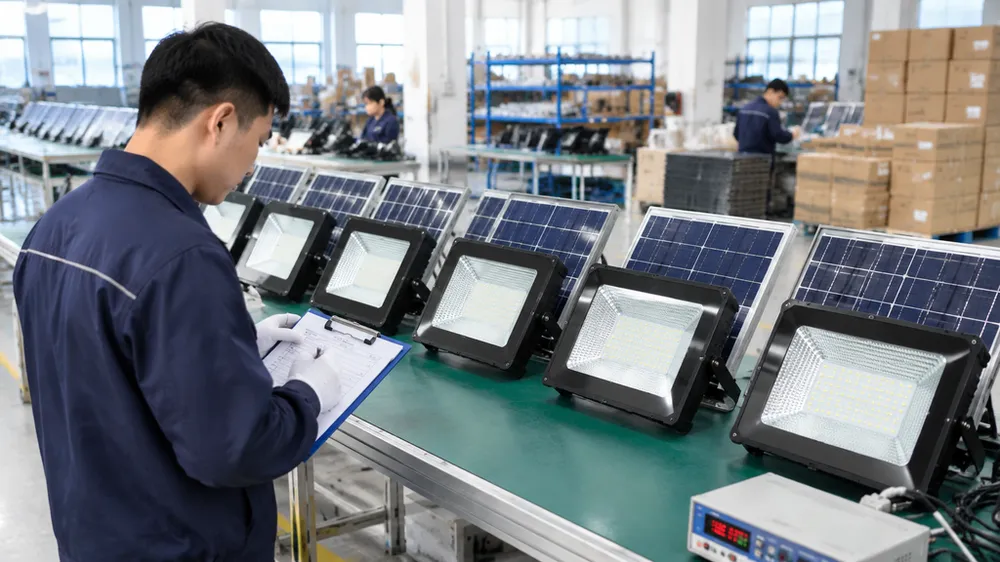
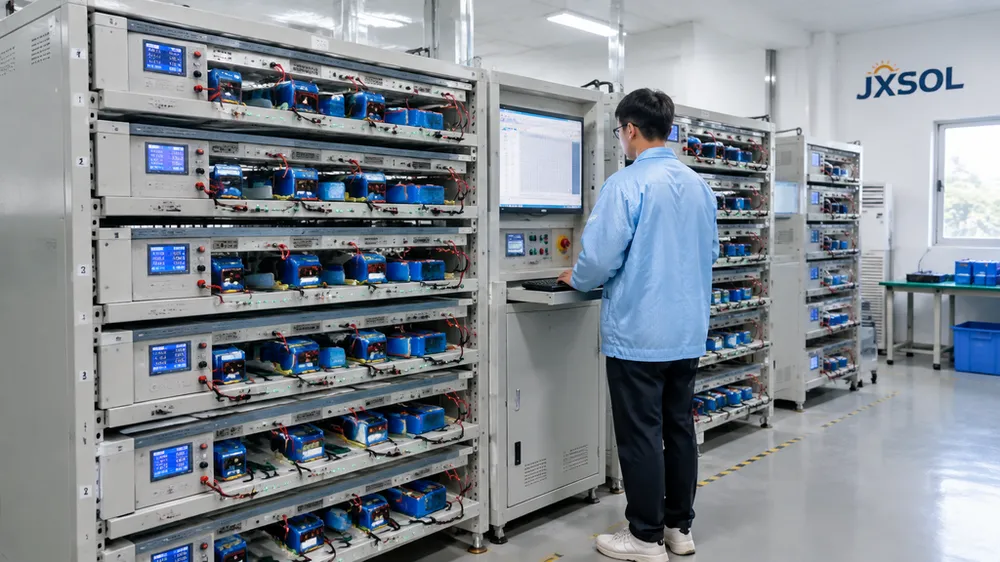
After pack assembly, we run aging tests: three full charge/discharge cycles under rated load on test racks in our QC lab. We record the voltage curve and measure actual delivered capacity. Packs that fall below 95% of rated capacity get pulled and the cells redistributed to different packs. That step catches cell-level defects (internal shorts, high self-discharge) and assembly defects (cold solder joints, BMS misconfiguration) before the unit ships. It's a 48-hour process per batch, which is why our lead time is 2–3 days longer than suppliers who skip this step, but it's also why our warranty claim rate for battery-related failures is under 1%.
The battery management system (BMS) in each pack is configured to cut off discharge at 80% depth of discharge for LiFePO4 packs. That's conservative — LiFePO4 can safely go to 90% DoD — but it extends cycle life from 2,000 cycles to 3,000+ cycles. For a distributor selling fixtures with a 3-year warranty, that margin is insurance. The BMS also protects against overcharge, short-circuit, and temperature excursions. We source BMS boards with temperature sensors that cut off charging if the pack exceeds 60°C, which prevents thermal runaway in fixtures that end up installed in poorly ventilated enclosures (it happens more often than buyers expect).
For project buyers who need traceability documentation, we can provide the capacity test report for each batch. It's a spreadsheet with serial number, measured capacity, charge/discharge voltage curves, and pass/fail status. That level of documentation isn't standard in the solar lighting industry, but it's what you need if you're deploying 5,000 units across a municipal contract and the city's procurement office requires QC records.
The differentiation here is simple: we test the pack, not the cell. A cell datasheet tells you what the manufacturer of the cell achieved under lab conditions. Our test report tells you what the assembled battery in your fixture will deliver when you install it on a pole in Omaha.
Application-Specific Battery Spec Priorities
Different solar security lighting applications put different demands on the battery, and your spec priorities should shift accordingly. A parking lot security light needs maximum autonomy days because uptime is the primary KPI — if the lights go dark during a storm, you've created a liability exposure. A perimeter security light in a northern climate needs cold-weather performance as the first-order spec. An off-grid commercial site needs cycle life because replacement labor is expensive.
For parking lot and area security lighting, autonomy-day count is the dominant spec. Projects typically require 3–5 autonomy days to cover extended rainy periods without compromising uptime. Battery capacity and chemistry drive this — you want the largest watt-hour capacity that fits the enclosure, and you want LiFePO4 for the cycle life and depth-of-discharge tolerance. Cost per watt-hour matters less than total cost of ownership, because a service call to replace a failed battery in year two costs more than the incremental cost of speccing LiFePO4 instead of NMC up front.
For perimeter and cold-climate security installations, low-temperature performance becomes the primary spec. You need to verify the cold-weather derating curve and oversize capacity by 1.5× to maintain autonomy days when temperature drops below -10°C. LiFePO4 is still the right chemistry choice here — not because it performs better than NMC in the cold (it's roughly equivalent), but because the longer baseline cycle life gives you more margin after cold-weather stress accelerates degradation. We've shipped perimeter lighting projects to buyers in Canada and Scandinavia where the battery capacity was 60% larger than the equivalent project in Texas, purely to account for winter derating.
Off-grid commercial and remote-site security puts cycle life and replacement logistics at the top of the spec priority list. If your fixtures are installed on a pipeline right-of-way or a mining site 200 km from the nearest service depot, battery replacement is a multi-thousand-dollar logistics event. You optimize for longest possible service life, which means LiFePO4, conservative depth-of-discharge limits (70% instead of 80%), and oversized capacity to reduce cycling stress. The upfront cost difference between a 400Wh pack and a 600Wh pack is $20–30. The cost difference between replacing batteries every 3 years and every 5 years is $200+ per site in labor alone.
For residential and light-duty applications, cost per unit becomes the primary spec because replacement labor is low (homeowner can swap the battery) and the consequence of failure is minor. You can use smaller capacity, NMC chemistry if enclosure size matters, or even lead-acid if the buyer understands they're trading service life for upfront cost. This is the one application segment where lead-acid still makes commercial sense, but only if the buyer has realistic expectations about 2-year replacement cycles.
If you're sourcing solar security light battery replacement packs for an existing installation, match the chemistry and capacity of the original spec. Cross-chemistry replacement (e.g., upgrading from lead-acid to LiFePO4) requires verifying that the charge controller in the fixture supports the new chemistry. Most modern controllers are multi-chemistry, but older fixtures (pre-2018) often have fixed-profile controllers that will undercharge or overcharge the wrong battery type.
Spec Verification and Supplier Disclosure Requirements
When you issue an RFQ for solar security lighting, request these battery specs explicitly: chemistry (LiFePO4, NMC, or lead-acid), nominal voltage, rated capacity in watt-hours (not just mAh), cycle life at 80% depth of discharge, low-temperature derating curve (percentage of rated capacity at -10°C and -20°C), and battery management system protection features. If the supplier's quote lists only "20,000mAh battery," send it back with a request for the full spec breakdown.
Three red flags indicate the supplier doesn't control their battery sourcing well enough for you to rely on their spec: they list only mAh without voltage, they provide cell specs but not pack specs, or they claim "maintenance-free" for lead-acid batteries (all lead-acid requires periodic equalization charging to prevent sulfation, even sealed types). Any of those gaps means you'll be discovering the real performance after you've placed the order.
For projects above 500 units or any project with formal traceability requirements, request test reports: capacity discharge curve at rated load, internal resistance measurement for the assembled pack, cycle-life test data if available (most suppliers won't have this, but larger factories should), and cold-temperature performance data if your deployment is above 40°N latitude. We provide capacity and internal resistance reports as standard for orders above 1,000 units and on request for smaller orders. The report adds 15 minutes to our QC process per batch — it's not a burden.
Battery warranty should correlate to cycle-life spec. If a supplier claims 2,000-cycle LiFePO4 but offers only a 1-year warranty, the spec is not backed by confidence. We warranty batteries for 3 years on LiFePO4 packs because we know they'll deliver 2,000+ cycles over that period based on 13 years of field data. A 1-year warranty on a 2,000-cycle claim means the supplier either doesn't trust their cell source or doesn't match cells before pack assembly.
After you receive shipment, you can verify autonomy days in the field by running a sample fixture off-battery with no solar recharge. Measure nightly runtime until the BMS cuts off discharge. Compare to the calculated autonomy days from the spec. If you're seeing more than 20% deviation, either the battery capacity is below spec or the fixture wattage is higher than rated (another common issue — LED driver inefficiency or poor thermal management can push real power draw above the fixture's rated wattage). We've had distributors ask us to validate competitor fixtures this way, and about 40% of the time the battery capacity was the problem, 30% the fixture was drawing more power than rated, and 30% the buyer miscalculated autonomy because they didn't account for efficiency losses.
One last verification step for larger projects: request a pre-production sample and test it yourself. Run it through a full discharge cycle, measure the capacity, and confirm the autonomy days match your calculation. If you're deploying 5,000 units across a municipal parking lot network, validating one sample is cheap insurance against discovering a spec gap after installation.
JXSOL Battery Specification and Sourcing Approach
We spec LiFePO4 chemistry for over 90% of our security and flood lighting SKUs. Nominal voltage is 6.4V (2S configuration) or 12.8V (4S configuration) depending on fixture wattage and LED driver requirements. Capacity range is 10Ah to 60Ah (64Wh to 768Wh at 6.4V nominal) depending on your fixture's power draw and your target autonomy days. If your project needs a capacity outside that range, we'll source the cells and build the pack — we're not limited to catalog SKUs.
Our engineering team calculates the battery size based on your deployment conditions, not a fixed product matrix. You tell us your latitude, your required autonomy days, your nightly runtime hours, and your fixture wattage. We calculate the watt-hour requirement with derating factors for efficiency loss, depth of discharge, aging, and cold weather if applicable. If you're deploying in Oslo, you're getting a different battery size than a buyer deploying in Atlanta with the same fixture, because the solar irradiance patterns and temperature profiles are different.
Battery pack assembly starts with cell matching: capacity grouped within 50mAh, internal resistance within 5 milliohms. After welding and BMS integration, packs go to the aging test racks for three full charge/discharge cycles under rated load. We record voltage curves and delivered capacity. Packs that fall below 95% of rated capacity don't ship. The BMS is configured for 80% depth-of-discharge cutoff to extend cycle life, and it includes over-charge, over-discharge, short-circuit, and over-temperature protection. The temperature cutoff is set at 60°C — high enough to avoid nuisance trips in hot climates, low enough to prevent thermal runaway.
For cold-weather orders (deployment above 45°N latitude or high-altitude sites), we test sample packs in our environmental chamber at -10°C and verify the derated capacity. We provide the derating curve with the shipment documentation so you know what autonomy-day performance to expect in winter. That test takes 8–12 hours per batch, so it adds a day to lead time, but it's the only way to confirm the pack will deliver in Fargo or Calgary.
We archive the battery specs for every order. If you need replacement packs three years later, we can build matched replacements from the original spec without reverse-engineering. That matters for distributors who sell fixtures into multi-year maintenance contracts — you can reorder batteries in year 4 and know they'll be compatible with the fixtures you sold in year 1. Suppliers who don't archive component specs leave you guessing about voltage, capacity, and BMS configuration when replacement time comes.
The sourcing approach is straightforward: we buy cells from tier-1 lithium suppliers (CATL, EVE, BYD), not spot-market aggregators. We pay more per cell, but we get traceability and consistent quality. When a batch of cells arrives, we run incoming inspection on 100% of units — capacity and internal resistance measured, not sampled. Cells that fall outside our matching tolerance get returned. That's a cost most buyers don't see on the invoice, but it's the difference between a 1% warranty claim rate and a 5% claim rate.