When you're comparing solar spotlight vs solar flood light for a project or catalog, the decision comes down to three linked variables: beam angle determines coverage area, lumen output determines visibility level, and battery capacity determines how long that output runs per charge. Get one wrong and you're either buying twice as many fixtures as you needed or fielding complaints about dark zones six months after installation.
Most comparison content online treats this as a residential aesthetics question — warm glow vs. bright security, decorative vs. functional. That framing doesn't help if you're a distributor deciding which SKUs to stock, a contractor sizing fixtures for a parking lot RFQ, or a brand owner choosing between two factory quotes. You need to know how beam angle maps to fixture count per zone, why a 2,000-lumen floodlight costs more than three 600-lumen spotlights, and whether your target market's latitude makes one type unviable regardless of coverage preference.
We manufacture both fixture types in the same factory, on adjacent production lines, using the same component suppliers and QC protocol. Over 13 years we've shipped spotlight and floodlight orders to the same buyers — sometimes in mixed containers, sometimes as separate reorders when one type proved more profitable than the other in their market. This article covers the spec differences that drive those sourcing decisions, the application scenarios where each type delivers commercial value, and the factory-side variables (MOQ, lead time, customization options) that affect whether you can realistically stock both or need to pick one.
Beam Angle and Coverage Area — The Core Optical Difference
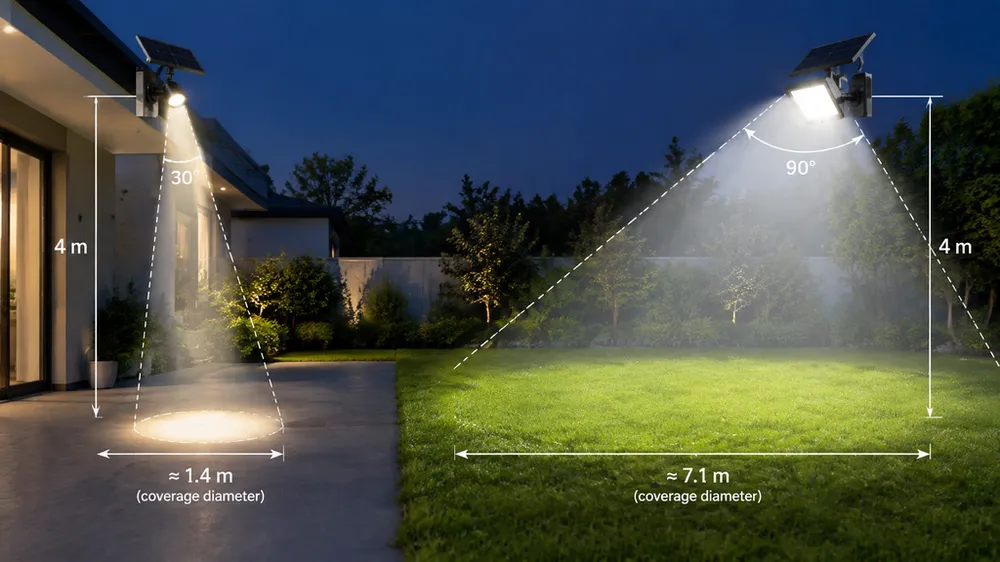
Beam angle is the single specification that separates solar spotlight vs solar flood light at the design level. A spotlight typically operates between 15° and 45°, creating a concentrated light pool. A floodlight operates between 60° and 120°, distributing the same lumens across a broader zone. At a 4-meter mounting height, a 30° spotlight covers roughly a 2-meter diameter circle; a 90° floodlight at the same height covers 7 meters. To light the same square footage, you need 3× to 5× more spotlight units than floodlights.
That multiplier directly affects your project economics. If you're quoting a parking perimeter with six 4-meter poles and you choose spotlights, you might need 18 fixtures (three per pole to eliminate dark zones between beams). The same perimeter with floodlights might need six fixtures (one per pole). Unit cost is lower for spotlights — smaller battery, smaller panel, lighter housing — but installation labor scales with fixture count. You're running more mounting brackets, more wiring pigtails (even on solar fixtures, many buyers group them for simultaneous on/off control), and more post-installation aiming adjustments. For large projects, that labor cost reversal often makes floodlights cheaper per square meter of coverage despite higher unit cost.
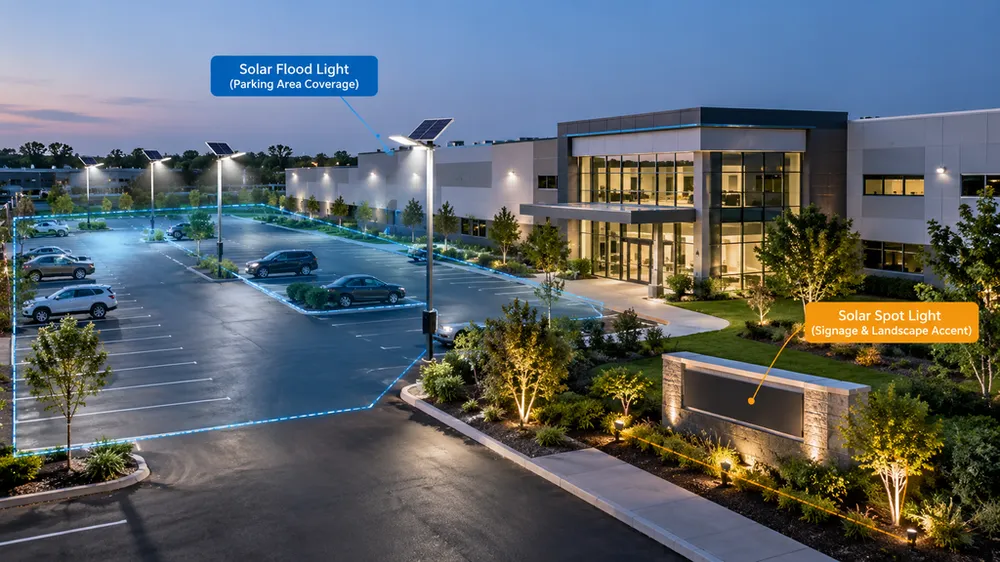
Narrow beam angle becomes the point when coverage isn't the goal. If you're lighting a building entrance sign, a flagpole, a sculpture, or a tree canopy for architectural accent, you want the light concentrated in one spot with sharp falloff around the edges. The visual effect depends on contrast — bright subject, dark surroundings. A floodlight in that scenario washes out the contrast and lights things you didn't intend to light (the ground around the tree, the wall behind the sign). For distributors, this means spotlight demand clusters in landscape supply, hospitality project, and retail storefront channels. Floodlight demand clusters in parking lot, perimeter security, and industrial site channels. If your sales mix tilts heavily toward one channel, your SKU mix should reflect that.

Our optical design team can customize beam angle within fixture type, so if a buyer needs a 50° spotlight (wider than catalog spec but still narrower than a floodlight), we reconfigure the LED array and reflector geometry. That capability matters when you're serving a market where the typical mounting height or pole spacing doesn't align with standard beam angles — you're not locked into catalog specs that force your customers into suboptimal layouts.
Wide beam angle makes floodlights the default for area lighting: parking lots, building facades, loading docks, pathway systems, open plazas. The goal is uniform lux across a zone, not accent or contrast. Lighting standards for those applications specify minimum lux at ground level (typically 5–20 lux depending on activity type), and inspectors or end clients measure with a light meter during commissioning. You can't meet a uniform lux spec with spotlights unless you massively over-fixture the project, because the overlap zones get double the lumens while the gaps stay dark. Floodlights, by design, create overlapping circles of light that smooth out into relatively even coverage (with proper spacing — the installer still needs to calculate pole distance based on beam angle and mounting height, but the physics cooperate).
For buyers stocking both types, the sourcing simplification is that one RFQ to our factory covers both. You're not coordinating spotlight quotes from one supplier and floodlight quotes from another, hoping their quality levels and lead times align. Same QC protocol, same component suppliers, same warranty policy, same technical contact if something needs adjustment mid-production. Beam angle differences don't create sourcing complexity on our end — they're just two variations of the same manufacturing process.
Lumen Output and Battery Capacity — Linked by Runtime Target
Lumen output ranges overlap between solar spotlight vs solar flood light, but the typical scale differs. Our spotlight catalog runs 200 to 800 lumens, floodlight catalog runs 800 to 3,000 lumens. A 600-lumen spotlight and a 600-lumen floodlight produce the same total light, but the floodlight spreads it across 4× the area, so perceived brightness per square meter is lower. That's intentional — area lighting doesn't need the intensity of accent lighting, it needs coverage.
Battery sizing follows lumen output, not beam angle. If you want 10 hours of runtime from a 2,000-lumen floodlight, you need roughly 3× the battery capacity of a 600-lumen spotlight running the same duration. The formula is straightforward: lumens determine LED wattage, wattage × runtime determines watt-hours, watt-hours determine battery capacity in amp-hours (after accounting for voltage and discharge efficiency). Our engineering team runs this calculation for every OEM/ODM order where the buyer specifies a target runtime and latitude, because the same fixture will get different daily solar charge in Norway vs. Saudi Arabia. If your market has short winter days and you need 12-hour runtime, the battery and panel both scale up. If your market has year-round sun and you only need 6-hour runtime, they scale down. We don't ship one-size-fits-all battery specs and let buyers figure out autonomy problems in the field.
Solar panel size is the third variable in this chain. Larger battery requires longer recharge time or larger panel area to refill in one day. A floodlight with 18,000 mAh battery might need a 60-watt panel, while a spotlight with 6,000 mAh battery runs on a 20-watt panel. That panel size difference creates two downstream effects you care about as a buyer: shipping cube and mounting footprint. Floodlights are physically larger and heavier, so they ship fewer units per cubic meter (matters for container-load freight cost) and require beefier mounting poles or brackets (matters for installation cost and wind load calculations). If your target market has a lot of existing poles where you're retrofitting old fixtures, the mounting footprint might eliminate floodlights as an option even if the coverage math favors them.
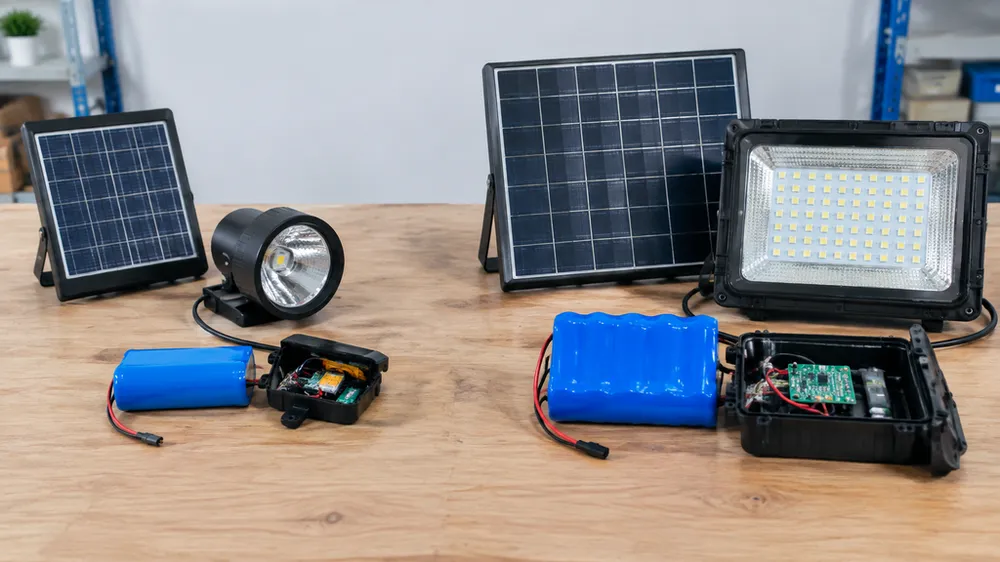
We see buyers make two common sizing mistakes. First: choosing lumen output based on competitor spec sheets without checking the test conditions. A "1,000-lumen" rating tested at full battery voltage in a 25°C lab will drop to 800 lumens in the field at 80% battery state-of-charge and -10°C ambient temperature. Our spec sheets state both initial lumens and maintained lumens after thermal and voltage degradation, because that's what your end customer will actually see. Second mistake: ignoring battery chemistry differences when comparing quotes. Lithium-ion delivers higher energy density than LiFePO4 (so smaller/lighter fixture), but LiFePO4 tolerates deeper discharge cycles and temperature extremes better (so longer field lifespan in harsh climates). We default to LiFePO4 for floodlights because they're typically deployed in fully exposed locations — rooftop mounts, coastal perimeters, desert parking lots — where thermal stress is highest. For spotlights in landscape beds with partial shelter, lithium-ion is often sufficient and keeps the fixture more compact.
Our engineering team doesn't just size components to hit a spec — we model the discharge curve over the target runtime to confirm the fixture maintains minimum lumen output through the end of the night. If the battery voltage sags and the lumens drop below usable levels in the last two hours, the runtime number is marketing fiction. You pay for a 10-hour fixture, your customer gets complaints after 8 hours, and you're fielding returns. We've been manufacturing solar lighting long enough to have seen every version of that failure pattern, so our battery matching and discharge testing protocol is built to prevent it. That's equally true for spotlights and floodlights — same testing rig, same rejection threshold.
Lumen output customization is one of the most frequent OEM/ODM requests we receive. A buyer will say "your 1,200-lumen floodlight is close, but we need 1,500 lumens to match our brand's existing non-solar line." We reconfigure the LED array — change chip count, adjust current, retest thermal performance — and confirm the battery and panel still support the target runtime. That capability exists because we design the LED modules in-house rather than buying pre-assembled units from a third-party supplier. If we outsourced the LED assembly, every custom lumen request would require negotiating with that supplier, waiting for their prototype batch, and hoping their quality holds when we scale to production. In-house control means faster iteration and tighter consistency between prototype and production.
Application Scenario Mapping — Coverage Type Drives Fixture Selection
Your buyers (or your buyers' customers) are trying to solve a lighting problem tied to a physical space and a functional requirement. The decision between solar spotlight vs solar flood light should map directly to that requirement, not to preference or habit. When we consult with distributors on which SKUs to stock, we ask: what are the top three project types your sales team quotes most often? The answer determines which fixture type will move faster.
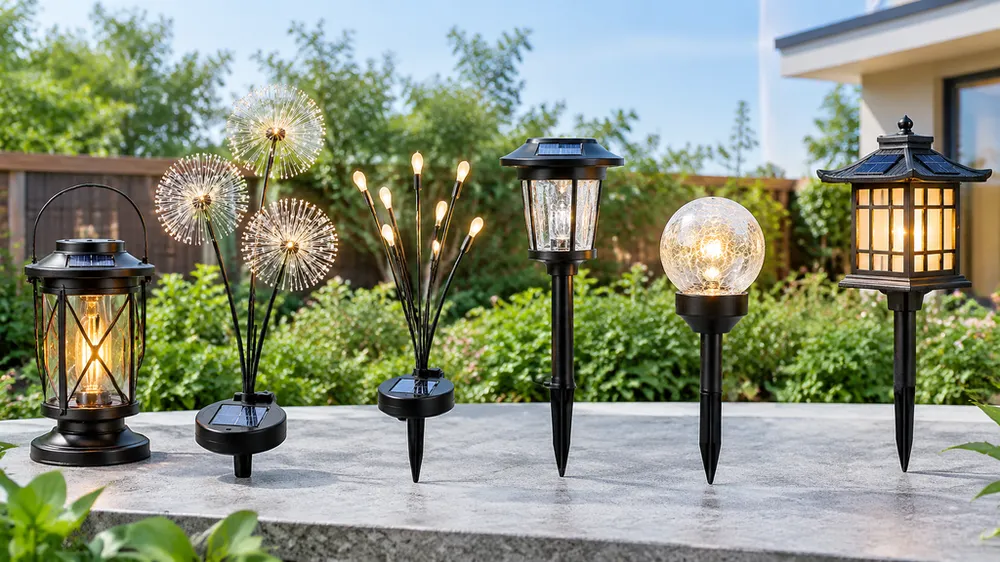
Spotlight-dominant scenarios center on directing attention. Landscape accent lighting — uplighting a tree canopy, washing a stone wall, highlighting a fountain or sculpture — uses narrow beam to create visual hierarchy. The lit element is the point; everything else fades into the background. Signage and flag illumination follow the same logic: you want high lumens concentrated on the sign face or flagpole, sharp cutoff beyond the edges. Retail storefronts use spotlights to create windows of brightness that pull the eye toward entry zones or product displays. Monument lighting, architectural feature highlighting, and art installation lighting all depend on contrast. A floodlight in any of those scenarios diffuses the effect and makes the installation look generic. For distributors serving landscape contractors, hospitality designers, or retail fixture buyers, spotlights are the core SKU. If those channels represent 70% of your volume, your catalog should reflect that ratio — maybe four spotlight models and one floodlight model, not equal split.
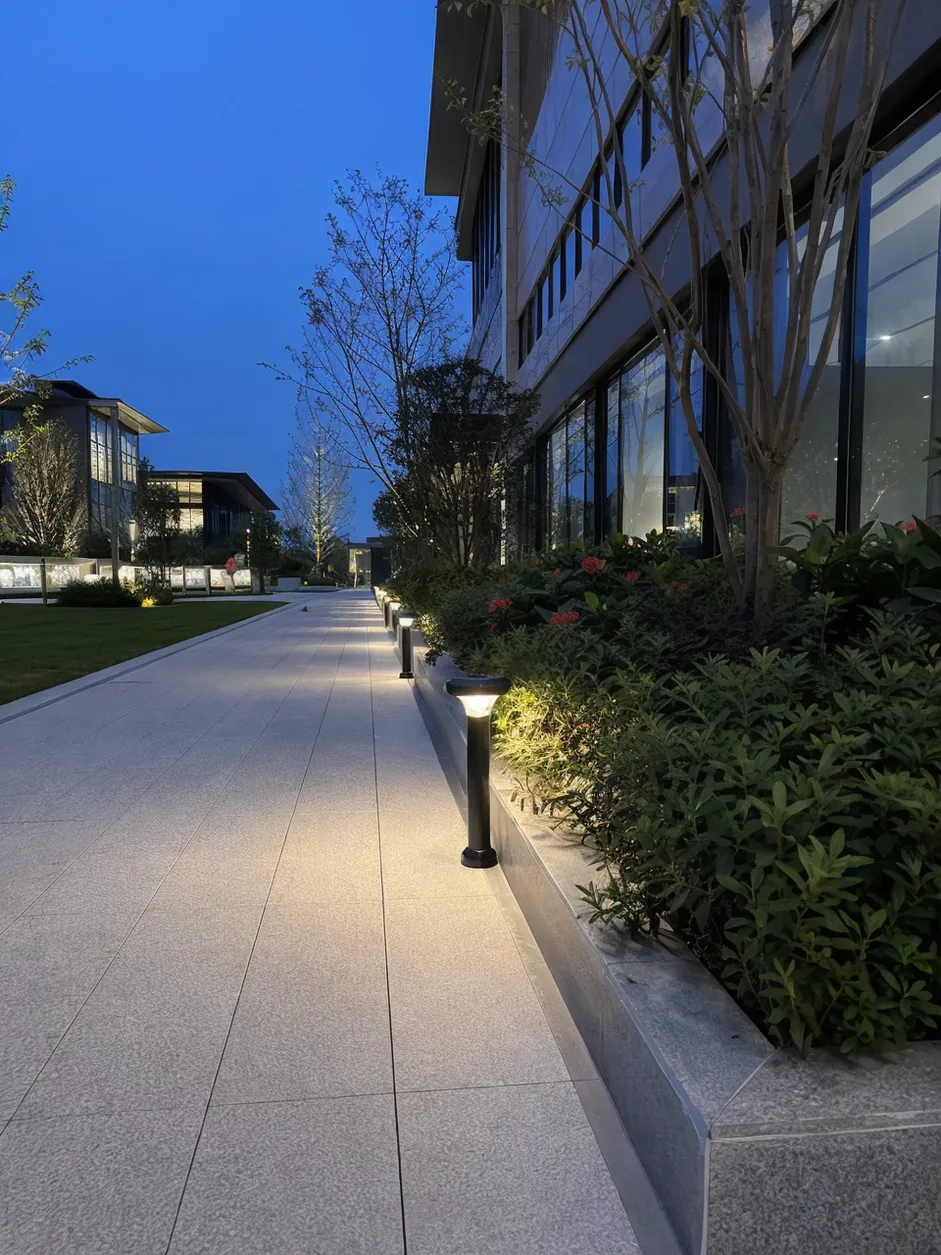
Floodlight-dominant scenarios center on eliminating dark zones. Parking lot perimeter lighting exists to meet minimum lux requirements for safety and liability reduction — insurance underwriters and municipal codes specify lumens-per-square-meter, and if you don't hit it, the property owner has a problem. Building facade security lighting serves the same purpose: make the area bright enough that camera systems capture usable footage and potential intruders are visible from a distance. Loading dock and industrial workzone lighting is about task visibility — forklift operators, delivery drivers, and warehouse staff need even lighting across the work surface to avoid accidents. Pathway and walkway systems in parks, campuses, or residential communities use floodlights to illuminate the travel surface continuously, not in spotty pools. Open plaza areas in commercial developments need uniform lux for evening events or pedestrian traffic. None of those applications tolerate the uneven coverage pattern that spotlights create. For distributors serving electrical contractors, property managers, or municipal procurement, floodlights are the core SKU.
Mixed deployments are common enough that we see them in 30–40% of project orders. Residential community perimeters might use floodlights on corner poles for broad security coverage and spotlights on entry monument signs for branding visibility. Retail plaza projects use floodlights for parking area safety and spotlights for storefront accent. Industrial sites use floodlights for work area task lighting and spotlights to mark equipment locations or hazard zones. The commercial logic is straightforward: use each fixture type where it delivers the most value per dollar spent. The sourcing advantage for buyers is that both types come from one factory with one QC standard, so there's no risk that the spotlights arrive on time and pass inspection while the floodlights are delayed or fail field testing because they came from a different supplier.
We've worked with distributors who initially stocked only one fixture type based on what their sales team was familiar with, then lost bids because they couldn't offer both. A parking lot contractor who also does landscape lighting for the same client wants to source both from one vendor — split sourcing adds complexity for no gain. When buyers realize we carry both and the MOQ for each type is 100 units (so a 200-unit mixed container is viable), they often shift their entire solar lighting spend to us rather than managing two supplier relationships. That consolidation benefits both sides: they get simpler logistics and consistent quality, we get higher average order value and better production line utilization.
The application scenario also determines what post-installation support looks like. Spotlights often require field aiming adjustment after installation — you mount the fixture, power it on, and adjust the angle until the beam hits the target correctly. That's normal; the installer bills for it as part of commissioning. Floodlights are usually pre-aimed at the factory based on the mounting height and coverage area the buyer specifies, because there's less precision required — you're flooding a zone, not hitting a specific target. If a buyer orders a mixed shipment, we'll mark the spotlight boxes to note that field aiming is expected and include angle adjustment instructions. Small detail, but it prevents confusion when the installer's crew is used to one fixture type and suddenly has to handle the other.
When distributors ask which fixture type is "easier to sell," the answer depends on whether their sales team is comfortable explaining coverage math or prefers to sell based on visual demos. Spotlights are easier to demonstrate because the effect is immediate and obvious — you point it at a tree, the tree lights up, the customer gets it. Floodlights require explaining lux levels, coverage area, and fixture spacing — more technical, harder to visualize on a jobsite walk. If your sales team skews toward contractors who understand lighting design, floodlights sell fine. If your sales team skews toward property owners who make decisions based on visual appeal, spotlights move faster. We've seen both patterns hold across different markets.
Spec Comparison Table — Quick Reference for RFQ Preparation
When you're preparing an RFQ or comparing supplier quotes, this table gives you the core specifications that differentiate solar spotlight vs solar flood light at the component level. These are catalog reference ranges for our standard models; OEM/ODM customization shifts any of these values if your market requires it.
| Specification | Solar Spotlight | Solar Floodlight |
|---|---|---|
| Beam Angle | 15° – 45° | 60° – 120° |
| Lumen Range | 200 – 800 lm | 800 – 3,000 lm |
| LED Wattage | 6 – 12W | 15 – 40W |
| Solar Panel Size | 10 – 20W | 25 – 60W |
| Battery Capacity | 3,000 – 6,000 mAh | 8,000 – 18,000 mAh |
| Typical Mounting Height | 2 – 4m | 4 – 8m |
| Coverage Diameter | 1 – 3m | 6 – 15m |
| IP Rating | IP65 / IP67 | IP65 / IP67 |
| Weight Range | 2 – 4 kg | 5 – 12 kg |
| MOQ (Standard Models) | 100 units | 100 units |
Every specification in this table is linked to a sourcing variable. Beam angle determines fixture count per project zone, which drives your quote price and installation labor cost. Lumen output determines visibility level and battery size, which drives unit cost and shipping weight. Solar panel size determines mounting footprint and wind load, which affects whether existing poles can support the fixture or you need new structural installation. Weight range determines freight class and handling requirements. MOQ determines whether you can test the market with a small order or need to commit to volume before you've proven local demand.
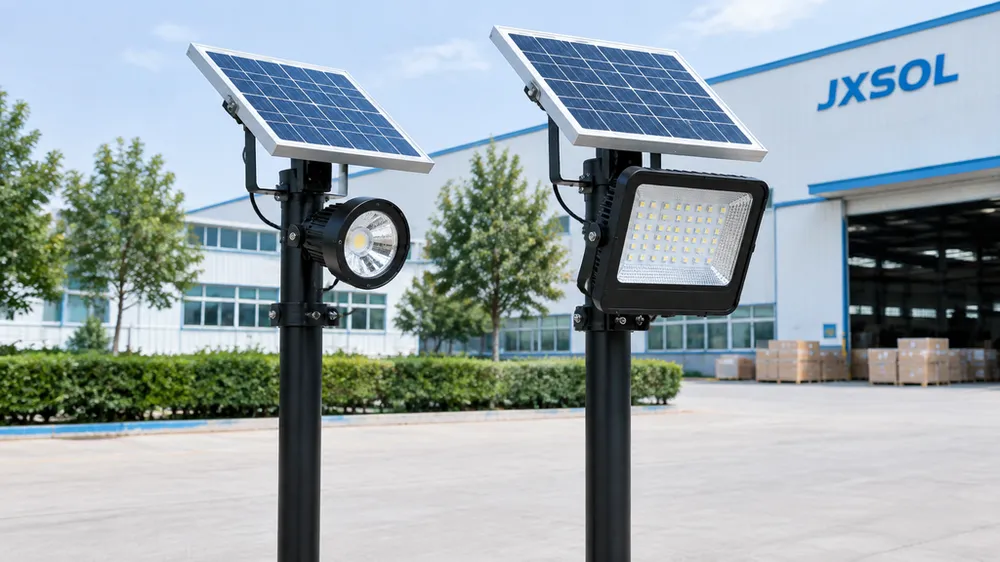
The note on customization is important: these specs are starting points, not limits. If your market needs a 1,500-lumen spotlight (outside the catalog range), we reconfigure the LED array and resize the battery and panel to support it. If your latitude means 6 hours of daily sun in winter and you need 12-hour runtime, we scale the battery and panel up from the table values. If your installation environment has extreme temperatures (desert heat or sub-arctic cold), we adjust the battery chemistry and housing material. The engineering team runs the full component calculation for every OEM/ODM request and provides updated specs before production starts. You're not locked into the table — it's just the reference point for standard orders.
Color temperature is another frequent customization request. Catalog models default to 5000K–6000K (neutral to cool white) because that's what most parking lot and security applications specify. Landscape and hospitality buyers often want 3000K–4000K (warm white) because it matches architectural lighting aesthetics. We source LED chips in both temperature ranges and configure the array to match your target during assembly. That's a zero-cost customization if you're ordering 100+ units — no tooling change, just a different chip bin. Below 100 units we might charge a setup fee because the line changeover time is proportionally higher, but at standard MOQ it's included.
One spec not in the table but relevant to mixed-SKU orders: lead time. Standard catalog models ship in 25–35 days after order confirmation. OEM/ODM models ship in 35–45 days because of the component recalculation, prototype approval, and line reconfiguration steps. If you're ordering both spotlight and floodlight in one container, both types follow the longer lead time — we don't split-ship because the freight cost savings from consolidation outweigh the time savings from shipping standard models early. Most buyers prefer that; it simplifies receiving and inventory intake.
Cost Structure and Commercial Value — Unit Cost vs Coverage Cost
Unit cost for solar spotlight vs solar flood light follows component cost. A spotlight with a 6,000 mAh battery, 20W panel, and 600-lumen LED array costs 30–50% less than a floodlight with an 18,000 mAh battery, 60W panel, and 2,000-lumen array. Larger battery = more lithium cells. Larger panel = more polycrystalline or monocrystalline silicon area. Higher lumens = more LED chips. The BOM (bill of materials) drives the unit price, and every line item in that BOM scales with the performance spec.
But unit cost is the wrong variable to optimize if you're quoting a project or deciding which SKU to stock. The variable that matters is cost per square meter of coverage, and that metric often reverses the unit cost comparison. If you need to light a 200 m² parking area to 10 lux, you can use two floodlights at $150 each or ten spotlights at $80 each. Total fixture cost: $300 for floodlights, $800 for spotlights. Installation labor scales with fixture count — mounting ten units takes 4–5× longer than mounting two units, even if the individual fixtures are lighter and simpler. Add in the cost of extra mounting poles (if the existing layout doesn't support ten fixtures), extra wiring (if you're grouping them for control), and extra commissioning time (if spotlights need individual aiming), and the total project cost often tips toward floodlights despite higher unit cost.
We see this reversal surprise buyers who default to "lower unit cost = better value." It's true for decorative or accent applications where you're buying fixtures one at a time to light individual features. It's false for area lighting where coverage is the goal and fixture count is the variable. The break-even calculation is straightforward: (unit cost + installation cost per fixture) × fixture count. If installation cost per fixture is $50 and you need ten spotlights vs two floodlights, you're adding $400 in labor cost to save $200 in fixture cost. The math doesn't close.
Battery replacement cycle adds another layer to total cost of ownership. Both spotlight and floodlight batteries last 3–5 years depending on daily discharge depth and climate (heat degrades lithium chemistry faster, so fixtures in Saudi Arabia or Arizona see shorter cycles than fixtures in Germany or Canada). When replacement time comes, you're swapping the battery pack, not the entire fixture. Floodlight battery packs cost 2–3× spotlight battery packs because of the capacity difference. Over a 10-year project lifespan, you'll replace the battery twice; that replacement cost delta needs to factor into your ROI calculation if you're managing a portfolio of properties with ongoing maintenance budgets. For one-time project sales, it's less relevant (the property owner carries that cost), but for distributors who also run service contracts, it's part of your margin structure.
Shipping cube efficiency matters more than most buyers expect. Spotlights ship roughly three units per cubic meter; floodlights ship roughly one unit per cubic meter (varies by model, but that's the typical ratio). If you're ordering a 20-foot container (33 m³ usable), you can fit ~100 spotlights or ~33 floodlights. Freight cost per unit drops as cube utilization increases. For buyers sourcing container loads, spotlight orders deliver better freight economics. For buyers doing LCL (less-than-container-load) or air freight for speed, the cube difference matters less because you're paying by weight or dimensional weight rather than container volume.
One cost variable buyers often miss: the opportunity cost of stocking the wrong fixture type. If you stock floodlights and your market turns out to want spotlights (or vice versa), you're carrying dead inventory that ties up working capital and warehouse space. The risk mitigation is to start with a small mixed order — 100 units of each type — and let actual sales data determine the reorder ratio. Our MOQ structure supports that approach; you're not forced into 500-unit minimums that make market testing unaffordable. After two or three reorder cycles, you'll have clear data on which type moves faster in your channels, and you can adjust the mix accordingly.
We've worked with distributors who initially ordered 80/20 floodlight-heavy based on assumptions about their market, then shifted to 20/80 spotlight-heavy after six months because their landscape contractor channel grew faster than expected. The flexibility to rebalance SKU mix without penalty (no minimum reorder quantity above 100 units, no tooling fees for repeat orders) means you're not locked into a decision you made before you had market feedback. That's particularly valuable if you're entering a new geographic region where buyer preferences differ from your core market.
IP Rating, Housing, and Installation Environment Correlation
IP65 and IP67 ratings appear in spec sheets for both solar spotlight vs solar flood light, but the rating alone doesn't tell you how the fixture will perform in its actual installation environment. IP65 means dust-tight and protected against water jets; IP67 means dust-tight and protected against temporary immersion. Both ratings assume the fixture is installed correctly — gaskets seated, cable entries sealed, mounting angle allowing water runoff. In the field, installation quality varies, and the fixture design needs to tolerate some installer error.
Spotlights typically deploy in environments with partial shelter: landscape beds surrounded by shrubs or walls, building alcoves with overhead coverage, covered walkways with some rain shadow. The fixture still needs full IP rating because rain and dust exposure happen, but the daily stress level is lower than a fully exposed location. Floodlights deploy in fully exposed locations by design: rooftop mounts with no overhead shelter, perimeter poles in open parking lots, coastal or industrial zones with high salt or dust load. The fixture sees direct weather 24/7, and there's no environmental buffer.
That exposure difference shows up in housing material and gasket design. Our spotlights use die-cast aluminum housings with powder coat finish and standard silicone gaskets. That's sufficient for the partial-shelter environments where they're deployed, and it keeps the weight and cost down. Our floodlights use thicker-gauge aluminum (sometimes reinforced with internal ribs to handle the larger panel and battery weight) and dual-seal gaskets at every cable entry and lens interface. The housing design allows water to drain even if the fixture is installed at a suboptimal angle — we see installers mount floodlights on poles that aren't perfectly vertical, or on building facades where the mounting bracket doesn't give them precise angle control. If the gasket design assumes perfect installation and water pools against a seal, that seal will fail eventually. The dual-gasket approach and internal drain channels give some margin for real-world conditions.
Mounting hardware differs more than most buyers expect. Spotlights use adjustable-angle brackets with 180° vertical rotation and 360° horizontal rotation, because the entire point of a spotlight is aiming it at a specific target. The installer mounts the fixture, powers it on, and adjusts until the beam hits correctly. The bracket needs to hold that angle under wind load and vibration, but it doesn't carry much structural stress because the fixture is lightweight (2–4 kg). Floodlights use fixed-angle or limited-angle brackets because the beam is wide enough that precise aiming isn't required — you're flooding a zone, not hitting a target. The bracket needs to support 5–12 kg, and it needs to handle wind load on the larger panel surface. We test mounting brackets for both fixture types to 120 km/h wind load (the coastal/industrial standard), but the floodlight bracket is a heavier component because of the structural requirement.
Field adjustment capability is another difference tied to installation environment. If a spotlight's aim is slightly off after installation, the installer rotates the bracket and fixes it in two minutes. If a floodlight is mounted at the wrong height or angle for the coverage area, there's no easy fix — the fixture is doing what it's designed to do (flood a zone at a fixed angle), the problem is the installation design. That makes floodlight projects more sensitive to upfront planning. You need accurate pole height, spacing, and coverage area calculations before installation, because post-installation corrections are expensive (move the pole, swap the fixture for a different beam angle, or accept suboptimal coverage). Spotlight projects tolerate more trial-and-error because you can adjust in the field.
One installation environment variable that catches buyers off guard: shade from trees or buildings on the solar panel. If you're installing spotlights in a landscape bed and there's tree canopy overhead, the panel might only get 4–6 hours of direct sun instead of the 8–10 hours you assumed when sizing the battery. That shortfall compounds in winter when sun angle is lower and days are shorter. We ask buyers to confirm panel sun exposure when they request battery sizing, because we've seen projects where the fixtures were spec'd correctly but the installation location made full recharge impossible. For floodlights on perimeter poles or rooftops, shade is rarely an issue (those locations are chosen specifically for being open and exposed), but for spotlights in landscape or architectural settings, it's a frequent problem.
We run 100% pre-shipment waterproof testing for both fixture types: 24 hours in a humidity chamber at 95% RH and 40°C, followed by IP rating confirmation (water jet test for IP65, immersion test for IP67). Every fixture that passes gets a test sticker with QC serial number; every fixture that fails gets disassembled to identify the failure point (gasket misalignment, cable entry gap, lens seal defect) and we adjust the assembly process to prevent recurrence. That testing protocol is the same whether the fixture is a 2 kg spotlight or a 10 kg floodlight — same chamber, same pass/fail criteria. The result is that field return rates for waterproofing failures run below 0.5% across both product lines, which matters a lot if you're a distributor managing warranty claims or a contractor with callback liability.
OEM/ODM Customization and Mixed-SKU Order Handling
Both solar spotlight and solar flood light are available for OEM/ODM customization, and the customization options are identical because the underlying component platform is shared. The most common requests: lumen output adjustment, color temperature selection, housing color change, and private label branding. Each of those is a line-item decision during the RFQ process, not a separate negotiation.
Lumen output adjustment involves reconfiguring the LED array. If your brand's existing non-solar line runs at 1,500 lumens and you want the solar version to match, we change the LED chip count and current to hit that target. The battery and panel sizing recalculates automatically — higher lumens = higher wattage = larger battery for same runtime. Our engineering team provides updated battery capacity and panel size specs in the quote, so you see the full component impact before committing to production. That's particularly important if you're trying to keep the fixture within a certain weight or size limit for mounting compatibility; sometimes hitting a target lumen number makes the fixture too large or heavy for the application, and you need to negotiate a compromise.
Color temperature selection matters more for aesthetic applications (landscape lighting, hospitality, retail) than for functional applications (parking, security, industrial). Catalog models default to 5000K–6000K because that's the neutral-to-cool range most commercial and municipal buyers specify. If your market prefers warm white (3000K–4000K) for visual comfort or brand consistency, we source LED chips in that temperature range and configure the array to match. Zero cost at 100+ unit orders, small setup fee below that threshold. We stock both temperature ranges in our component inventory, so lead time impact is minimal (2–3 days for line changeover, not weeks for chip procurement).
Housing color is a frequent request from brand owners who want the fixture to match their product line's visual identity. Catalog models ship in matte black or dark gray because those colors blend into most installation environments (you're trying to light a space, not call attention to the fixture itself). If your brand uses a specific RAL color or you're serving a market where bronze, white, or custom finishes are standard, we can powder-coat to match. That adds 5–7 days to lead time (the housing has to go through a separate powder-coat line after fabrication) and a per-unit cost increase of $3–$8 depending on color complexity. For orders above 500 units, the per-unit cost drops because setup time amortizes.
Private label branding is standard for OEM/ODM orders. We laser-etch your brand name, logo, or model number onto the housing, usually on the back panel or mounting bracket where it's visible for warranty reference but doesn't interfere with the fixture's appearance from the front. Setup cost is $200–$300 for the laser file and fixture positioning jig; after that, etching adds 30–60 seconds per unit. We also support custom packaging if your distribution model requires retail-ready boxes, but most B2B buyers ship in plain cartons with their own labeling applied at the warehouse.
Battery and panel customization for target latitude and autonomy is one of the most valuable OEM/ODM options for buyers serving geographically diverse markets. A standard catalog floodlight sized for southern China (latitude 22°N, 8–10 hours daily sun year-round) will underperform in Norway (latitude 60°N, 4–6 hours daily sun in winter). The solar panel won't recharge the battery fully, runtime drops, and you get customer complaints about the fixture "not working" in winter. We resize the panel and battery for your target latitude when you provide that information during RFQ. The engineering team uses solar insolation data for your region (kWh/m²/day by month) and calculates the panel wattage needed to maintain full battery charge in the lowest-sun month. That calculation is free as part of the OEM/ODM quoting process; you don't pay extra for regionally optimized specs.
Mixed-SKU order handling is simpler than most buyers expect. If you want 100 spotlights and 100 floodlights in one shipment, you submit one RFQ covering both types, we quote both, you approve, and both types go into production in parallel on adjacent assembly lines. They ship in the same container, they share the same inspection documentation, and they carry the same warranty policy. You're not coordinating delivery timing between two suppliers or reconciling different QC standards. The MOQ applies per fixture type (100 spotlights + 100 floodlights = 200-unit minimum), but there's no penalty for mixing SKUs. Lead time follows the longer of the two production schedules — if spotlights are standard catalog and floodlights are OEM/ODM, the full order ships when the OEM/ODM units are ready.
We've handled orders where a distributor wanted four spotlight models (different lumen outputs) and two floodlight models (different beam angles) in one container, all with private label branding. That's six SKUs, 100 units each, all customized. From the buyer's perspective, it's one RFQ, one quote, one purchase order, one shipment. From our perspective, it's six parallel production runs with shared component inventory and shared QC protocol. The complexity doesn't compound the way it would if you were coordinating six different suppliers.
One customization limitation to note: we don't change the core fixture platform (housing design, mounting bracket type, solar panel orientation) for orders below 1,000 units, because that would require new tooling. If your target market needs a fundamentally different form factor (e.g., a spotlight with side-mounted panel instead of top-mounted), that's a 1,000+ unit MOQ conversation and we'd treat it as a new product development project with tooling cost amortization. For component-level customization (lumens, color temp, battery size, housing color, branding), the 100-unit MOQ holds.
Pre-Shipment Inspection and Quality Consistency Across Fixture Types
Every spotlight and floodlight that leaves our factory passes through the same inspection protocol: lumen output test in an integrating sphere, color temperature confirmation with a spectrometer, battery charge/discharge cycle test to confirm rated capacity, waterproof chamber test for IP rating, and drop test for shipping durability. The protocol is identical regardless of fixture type, so quality consistency is built into the process rather than being a per-SKU variable.
Lumen output testing happens after final assembly. We place the fixture in an integrating sphere (a calibrated white chamber that captures total light output regardless of beam angle), power it to full brightness, and measure lumens with a photometer. Catalog spec is initial lumens at full battery voltage; we also measure maintained lumens at 80% battery state-of-charge, because that's closer to what the fixture will deliver in the field after a few hours of runtime. The tolerance is ±5% from the spec. If a fixture tests outside that range, it goes back to the assembly line for LED array inspection — usually it's a connection issue or a chip mismatch. For buyers, the value is that when you order 200 units, they all deliver consistent lumen output. You're not getting batch variation where some fixtures are brighter than others, which matters if your customer is installing them in a row where inconsistency would be visually obvious.
Color temperature confirmation follows the same logic. We test every fixture with a spectrometer to confirm it hits the target color temp (e.g., 3000K ±200K or 6000K ±300K). LED chips from the same production batch should match, but if there's a chip supplier quality slip or a wiring error during assembly, the color temp will shift. Catching that before shipment prevents field complaints about fixtures looking "off" compared to each other or compared to non-solar fixtures in the same installation.
Battery testing is the most time-intensive part of the QC protocol. We pull a sample from each production batch (10% of batch size, minimum 5 units), charge the battery to full, discharge it at the fixture's rated wattage, and measure the runtime. If the battery hits 95%+ of rated capacity, the batch passes. If it falls short, we test every unit in the batch individually to identify defective cells. That level of testing adds 2–3 days to production time, but it eliminates the early-life battery failures that used to be the number-one complaint in solar lighting. Batteries that pass this test will deliver the rated runtime in the field (assuming proper solar panel sizing for the installation latitude, which is a design question, not a QC question).
Waterproof testing uses a humidity chamber and a water jet / immersion tank depending on whether the fixture is rated IP65 or IP67. The fixture sits in 95% relative humidity at 40°C for 24 hours to stress the gasket seals, then we run the water jet test (IP65) or submerge it in 1 meter of water for 30 minutes (IP67). After the test, we disassemble the fixture and inspect for moisture intrusion. If we find any, we trace the entry point (gasket misalignment, cable entry gap, lens seal defect) and adjust the assembly process. That feedback loop runs continuously — every failed test becomes a process correction, so the failure rate trends downward over time. Our current field return rate for waterproofing issues is under 0.5%, which is where it needs to be for distributors who can't afford callback costs.
Drop testing simulates shipping damage. We package the fixture in its standard carton, drop it from 1 meter onto a concrete floor (corner drop, edge drop, face drop), then inspect for housing cracks, panel damage, internal component displacement, or lens cracks. Solar lighting fixtures ship internationally, often through multiple handling points (factory → port → customs → regional warehouse → jobsite), and rough handling is guaranteed at some point in that chain. If the packaging and housing design can't survive a 1-meter drop, you'll get a percentage of damaged units in every shipment. We've iterated the carton design and internal cushioning over multiple years to get the damage rate below 1% even on long-distance shipments with 3–4 transload points.
Every fixture that passes inspection gets a QC serial number sticker on the housing and a test report in the shipment documentation. The report includes lumen test data, color temp reading, battery runtime result, and IP test pass/fail status. For buyers who need traceability (common in municipal or institutional procurement where audit trails are required), the serial number links back to production batch, component lot numbers, and QC test results. If a warranty claim comes in two years later, we can trace the unit back to the exact production run and determine whether it's a systemic issue or an isolated failure.
Inspection consistency across fixture types means you don't inherit different quality risks depending on whether you order spotlights or floodlights. Both types pass the same gates, both types carry the same 3-year warranty, and both types have the same field return rate profile. For distributors managing inventory from multiple suppliers, that consistency is valuable — you're not fielding more warranty claims on floodlights than spotlights (or vice versa) because the QC standards differ. It's one factory, one quality baseline, one technical contact for support.
Single-Factory Sourcing Value for Distributors and Contractors
When you source solar spotlight vs solar flood light from the same factory, you consolidate risk and simplify logistics. One quality standard means you're not betting that two different suppliers both deliver to spec. One warranty policy means you have one contact for claims and one set of documentation requirements. One technical support contact means you're not repeating the same question to two different engineering teams and hoping the answers align. One shipping consolidation point means both fixture types arrive on the same day, you warehouse them together, and you can fulfill mixed orders without split shipments.
The risk reduction shows up most clearly in reorder situations. If you source spotlights from Factory A and floodlights from Factory B, and a year later you need to reorder both, you're hoping both factories still offer the same models, use the same components, and deliver the same quality. If Factory A changed their battery supplier or Factory B revised their housing design, your inventory is no longer consistent and your customers might notice. If you source both types from us, the tooling, component suppliers, and QC protocol are already locked in from the first order. Reorders are faster, specs are consistent, and there's no requalification step.
Inventory planning simplifies when both fixture types arrive in one shipment. You allocate warehouse space once, you do receiving inspection once, you update your inventory system once. If the fixtures arrive in two separate shipments from two suppliers with different lead times, you're doing the warehouse intake process twice and carrying the risk that one shipment is delayed while the other sits on your shelf waiting to be sold as a pair. For distributors serving contractors who buy both types for the same project, that split-shipment risk translates to lost sales — the contractor won't buy spotlights from you if the floodlights aren't available yet.
Reorder efficiency improves with single-factory sourcing because we've already done the upfront work. If you ordered OEM/ODM units with custom lumen output and private label branding, that spec is on file. The laser etching jig is saved, the LED array configuration is documented, the battery sizing calculation is in the engineering database. Reorders skip the quoting and prototype steps and go straight to production. Lead time drops from 35–45 days to 20–25 days because there's no setup phase. That faster turnaround helps if you're managing just-in-time inventory or responding to unexpected demand spikes.
Technical support continuity is underrated until you need it. If you have a question about battery sizing for a specific latitude, beam angle options for a particular mounting height, or housing color availability for a custom order, you ask one engineering team and get one answer that applies to both spotlight and floodlight. You're not triangulating between two suppliers who might give you conflicting recommendations. If a field issue comes up (a fixture underperforms, a customer has an installation question, a warranty claim needs evaluation), one conversation covers both product lines. That support continuity saves time and reduces the risk of miscommunication.
We've been manufacturing solar lighting for export since 2012, and over that time we've refined the spotlight and floodlight production process to the point where it's a mature, repeatable operation. You're not working with a factory that just added floodlights to their catalog last year and is still working out the quality issues. Both product lines have 10+ years of field history, component supplier relationships are stable, and the common failure modes have been engineered out. That maturity level reduces the support burden for buyers — fewer technical questions, fewer warranty claims, fewer mid-project surprises.
For contractors quoting projects, single-factory sourcing simplifies the proposal. You can list one supplier, one set of certifications, one warranty policy, and one technical reference. If the project specs require multiple fixture types, you're not building a Frankenstein proposal where the spotlights come from one source and the floodlights come from another and the client questions whether those sources are equivalent. For municipal or institutional procurement where consistency and audit trails matter, single-source documentation is cleaner and easier to defend during bid evaluation.
The commercial value of single-factory sourcing compounds as order volume grows. If you're doing 500 units per year split between spotlights and floodlights, the coordination savings are modest. If you're doing 5,000 units per year, those savings become material — fewer POs to manage, fewer freight invoices to reconcile, fewer QC audits to schedule, fewer warranty processes to maintain. The operational overhead of managing two suppliers instead of one is a hidden cost that doesn't show up in unit price comparisons but affects your margin and bandwidth.