Start With the Failure Points, Not the Supplier List
One approved sample does not prove batch consistency. That's the real problem when sourcing from solar street lighting manufacturers — the sample looks right, the price is acceptable, and then the first container arrives with battery packs that drain in two days, lumen output that varies 20% across units, or housings that leak after the first rainy season.
A real solar street light manufacturer controls the full production chain: component selection, LED module assembly, battery cell matching, controller configuration, waterproof structure, in-process testing, and pre-shipment inspection. A supplier who assembles from whatever components are available that week cannot reproduce your approved sample reliably at reorder scale.
The commercial risks are specific. Battery failures after one rainy season are the most common warranty driver — usually caused by unmatched cells or skipped charge/discharge testing. Lumen inconsistency across a batch creates downstream complaints from your customers and complicates project acceptance. Waterproof shortcuts that pass visual inspection fail in humid storage or coastal installation. Non-matching certificates create import clearance problems. And suppliers who cannot reproduce the approved sample at scale turn your second order into a new sourcing project.
This guide works through the decision path: factory control, specifications, QC workflow, production capacity, customization, export documentation, and the RFQ questions that separate real manufacturing control from thin assembly.
Factory Control Changes Your Warranty Exposure
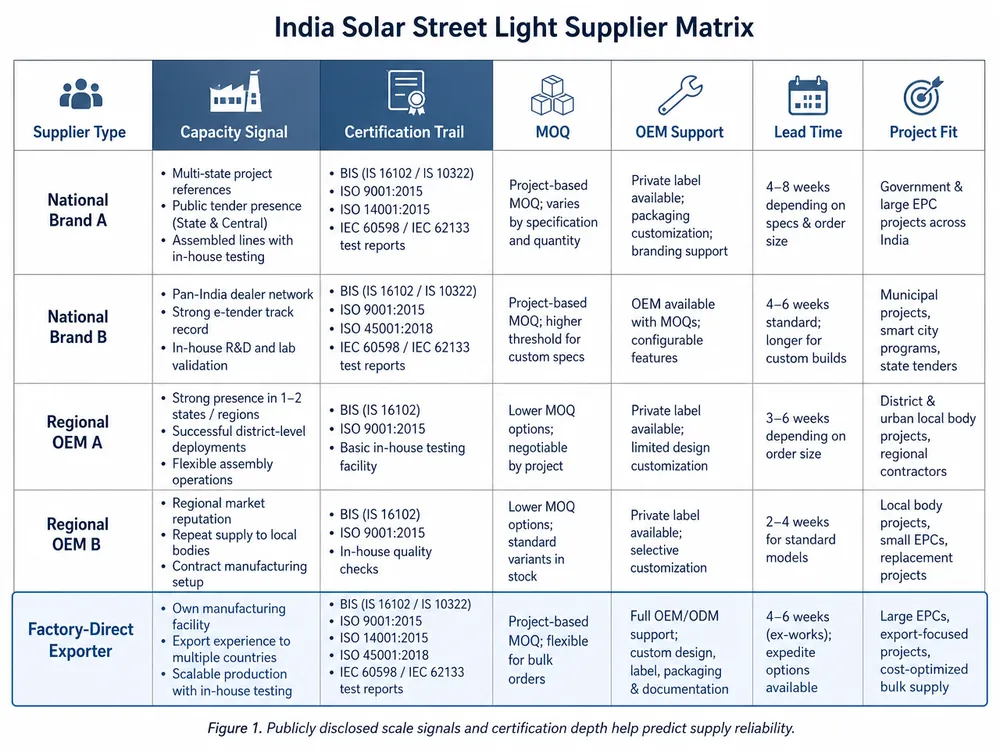
The most important distinction in solar street lighting manufacturers is not price — it's how much of the production chain the supplier actually controls. Three supplier types dominate the market, and they carry very different risk profiles.
| Supplier Type | Component Control | Engineering Support | Quality Traceability | Reorder Consistency | Documentation |
|---|---|---|---|---|---|
| Trading company | None — sources from multiple factories | None on-site | Depends on factory used | Low — factory changes between orders | Inconsistent |
| Assembly-only workshop | Partial — buys components, assembles | Limited | Batch-level at best | Moderate — depends on component sourcing | Basic |
| Integrated manufacturer | Full — in-house component testing, assembly, QC | On-site engineering team | Full batch traceability | High — same line, same process, same components | Complete |
JXSOL is the export brand of Zhongshan Century Juxing Optoelectronics Technology Co., Ltd., based in Guzhen Town, Zhongshan, Guangdong — the center of China's lighting manufacturing industry. We've focused on solar-powered outdoor lighting since 2012, and our R&D team, production lines, and inspection lab are all in the same building where the product is assembled. There's no handoff to a third-party factory between your order and your shipment.
That integration matters commercially. When the same engineering team that designed the product also runs incoming inspection and signs off on outgoing quality, warranty claims trace back to a specific batch, a specific component lot, and a specific production checkpoint — not to a supplier who sourced from three different factories that month.
For buyers building a distributor program or supplying project contracts, fewer warranty claims and repeatable SKU quality are the two things that protect margin over time. See the full solar street and roadway lighting range for the product scope we manufacture in-house.
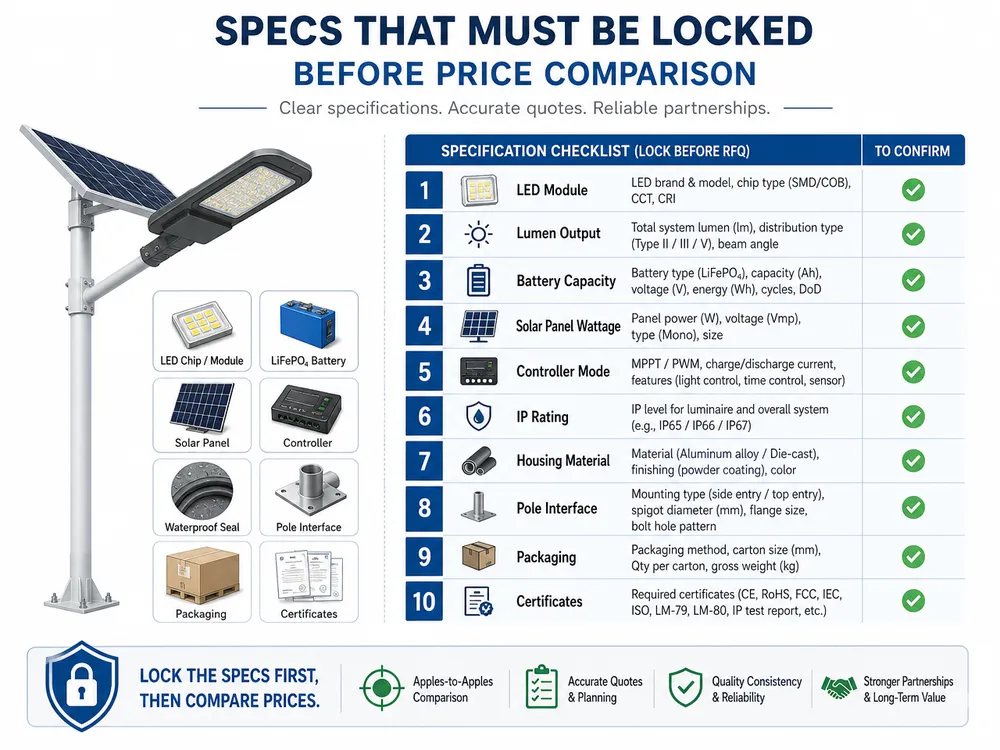
Specs That Must Be Locked Before Price Comparison
The cheapest quote is meaningless until the buyer confirms the real configuration. Solar street light pricing varies by 40–60% across the market — and most of that variation is hidden in the specs, not in the margin.
| Spec Item | What to Ask the Manufacturer | Why It Changes Your Commercial Risk |
|---|---|---|
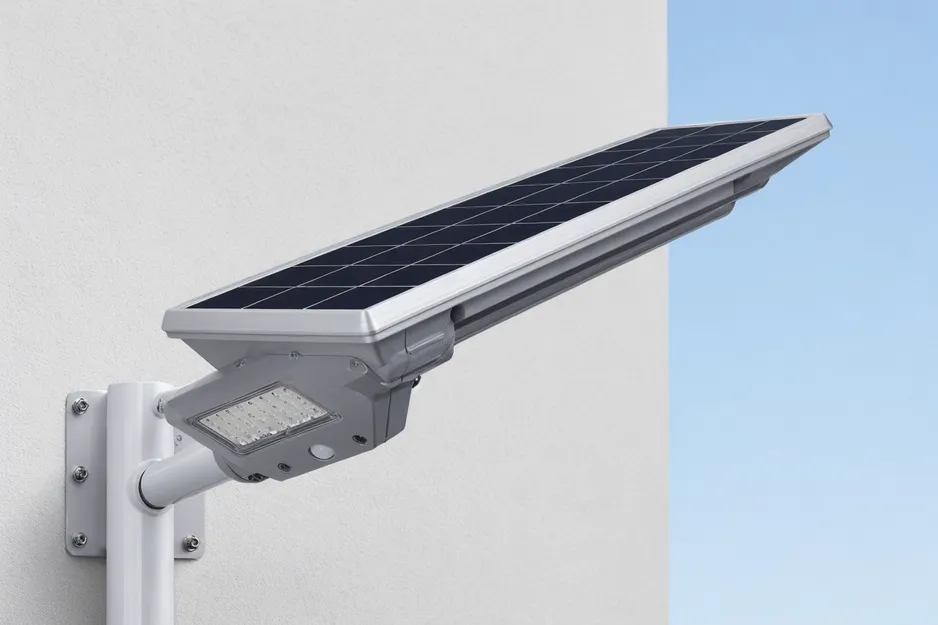
| All-in-one vs split configuration | Which design is quoted? Are both available? | All-in-one suits standard roads; split suits high-wind or high-lumen applications. Mixing them in a project creates installation and warranty complexity. |
| LED module output and lumen target | What is the tested lumen output at the module level, not just the chip rating? | Chip ratings are theoretical. Module-level lumen output after thermal management is what your buyer's project actually delivers. |
| Battery chemistry and capacity | LiFePO4 or Li-ion? What is the rated Ah capacity and how many autonomy days? | LiFePO4 has longer cycle life and better thermal stability — relevant for hot climates and coastal markets. Autonomy days determine whether the light survives a cloudy week. |
| Solar panel wattage | What wattage is quoted, and for which target latitude? | A panel sized for Southeast Asia will underperform in Northern Europe or Canada. Mismatched panel sizing is the most common cause of early battery failure. |
| Controller and dimming logic | Is the controller programmable? What dimming modes are available? | Fixed-output controllers waste battery capacity. Programmable dimming extends autonomy and reduces warranty claims in markets with long winter nights. |
| PIR or smart control | Is PIR standard or optional? What is the detection range and delay? | PIR motion sensing is a margin-protection feature — it lets your buyer sell a smarter product at a higher price point. |
| IP rating | Is IP65 or IP67 tested on the specific model, or assumed from housing design? | IP ratings that are assumed rather than tested fail in field conditions. Ask for the test certificate, not just the spec sheet claim. |
| Housing and pole compatibility | What pole diameter and mounting interface does the housing support? | Pole compatibility mismatches create installation delays and project cost overruns. |
| Installation accessories | What is included in the carton? Mounting hardware, remote, manual? | Missing accessories generate after-sales complaints and warranty claims that cost more to resolve than the accessories themselves. |
For standard solar street lights, locking these specs before requesting price protects your landed cost calculation. For all-in-one solar street lights and split solar street lights, the configuration choice itself changes the installation cost and the warranty risk profile. Smart solar street lights add sensor logic and dimming variables that need to be confirmed at the engineering level before pricing.

Battery, LED, Controller, and Waterproof Tests Decide Real Quality
Most solar street light failures in the field trace back to four production shortcuts: battery cells not matched by capacity and internal resistance, LED output drifting across a batch, controller settings that don't match the project's autonomy requirements, and waterproof structures that pass visual inspection but fail under real rain, dust, or humid storage conditions.
We've built our production system around those four failure points specifically because they were the most common buyer complaints when we started in 2012. The process hasn't changed in structure — it's gotten more controlled.
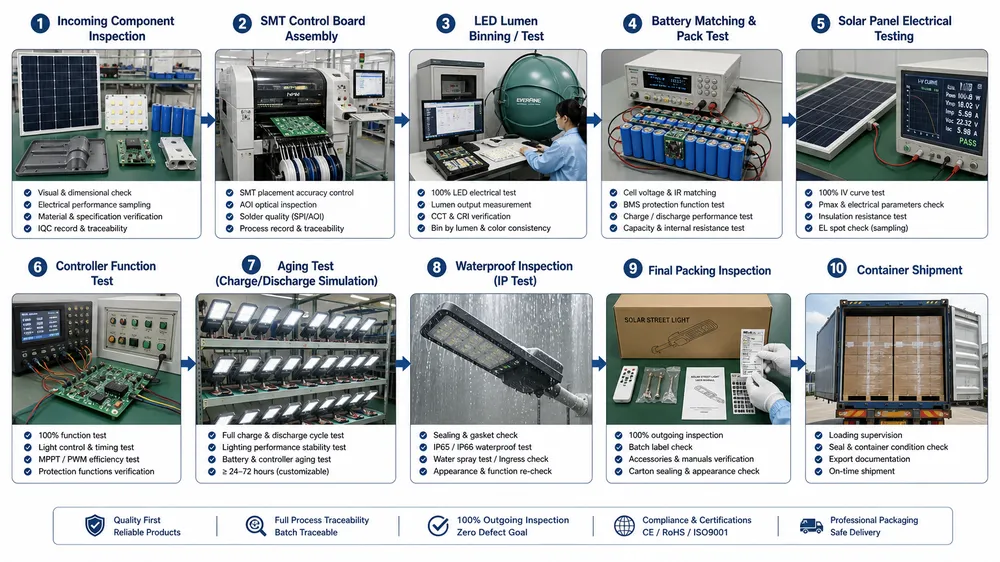
Incoming inspection covers every component category before anything enters the production floor: solar panels, LED chips and modules, battery cells, controllers, housings, fasteners, and packaging materials. A component that doesn't meet spec doesn't enter the line — it doesn't get assembled and then rejected at final inspection.
In-process checkpoints run at SMT for control boards, LED module assembly with lumen binning to confirm output and color temperature, battery pack matching by capacity and internal resistance, and controller function verification. Lumen output and color temperature are confirmed at the module assembly stage, not assumed from chip specifications.
Reliability testing includes aging tests under full charge/discharge cycles, waterproof structure inspection on the assembled unit, and lighting mode verification for products with PIR sensors or dimming functions. The aging test is where controller mismatches and battery cell inconsistencies surface — before shipment, not after installation.
Outgoing inspection is 100% — every unit, every carton, every accessory pack, every label — before the container is sealed. (Buyers sometimes push back on this as a cost driver. It adds time. It also means a defective batch gets caught before it's on a ship, not after it's in your warehouse. We've kept it as a non-negotiable since 2012.)
Certifications: ISO 9001:2015, CE, RoHS, IP65/IP67 Ingress Protection, and IEC 62124. CE and IEC 62124 cover the electrical and photovoltaic performance requirements for European and regulated market entry. IP65/IP67 ratings are tested on our own waterproof inspection equipment, not assumed from housing design. Full certification and quality documents are available per order.
Capacity Only Matters When Reorders Stay Consistent
A large factory number on a spec sheet doesn't protect your reorder. What protects your reorder is a factory that schedules production in advance and doesn't displace existing accounts to onboard new customers.
Our facility covers 12,000 square meters in Guzhen Town, with 150 employees across production, engineering, QC, and operations. Six dedicated production lines run automated SMT assembly, LED module integration, battery pack matching, and final assembly. Daily output runs above 5,000 units, and annual capacity sits at 1,200,000 units.
For distributors, that capacity means your repeat order runs on a scheduled line — not in a queue behind a new customer's first run. A 10,000-unit reorder doesn't compete with a 50,000-unit project order; the lines are sized to handle both simultaneously. For project buyers, it means a batch can be scheduled and confirmed at order placement, not estimated at shipment.
Batch traceability runs through the full production flow. Every carton carries a batch code, accessory packs are checked against a packing list before sealing, and container loading is planned for standard 20GP and 40HQ configurations. When your customer reports a field issue, you can trace it to a specific production batch and a specific component lot — not to "somewhere in that shipment."
Mixed-SKU orders across multiple solar lighting categories stay under one quality system, one inspection standard, and one point of contact for reorders. That's a supply chain efficiency advantage for distributors building a broader solar-powered catalog.
OEM and ODM Options Should Protect Margin, Not Just Add Logos
Customization has commercial value only when it helps you sell into a segment, reduce warranty exposure, or simplify your product line. A logo on a standard product is the lowest-value form of OEM. Engineering-led customization — where the specification is built around your market's actual requirements — is what protects margin.
Our in-house R&D team includes 15+ optical and electrical engineers who work on both standard product development and OEM/ODM project support. The customization scope covers:
- Lumen output adjustment within the LED module's design range — without changing the housing
- Color temperature selection across the standard range from warm white through daylight
- Battery capacity sizing for target autonomy days in your specific market
- Solar panel sizing for your buyer's target latitude — a panel spec that works in Southeast Asia will underperform in Northern Europe
- Sensor logic configuration for PIR detection range, delay, and dimming behavior
- Housing layout modifications for specific pole interfaces or installation requirements
- Packaging, labeling, and accessory configurations for private-label programs
MOQ for standard catalog models starts at 100 units — low enough to test a new SKU with your customers before committing to a larger program. For OEM/ODM projects with custom specifications, we run an engineering review before production to confirm the configuration is achievable and to lock the spec before tooling or component procurement. (We've seen buyers skip the engineering review to save time and then spend three times as long resolving spec mismatches during production. The review is faster.)
OEM and ODM solar lighting services are available for buyers building a private-label solar lighting line or configuring a product for a specific project requirement. For buyers who want to add intelligence to their catalog, smart solar street light options include programmable dimming and PIR sensor configurations that can be adjusted to your market's installation standards.
Match the Manufacturer to the Market Segment
Application scenarios in solar street lighting are commercial segments, not installation environments. The question isn't "where does the light go" — it's "which segment can you profit from, and does your manufacturer's capability support it."
| Market Segment | Manufacturer Capability to Check | Commercial Reason It Matters |
|---|---|---|
| Municipal roads and public streets | CE, IEC 62124, IP67 documentation; lumen output verification; batch traceability | Tender acceptance requires certified documentation. Batch traceability protects you when a project inspector flags a unit. |
| Commercial streets and private developments | Flexible lumen and color temperature options; OEM/ODM support; MOQ flexibility | Developers want differentiated specs, not catalog standards. Customization capability lets you win specs that commodity suppliers can't match. |
| Highways and access roads | Split configuration availability; high-lumen output; robust housing for high-wind installation | Highway projects specify higher lumen targets and structural requirements. A manufacturer without split-configuration capability loses these tenders. |
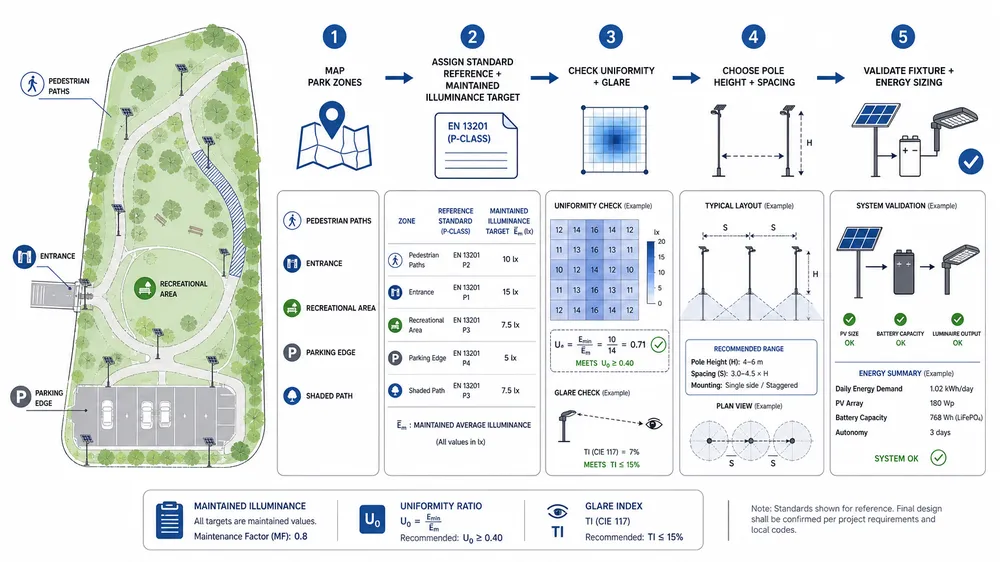
| Parks and public outdoor areas | Warm color temperature options; PIR sensor availability; aesthetic housing options | Park lighting tenders increasingly specify warm white and motion sensing. Manufacturers without these options are excluded at the spec stage. |
| Remote sites and low-grid areas | Extended battery autonomy configurations; LiFePO4 chemistry; solar panel sizing for low-irradiance seasons | Remote sites need 5–7 autonomy days minimum. A manufacturer who can't size battery and panel for the target latitude creates field failures that come back to you. |
| Distributor mixed-SKU programs | Broad catalog depth; consistent quality standards across SKUs; single-supplier reorder reliability | Mixed-SKU programs fail when quality standards vary across product types. One factory, one inspection standard, one reorder contact — that's the supply chain efficiency your program needs. |
Solar road lights and solar highway lights serve the higher-lumen, higher-structural-spec end of the market. Solar park lighting covers the aesthetic and sensor-logic requirements of public outdoor spaces. For project buyers who need to specify the full installation, solar street lighting poles are part of the same supply relationship.
Supplier Questions That Expose Weak Manufacturing Control
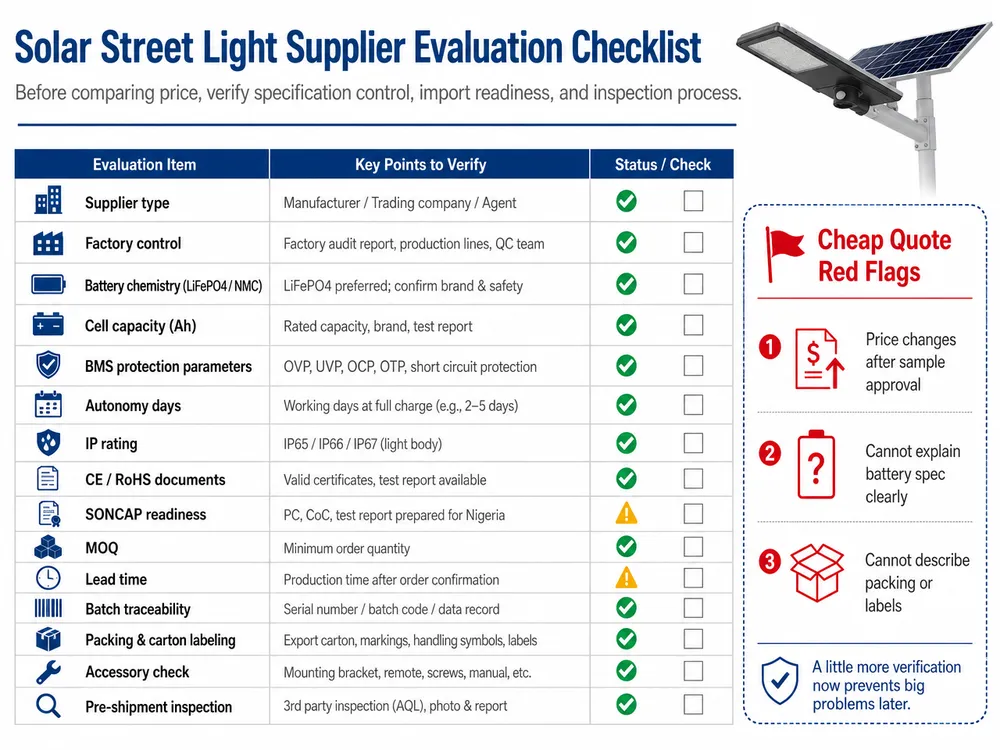
Vague answers at RFQ stage become warranty and documentation problems after shipment. These questions separate real manufacturing control from thin assembly — ask them before you commit to a sample order.
On component testing:
- Which components are tested before assembly — solar panels, LED modules, battery cells, controllers, housings?
- Can battery capacity and internal resistance test records be provided by batch?
- Is lumen output checked during LED module assembly, or only after final assembly?
On waterproof and certification:
- What IP rating is tested on the specific model being quoted — IP65 or IP67?
- Are CE, RoHS, IP65/IP67, and IEC 62124 documents available for the specific product, not just the product category?
- Is the IP rating tested on your own equipment or assumed from housing design?
On production and reorder consistency:
- How does the production sample connect to the final batch — same components, same line, same process?
- What is the batch traceability system — how do you trace a field failure back to a specific production lot?
- How are cartons, labels, accessories, and batch codes checked before shipment?
On MOQ and customization:
- What is the MOQ for standard models?
- When does OEM/ODM engineering review start, and what does it cover before tooling or component procurement?
A manufacturer who can answer these questions with specific process details — not marketing language — has the production control that protects your project margin and warranty exposure. For buyers ready to move to the next step, solar lighting RFQ details can be submitted with your project specifications, target market, and required configuration.
FAQ: Evaluating Solar Street Lighting Manufacturers
What should I check first when comparing solar street lighting manufacturers?
Start with battery testing and lumen verification — these are the two most common sources of field failures and warranty claims. Ask whether battery cells are matched by capacity and internal resistance before pack assembly, and whether lumen output is confirmed at the module level during production. A manufacturer who can provide batch-level test records for both has the production control that matters. Certifications and price come after you've confirmed the quality system.
Is an all-in-one or split solar street light better for bulk projects?
It depends on the installation environment and lumen requirement. All-in-one units are faster to install and suit standard road widths with moderate lumen targets — they're the right choice for most municipal and commercial street projects. Split configurations separate the solar panel from the light head, which allows higher panel wattage, better panel angle optimization, and higher lumen output — relevant for highways, wide roads, and high-latitude markets where panel sizing is critical. For bulk projects, confirm which configuration your manufacturer actually produces in-house rather than sources externally.
Why do solar street lights from different manufacturers fail at different rates?
Battery cell matching is the primary variable. Manufacturers who assemble battery packs from unmatched cells — different internal resistance, different capacity — create packs that degrade unevenly. One weak cell pulls down the whole pack, and the light fails within one or two seasons. The second variable is waterproof structure: IP ratings that are assumed from housing design rather than tested on the assembled unit fail in field conditions that the spec sheet never anticipated. The third is controller configuration — a controller not matched to the battery capacity and panel wattage will either undercharge or overcharge the pack, shortening battery life regardless of cell quality.
What certificates should a solar street light manufacturer provide for export orders?
For European market entry: CE Declaration of Conformity, RoHS test report, and IP test certificate (IP65 or IP67 depending on the model). IEC 62124 covers photovoltaic standalone system performance and is increasingly required for regulated project tenders. ISO 9001:2015 certification covers the quality management system. For North American and Middle East project buyers, ask specifically which certificates apply to the model being quoted — not the product category. A manufacturer with real certification control can provide documents tied to the specific product, not just a general factory certificate.
What MOQ is reasonable when testing a new solar street light supplier?
100 units is a workable test quantity for standard catalog models — enough to validate the product with your customers or on a small project without committing to a full container. Below 50 units, most manufacturers either decline or quote at sample pricing that doesn't reflect production cost. For OEM/ODM projects with custom specifications, the MOQ is higher because engineering review, component procurement, and tooling are involved — but the starting point for standard models at 100 units means you can test a new SKU before scaling. Run the 100-unit order through your own inspection before placing the first full container order.