

Solar Highway Lights Configured From Your Road Specs
Built for expressways, arterial roads, bridge approaches, and off-grid infrastructure routes where under-specification creates warranty claims and expensive site revisits.
Every system sized from road width, pole height, lux target, and autonomy days before production — not just a wattage catalog.
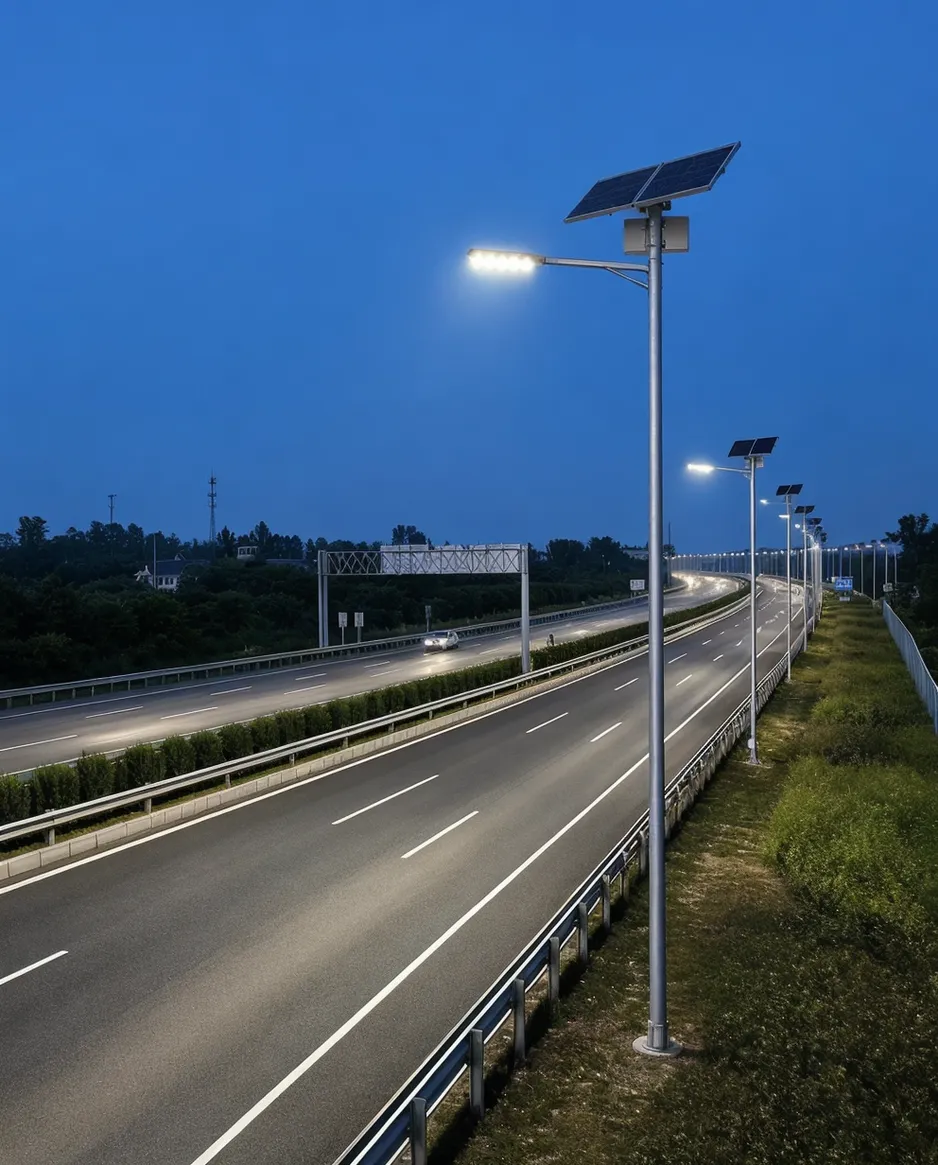
Solar Highway Lights for Roads Where Rework Is Expensive
Solar highway lights are not a wattage step up from standard street lights. They are a different specification category — higher pole heights, wider beam distributions, longer nightly operating hours, and battery autonomy requirements that standard residential road fixtures are not designed to meet. When a highway project is under-specified, the failure shows up after installation: fixtures that dim before dawn, batteries that can't sustain three consecutive overcast days, or beam patterns that leave dark zones between poles. Fixing those problems on a highway means sending a crew back to a live road. That cost lands on whoever specified the fixture.
JXSOL solar highway lights are engineered for expressways, arterial highways, bridge approaches, toll stations, interchange areas, and off-grid rural highways where grid extension is either unavailable or cost-prohibitive. We've been manufacturing solar roadway lighting since 2012, with six production lines, 1,200,000-unit annual capacity, and 100% pre-shipment inspection on every unit. The configuration process starts with your road inputs — not a wattage selection from a dropdown.
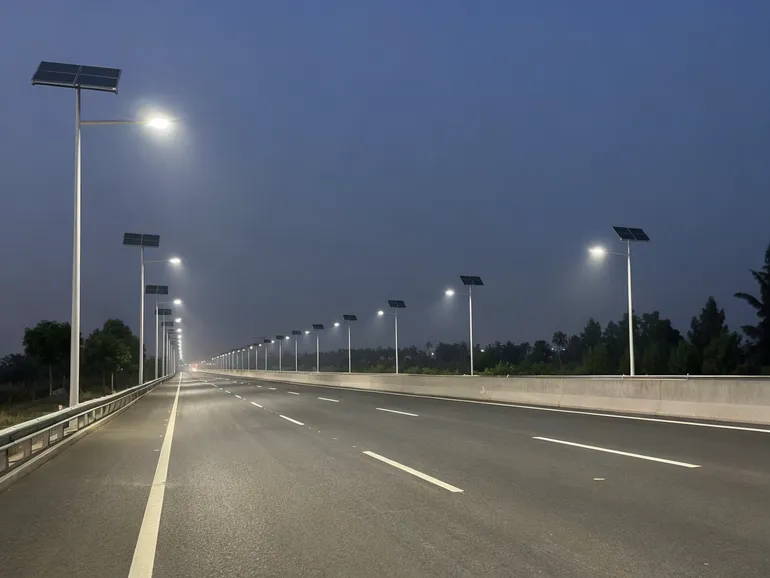
Common failure modes from under-specification
- • Fixtures dim before dawn due to undersized batteries
- • Batteries fail after 3 consecutive overcast days
- • Dark zones between poles from wrong beam angles
- • Crew revisits to a live highway at project-owner cost
The Four Inputs That Decide Highway Lighting Cost
Most buyers who come to us with a highway project have a wattage number in mind. That number is usually derived from a previous project, a competitor quote, or a rule of thumb. It's often wrong — not because the buyer doesn't know their project, but because wattage alone doesn't determine whether a solar highway lighting system will perform. Four inputs drive the actual configuration, and each one affects landed cost in a different direction.
Road Width & Lane Count
Road width and lane count determine the required illuminance footprint. A two-lane rural highway at 7m width needs a different beam distribution than a four-lane expressway at 22m. Wider roads require either higher pole heights, closer pole spacing, or fixtures with asymmetric wide-road optics — and sometimes all three.
Specifying a fixture by wattage without confirming the beam angle against the road width is the most common source of dark-zone complaints after installation.
Pole Height & Spacing
Pole height and spacing set the geometry of the lighting layout. Highway applications typically run 10m–12m poles with 30m–40m spacing, though arterial roads and bridge approaches often specify 8m or 15m depending on the road classification and local standards.
Pole height affects the required lumen output directly: the same fixture at 10m covers a different area than at 12m, and the lux level at road surface changes accordingly. If you're working from a project brief that specifies pole height and spacing, those numbers are the starting point for fixture selection — not the other way around.
Required Lux Level or Lighting Standard
This is the compliance input. Municipal and infrastructure projects in most markets reference a road lighting standard — EN 13201 in Europe, CIE 115 internationally, or national equivalents. These standards define minimum maintained illuminance and uniformity ratios by road class.
A highway project that needs to pass a photometric acceptance test requires a fixture spec that's confirmed against the standard, not estimated from wattage. We run photometric confirmation against your project standard as part of the configuration process.
Nightly Operating Hours & Autonomy Days
Nightly operating hours and autonomy days determine battery and panel sizing — and this is where highway projects diverge most sharply from standard street lighting. A highway fixture running 10–12 hours per night in a region with 4–5 peak sun hours per day needs a significantly larger battery and panel than a residential road fixture running 8 hours in a high-irradiance location.
Autonomy days (the number of consecutive low-irradiance days the system must sustain without going dark) add another multiplier. Undersizing the battery to reduce unit cost is the most reliable way to generate warranty claims in the first rainy season.
The commercial value of getting these four inputs right before quoting
Accurate bids, no change orders after site survey, and no after-sales disputes about fixture performance. For buyers quoting highway projects competitively, the configuration review we provide before production is the difference between a defensible bid and a liability.
Highway-Grade Specification Range for RFQ Comparison
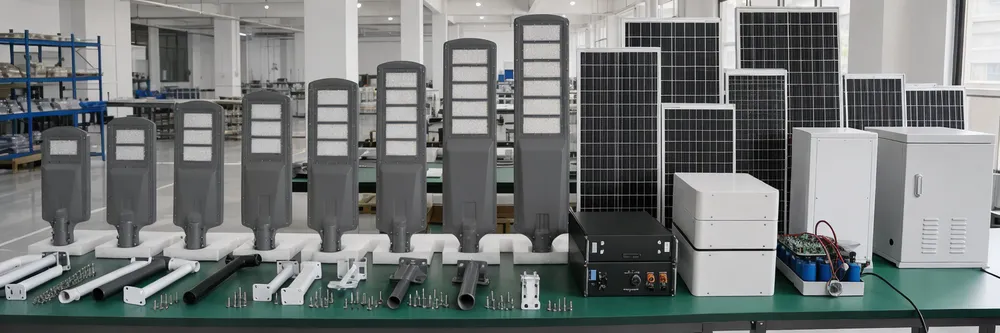
The table below covers the typical specification range for JXSOL solar highway lights. These are industry-typical values for highway-class roadway fixtures — exact specifications for your project are confirmed through the configuration process. Use this table to verify that our range covers your project requirements before sending an RFQ.
LED Power
80W – 300W
Road class and pole height determine the required output. 100W–150W covers most two-lane highway applications at 10m poles; 200W–300W for wider roads or higher poles.
Lumen Output (Fixture)
10,000 lm – 40,000 lm
Confirm at fixture level, not LED chip level. We test and confirm lumen output at the module assembly stage.
Pole Height Compatibility
8m – 15m
10m–12m is most common for highway applications. Confirm arm length and mounting interface alongside pole height.
Solar Panel
100W – 400W monocrystalline
Sized to battery capacity, daily operating hours, and installation latitude. Panel wattage is calculated against peak sun hours at your location.
Battery Type
LiFePO4
Standard across the range. 2,000+ cycle life, wider operating temperature range than lead-acid or standard lithium, safer chemistry for highway installations.
Battery Capacity
60Ah – 200Ah
Sized for autonomy days and nightly operating hours. Highway projects typically require 3–5 autonomy days; confirm your target before RFQ.
Autonomy Days
3 – 7 days
3 days is the standard minimum. 5 days for monsoon regions, high latitudes, or variable irradiance. 7 days for critical infrastructure or difficult maintenance access.
Color Temperature
4000K – 5000K standard
4000K–5000K is the road visibility standard for highway applications. 3000K or 6000K available if project specification requires.
IP Rating
IP65 standard / IP67 available
IP65 covers all standard highway environments. IP67 for flood-prone areas, coastal installations, or bridge deck applications with standing water exposure.
Beam Angle / Optics
Type II, III, IV road optics
Optic type selected by road width and pole offset. Asymmetric wide-road optics available for multi-lane highways. Glare control lens available for high-speed road applications.
Control Modes
Dusk-to-dawn / timed dimming / motion-activated
Standard: dusk-to-dawn with 50% dim mode. Optional: scheduled multi-level dimming, PIR motion sensing, smart network integration.
Wind Load Rating
120–150 km/h wind exposure
Mounting bracket and housing designed for highway wind exposure. Confirm local wind zone before specifying bracket configuration.
Housing
Die-cast aluminum, powder-coated
Standard colors: silver grey, black, dark green. Custom colors on runs of 100+ units.
Certifications
CE, RoHS, IP65/IP67, IEC 62124
Documentation provided with order. CE Declaration of Conformity, RoHS test reports, IP test certificates, IEC 62124 available.
Complete Specification Range — Highway-Class Solar Roadway Fixtures
| Specification | Typical Range | Buyer Decision Note |
|---|---|---|
| LED Power | 80W – 300W | Road class and pole height determine the required output. 100W–150W covers most two-lane highway applications at 10m poles; 200W–300W for wider roads or higher poles. |
| Lumen Output (Fixture) | 10,000 lm – 40,000 lm | Confirm at fixture level, not LED chip level. We test and confirm lumen output at the module assembly stage. |
| Pole Height Compatibility | 8m – 15m | 10m–12m is most common for highway applications. Confirm arm length and mounting interface alongside pole height. |
| Solar Panel | 100W – 400W monocrystalline | Sized to battery capacity, daily operating hours, and installation latitude. Panel wattage is calculated against peak sun hours at your location. |
| Battery Type | LiFePO4 (lithium iron phosphate) | Standard across the range. 2,000+ cycle life, wider operating temperature range than lead-acid or standard lithium, safer chemistry for highway installations. |
| Battery Capacity | 60Ah – 200Ah | Sized for autonomy days and nightly operating hours. Highway projects typically require 3–5 autonomy days; confirm your target before RFQ. |
| Autonomy Days | 3 – 7 days | 3 days is the standard minimum. 5 days for monsoon regions, high latitudes, or variable irradiance. 7 days for critical infrastructure or difficult maintenance access. |
| Color Temperature | 4000K – 5000K standard | 4000K–5000K is the road visibility standard for highway applications. 3000K or 6000K available if project specification requires. |
| IP Rating | IP65 standard / IP67 available | IP65 covers all standard highway environments. IP67 for flood-prone areas, coastal installations, or bridge deck applications with standing water exposure. |
| Beam Angle / Optics | Type II, III, IV road optics | Optic type selected by road width and pole offset. Asymmetric wide-road optics available for multi-lane highways. Glare control lens available for high-speed road applications. |
| Control Modes | Dusk-to-dawn / timed dimming / motion-activated | Standard: dusk-to-dawn with 50% dim mode. Optional: scheduled multi-level dimming, PIR motion sensing, smart network integration. |
| Wind Load Rating | 120–150 km/h | Mounting bracket and housing designed for highway wind exposure. Confirm local wind zone before specifying bracket configuration. |
| Housing | Die-cast aluminum, powder-coated | Standard colors: silver grey, black, dark green. Custom colors on runs of 100+ units. |
| Certifications | CE, RoHS, IP65/IP67, IEC 62124 | Documentation provided with order. CE Declaration of Conformity, RoHS test reports, IP test certificates, IEC 62124 available. |
Specifications shown are industry-typical values for highway-class solar roadway fixtures. Actual specifications depend on project inputs. Contact us for project-specific data sheets and photometric files.
Project Segments Where Solar Highway Lighting Makes Commercial Sense
Highway lighting is a higher-margin, higher-specification segment than standard residential road lighting. The projects are larger, the documentation requirements are more demanding, and the buyers — infrastructure contractors, municipal road agencies, and development finance-backed projects — are more sophisticated. That creates a different commercial profile for distributors and contractors who serve this segment.
Expressway & Arterial Road Upgrades
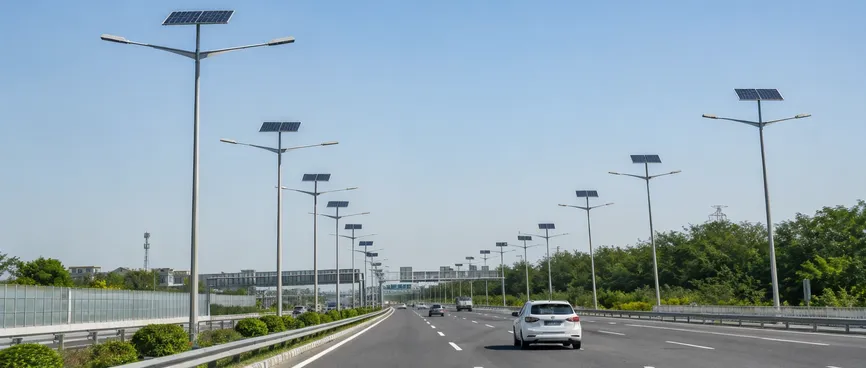
In markets across Southeast Asia, the Middle East, and Africa, extending the grid to a new highway corridor can cost more than the road itself. Solar highway lighting is the practical alternative — no trenching, no transformer stations, no ongoing electricity tariff.
Typical Project Scale
500–5,000 fixtures per contract, with repeat orders as the road network expands.
For contractors who can demonstrate photometric compliance and provide the required certification documentation, this is a defensible margin segment with limited commodity competition.
Bridge Approaches, Toll Stations & Interchange Areas
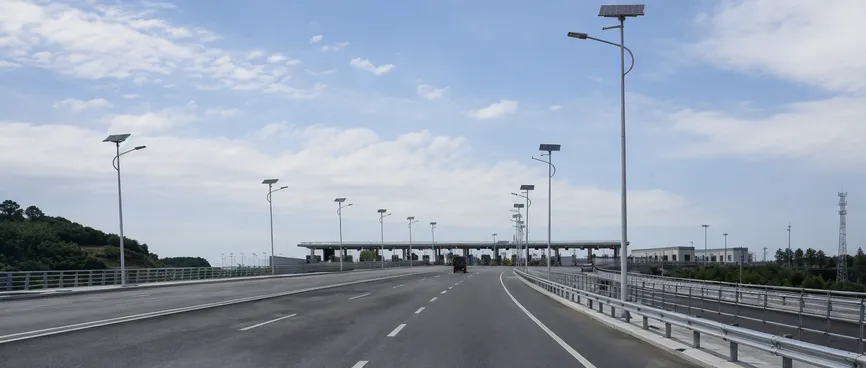
These are defined lighting zones with specific photometric requirements and often higher safety standards than open road sections. Bridge deck installations add IP requirements (standing water, salt spray on coastal crossings) and wind load considerations that standard street light fixtures are not rated for.
Typical Project Scale
50–300 fixtures per project. Specification complexity creates a margin premium.
Buyers in this segment need a manufacturer who can confirm fixture performance against the site-specific requirements — not just supply a catalog wattage.
Rural & Off-Grid Highways
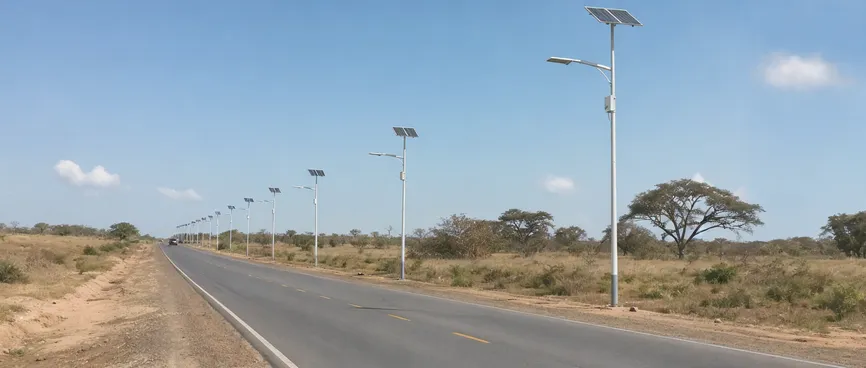
Rural highway electrification is one of the fastest-growing segments for solar roadway lighting globally. Grid infrastructure is absent or unreliable, maintenance access is infrequent, and battery autonomy requirements are higher than urban projects.
Key Buyers
Development contractors, NGO-funded infrastructure programs, government rural electrification agencies.
Buyers serving this segment prioritize system reliability and autonomy over advanced features. Split configurations with larger battery banks are the standard architecture.
This segment has grown significantly over the last three years — infrastructure investment in Africa, Southeast Asia, and the Middle East is driving consistent demand for highway-grade solar fixtures.
Infrastructure Contractors Bidding Solar Alternatives
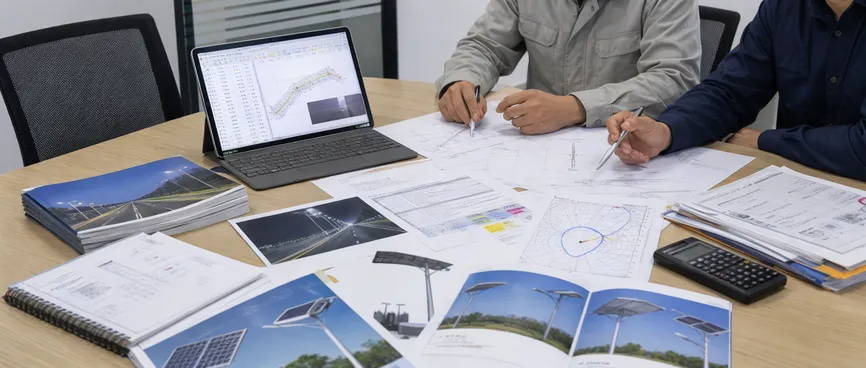
When a contractor is bidding a highway lighting project against a grid-connected alternative, the solar option needs to be specified with enough precision to survive a technical review.
What Wins Bids
- Photometric files (IES/LDT)
- Certification documentation
- Battery autonomy calculations
- Manufacturer performance guarantee
Contractors who can deliver that package win bids that commodity solar suppliers can't compete for.
Distributors Building a Higher-Margin Roadway Lighting Line
Standard all-in-one solar street lights are a competitive, price-sensitive product category. Highway-grade fixtures are not — the specification complexity, documentation requirements, and project scale create natural barriers to commodity competition.
Distributors who add solar highway lighting to their catalog alongside standard street lights can serve infrastructure project buyers who need a single-source supplier for the full road lighting range.
Catalog Expansion
- Higher margin than standard all-in-one fixtures
- Natural barriers to commodity competition
- Single-source supply for full road lighting range
Split Configuration, Battery Autonomy, and Panel Sizing for Highway Projects
Most highway projects we configure end up on a split architecture — separate solar panel and fixture housing — rather than an integrated all-in-one design. The reason is straightforward: the battery capacity and panel wattage required for 10–12 hours of nightly operation with 3–5 autonomy days at highway lumen levels exceeds what an integrated housing can physically accommodate without becoming impractical to mount on a standard pole arm.
When Integrated All-in-One Works
- LED output in the 80W–120W range
- Installation latitude between roughly 15°N and 35°N (high irradiance, consistent solar resource)
- Autonomy requirement of 3 days or less
Outside those parameters, the panel and battery sizing required for reliable performance pushes the integrated housing to a size and weight that creates mounting and wind load problems.
When Split Architecture Is Required
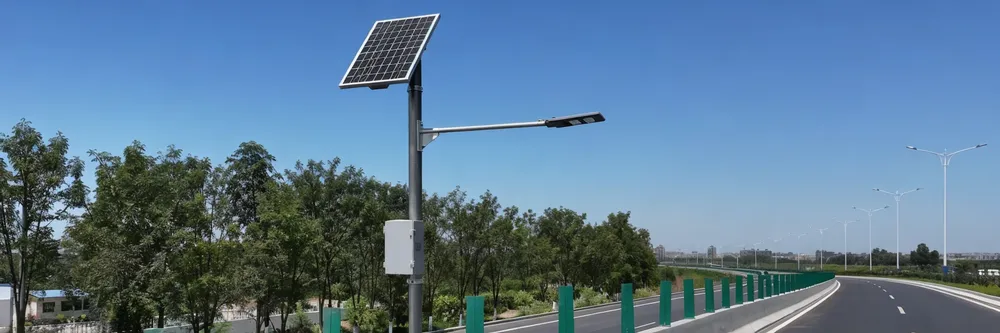
A split system — panel mounted separately on the pole, battery housed in a ground-level or pole-mounted enclosure, fixture on the arm — solves the sizing constraint cleanly.
- LED output above 120W or high-lumen highway requirements
- Latitudes above 35°N or regions with seasonal irradiance variation
- Autonomy requirements of 4–5+ days
- 10–12 hours nightly operation at full output
Battery Autonomy: The Specification That Most Affects Project Cost
Battery autonomy is the specification input that most directly affects project cost, and it's the one most commonly under-specified in initial RFQs. The calculation is not complicated:
Minimum Battery Capacity Formula:
Daily Energy Consumption (fixture wattage × operating hours) ÷ Battery Efficiency × Autonomy Days
What makes it complicated in practice is that the calculation has to be done at the worst-case month — the month with the lowest solar irradiance at the installation location — not the annual average.
A system sized for average irradiance will underperform in the low-irradiance season, which is exactly when highway lighting is most critical (longer nights, worse weather).
Location-Based Sizing
We ask for the installation location or latitude as a standard input in our configuration process. With that, we calculate peak sun hours for the worst-case month and size the panel and battery accordingly.
Year-Round Performance
The result is a system that performs to spec year-round, not just in the months when the solar resource is favorable. No seasonal underperformance, no dark-road incidents in winter months.
Cost-Performance Trade-Off
For price-sensitive bids, we can model both 3-day and 5-day autonomy scenarios and let you decide where the cost-performance trade-off lands for your project.
Trade-Off Worth Flagging
Sizing for 5-day autonomy in a low-irradiance region can add 30–40% to the battery cost compared to a 3-day spec. For most highway projects, that cost is justified by the reduction in maintenance visits and warranty claims. For price-sensitive bids, we can model both scenarios and present the data so you can make an informed decision.
Battery Cell Matching and Pack Testing
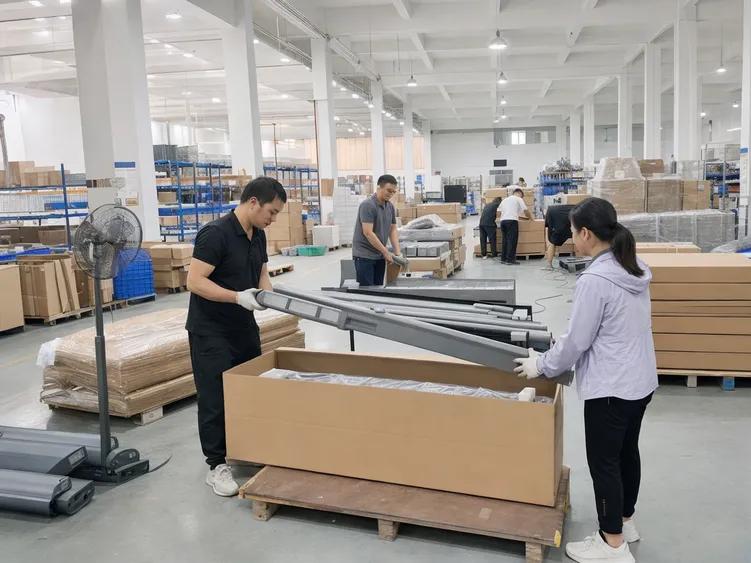
Battery cells are matched by capacity and internal resistance before pack assembly, and every completed pack goes through a full charge/discharge cycle test before it moves to final assembly — the same process described in our JXSOL production and inspection system.
For highway projects where battery failure means a dark road, that matching and testing step is not optional.
Optics, Mounting, and Site Details That Prevent Field Complaints
Wattage and battery autonomy get most of the attention in highway lighting specifications. Optics and mounting details generate most of the field complaints. A fixture with the right lumen output but the wrong beam distribution will leave dark zones between poles regardless of how well the battery is sized.
Beam Angle and Road Width Matching
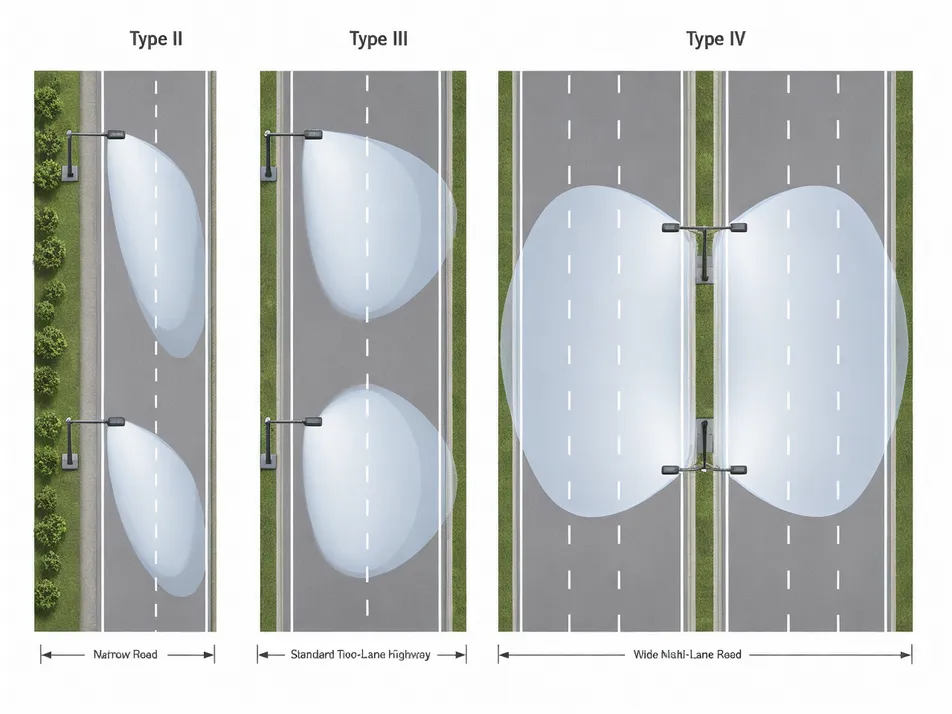
Highway fixtures use road-specific optic types — Type II for narrow roads with offset poles, Type III for standard two-lane highways, Type IV for wide multi-lane roads with center-median mounting. The optic type determines how the lumen output is distributed across the road surface.
Specifying a Type III optic on a four-lane expressway will produce adequate illuminance in the center lanes and inadequate illuminance at the road edges. We confirm optic type against road width and pole offset as part of the configuration process — it's one of the inputs that changes the fixture spec, not just the wattage.
Optic Type Quick Reference
Type II — Narrow roads, offset pole mounting
Type III — Standard two-lane highways
Type IV — Wide multi-lane roads, center-median mounting
Pole Height, Arm Length, and Tilt Angle
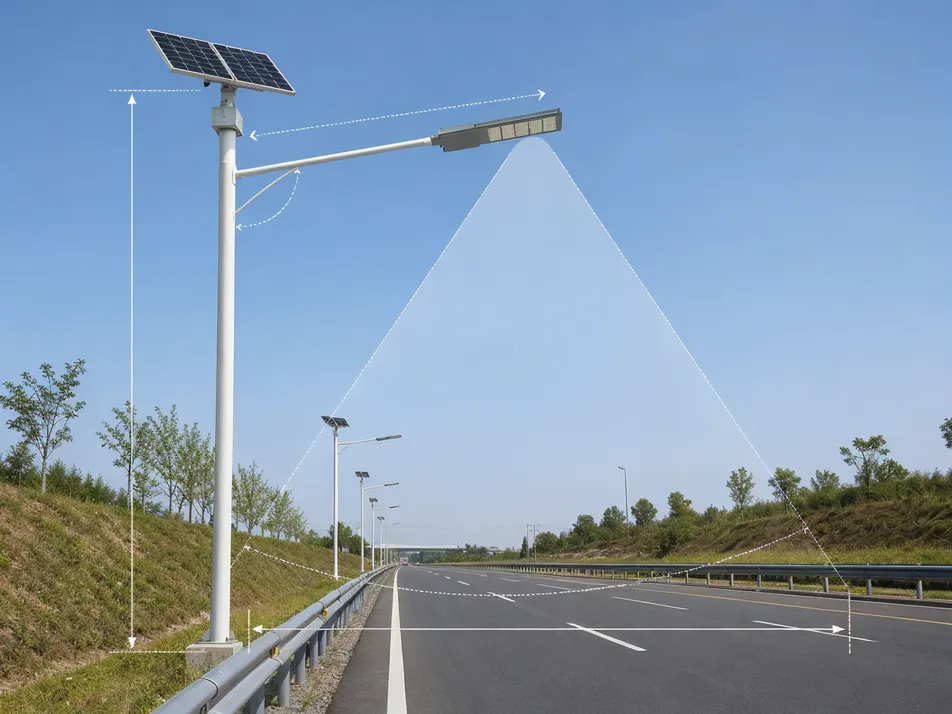
The fixture mounting height and arm length determine the effective illuminance at road surface. A 150W fixture at 10m with a 1.5m arm produces a different road surface illuminance than the same fixture at 12m with a 2m arm.
Tilt angle — the angle at which the fixture is aimed relative to horizontal — affects both the illuminance distribution and the glare index. For high-speed roads, glare control is a safety requirement, not an aesthetic preference.
We provide photometric simulation files for project specifications that require illuminance and glare confirmation before installation.
Panel Orientation and Shade Avoidance
Solar panel orientation is fixed at installation — a panel mounted facing the wrong direction or shaded by a bridge structure or roadside vegetation will underperform for the life of the installation.
We flag panel orientation requirements as part of the site review inputs. For bridge and interchange installations where shading is a real constraint, we can configure the panel mounting to maximize exposure within the site geometry.
Wind Exposure and Bracket Specification
Highway poles are exposed to higher wind loads than residential road poles, and the solar panel adds a significant wind load surface area compared to a standard luminaire. Bracket and mounting hardware must be rated for the local wind zone.
We design mounting brackets for 120–150 km/h wind exposure as standard; for coastal or high-wind-zone installations, confirm the local design wind speed before specifying the bracket configuration.
For fixture-and-pole matching, see our solar street lighting poles — we supply poles alongside fixtures and can confirm the mounting interface before production.
Cable Protection and Maintenance Access
Highway installations are not easily accessible for maintenance. Cable entry points, junction boxes, and battery enclosures should be sealed to IP65 or IP67 as appropriate, and cable routing should be protected against UV degradation and mechanical damage.
We include cable protection sleeves and sealed junction boxes as standard on highway configurations.
Custom Solar Highway Lights for Tender Specs and Private Label Supply
Standard catalog configurations cover a significant portion of highway project requirements. When they don't — when a tender spec calls for a specific lumen output, a non-standard color temperature, a custom dimming profile, or a private-label housing — our in-house R&D team of 15+ optical and electrical engineers handles the engineering review and production configuration.
Lumen Output and Optics
Lumen output can be adjusted within the LED module's design range without changing the housing. Optic type is selected by road width and pole geometry — we can configure Type II, III, or IV road optics, asymmetric wide-road distributions, and glare-control lenses for high-speed road applications.
Battery Autonomy and Panel Sizing
Battery capacity and panel wattage are sized to your target autonomy days, nightly operating hours, and installation latitude. If your tender spec calls for 5-day autonomy in a monsoon region, we size the system for that requirement — not for average annual irradiance.
Controller and Dimming Profile
Standard controllers include dusk-to-dawn operation with 50% dim mode. Custom configurations can include scheduled multi-level dimming (e.g., 100% from dusk to midnight, 50% midnight to dawn), PIR motion-activated boost, dawn-to-dusk timing, and smart network integration for municipal maintenance programs. If your project requires a specific dimming schedule, send the profile — we configure the controller to match.
Housing Finish and Color
Standard colors are silver grey, black, and dark green. Custom RAL colors are available on runs of 100+ units. Below that threshold, the powder line changeover cost doesn't make sense for either side — we'll tell you that upfront rather than after the order is placed.
Private Label and Project Documentation
Custom logo, brand labeling, packaging design, and accessory configuration for buyers building a branded highway lighting line or supplying a project under their own brand. We handle packaging engineering alongside product engineering. For tender projects requiring specific documentation formats — test reports, photometric files, compliance declarations, translated installation guides — confirm the requirements at order placement.
MOQ and Engineering Review Process
MOQ for standard highway configurations starts at 100 units. OEM/ODM projects with custom specifications go through an engineering review before production to lock the spec before component procurement.
That review prevents spec mismatches during production, which cost more time to resolve than the review takes.
Compliance Files, Batch Control, and Export Packing for Infrastructure Orders
Highway and infrastructure projects have documentation requirements that standard distributor orders don't. Tender submissions need compliance declarations. Customs clearance in regulated markets needs CE and RoHS documentation. Site acceptance tests need photometric files and IP test certificates. Getting these documents after the order ships is slower and more expensive than confirming them before production.
Certifications Available with Orders
CE Declaration of Conformity, RoHS test reports, IP65/IP67 test certificates, and IEC 62124 documentation are provided with orders for markets that require them. These are confirmed JXSOL certifications — not claimed without documentation.
For markets or tenders requiring additional compliance files, confirm the specific requirements at order placement. See our solar lighting certifications and test documentation page for the full list.
Batch Traceability
Every carton carries a batch code that traces back to the production run, component lot, and QC inspection records. For highway projects deploying fixtures across multiple road sections or in phases, batch traceability means that if a field issue surfaces after installation, the production window and inspection records can be identified without guessing. That traceability is the foundation of any warranty claim process on a large infrastructure deployment.
Accessory Pack Verification
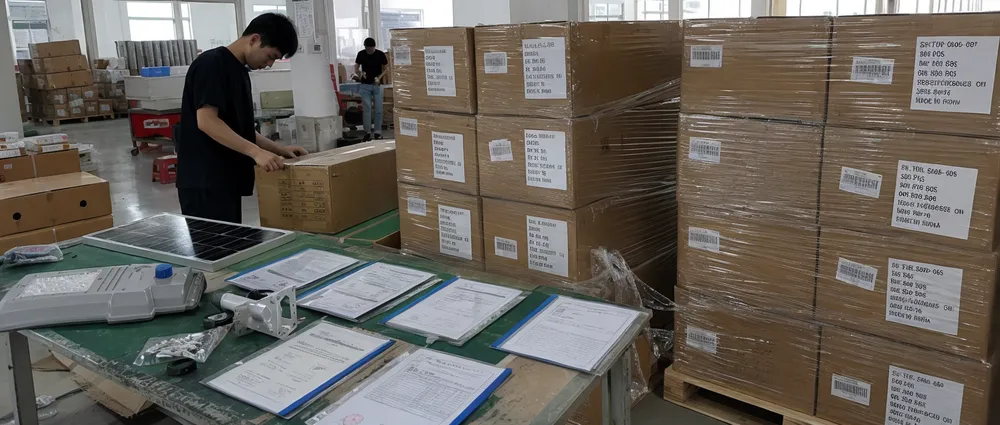
Mounting brackets, fasteners, cable protection sleeves, installation guides, and controller accessories are checked against the packing list before carton sealing. Missing accessories on a highway project site mean a crew waiting while parts are sourced — we check before the container closes.
Carton and Pallet Planning
Carton dimensions are sized for standard 20GP and 40HQ container loading. Palletized packing is available for buyers who need palletized delivery for warehouse receiving or project site logistics. Mixed-SKU orders are organized by product family and labeled by batch code.
For shipping and delivery details, including container loading quantities and lead time confirmation, contact us at order placement.
The full production and inspection system — incoming component inspection, in-process checks at SMT and module assembly, aging tests, and 100% outgoing inspection — is described on the JXSOL production and inspection system page.
Choosing Between Highway, Road, Street, Split, and Smart Models
Solar highway lights are the right choice for high-speed roads, expressways, and infrastructure routes with higher pole heights, wider beam requirements, and longer nightly operating hours. If your project or catalog requirement falls outside that profile, the table below maps the other product families to their primary fit.
| Product | Primary Fit | When to Choose It |
|---|---|---|
| Solar Highway Lights | Expressways, arterial highways, bridge approaches, toll roads, off-grid infrastructure routes | Pole height 8m–15m, road width 14m+, 10–12 hour nightly operation, project documentation required |
| Solar Road Lights | Arterial and collector roads, urban road projects | Pole height 8m–12m, road width 7m–14m, project spec with lux and uniformity requirements |
| Solar Street Lights | Standard public roads, secondary roads, residential streets | Pole height 4m–8m, standard road widths, distributor stock SKUs |
| Commercial Solar Street Lights | Commercial developments, business parks, private roads | Higher lumen output than standard street lights, longer nightly hours, private development projects |
| Split Solar Street Light | Projects requiring larger solar panels or battery banks than integrated housing allows | High latitude, 5+ autonomy days, 200W+ output, lower-irradiance regions |
| Smart Solar Street Light | Municipal projects with remote monitoring, dimming schedules, fault reporting | IoT integration, networked maintenance programs, city-wide lighting management |
| Solar Street Lighting Pole | Projects sourcing poles alongside fixtures | Galvanized steel poles in standard heights, flange or anchor bolt base, fixture-and-pole matching |
Expressways, arterial highways, bridge approaches, toll roads, off-grid infrastructure routes
Pole height 8m–15m, road width 14m+, 10–12 hour nightly operation, project documentation required
Arterial and collector roads, urban road projects
Pole height 8m–12m, road width 7m–14m, project spec with lux and uniformity requirements
Standard public roads, secondary roads, residential streets
Pole height 4m–8m, standard road widths, distributor stock SKUs
Commercial developments, business parks, private roads
Higher lumen output than standard street lights, longer nightly hours, private development projects
Projects requiring larger solar panels or battery banks than integrated housing allows
High latitude, 5+ autonomy days, 200W+ output, lower-irradiance regions
Municipal projects with remote monitoring, dimming schedules, fault reporting
IoT integration, networked maintenance programs, city-wide lighting management
Projects sourcing poles alongside fixtures
Galvanized steel poles in standard heights, flange or anchor bolt base, fixture-and-pole matching
If you're not certain which product family fits your project, send us the road classification, pole height, and required lux level — we'll confirm the right starting point before you spend time on a detailed RFQ.
Get GuidanceFAQ for Solar Highway Lighting Buyers
What wattage is typical for solar highway lights?
For most two-lane highway applications at 10m pole height with 30m–35m pole spacing, 100W–150W LED output covers the standard illuminance requirements. Four-lane expressways at 12m poles typically require 150W–200W. Wider roads, higher poles, or tighter pole spacing push the requirement toward 200W–300W.
The wattage number alone is not sufficient for a highway specification — beam angle, optic type, and pole geometry determine whether the lumen output is distributed correctly across the road surface. A 200W fixture with the wrong optic will underperform a 150W fixture with the correct road distribution.
Send us your road width, pole height, and pole spacing and we'll confirm the fixture spec rather than giving you a wattage estimate.
How many autonomy days should solar highway lighting be designed for?
Three days is the standard minimum for highway applications — it covers a typical sequence of overcast days without the system going dark.
Five days is the practical specification for projects in monsoon regions, high-latitude markets (above roughly 40°N or 40°S), or locations where consecutive low-irradiance days are common in winter.
Seven days is specified for critical infrastructure routes or installations where maintenance access is difficult or expensive.
Typical overcast coverage
Extended low-irradiance periods
Remote or hard-access sites
The trade-off is direct: each additional autonomy day adds battery capacity, which adds cost and, for integrated designs, may require moving to a split architecture.
We model the battery sizing for your target autonomy days and installation location as part of the configuration process — it's one of the first inputs we ask for.
Are split solar lights better for highway projects?
For most highway projects above 120W LED output or requiring 5+ autonomy days, yes — a split configuration is more defensible than an integrated all-in-one design. The reason is physical: the battery capacity and panel wattage required for reliable highway performance at those parameters exceeds what an integrated housing can accommodate without creating mounting and wind load problems.
Split systems separate the panel from the fixture, allowing each component to be sized independently for the project requirements. The trade-off is installation complexity — two mounting points, a wiring run between panel and fixture, and a slightly higher per-unit cost.
For highway projects where the alternative is a warranty claim after the first rainy season, that cost is justified.
For lower-output highway applications (80W–120W) in high-irradiance regions with 3-day autonomy, an integrated design may be sufficient — we'll confirm which architecture fits your project inputs.
What pole height is used for solar highway lights?
Highway applications typically use 10m–12m poles for standard expressway and arterial road sections. Bridge approaches and interchange areas sometimes specify 8m or 15m depending on the road classification and local standards.
Pole height is one of the four inputs that drives the fixture specification — it affects required lumen output, beam angle selection, and mounting bracket design.
We supply solar street lighting poles alongside fixtures and confirm the mounting interface before production.
If your project brief specifies pole height, include it in your RFQ — it's one of the inputs that changes the fixture spec, not just the installation detail.
What certifications should I request for highway solar lighting imports or tenders?
For European market entry and most regulated market tenders: CE Declaration of Conformity (covering Low Voltage Directive and EMC Directive), RoHS test report, IP65 or IP67 test certificate, and IEC 62124 photovoltaic system performance documentation. These are the four documents that cover the majority of import clearance and tender submission requirements across North America, Europe, the Middle East, and Southeast Asia.
For North American projects, some specifications reference UL listing — confirm the specific requirement with the project owner, as CE with test reports is accepted in many cases. For African development-finance-backed projects, CE and IEC 62124 are typically sufficient.
We provide all four standard documents with orders. If your tender requires additional documentation — country-specific certifications, translated guides, specific labeling formats — confirm at order placement.
See our solar lighting certifications and test documentation page for the full list.
What information should I send to get an accurate quote from JXSOL?
The most useful RFQ for a highway project includes:
- Road width or lane count
- Pole height
- Pole spacing
- Target lux level or the road lighting standard the project must comply with
- Nightly operating hours
- Target autonomy days
- Installation location or latitude
- Order quantity
- Destination market
- Documentation requirements (CE, IEC 62124, translated guides, etc.)
- Any branding or private-label requirements
With those inputs, we can confirm the fixture spec, run the battery and panel sizing, provide a photometric simulation if required, and send a detailed quote with a data sheet.
If you're earlier in the process — comparing configurations, evaluating us as a supplier, or building a distributor catalog — send what you have. We'll work from there and flag what additional inputs we need to complete the configuration.
Ready to get started?
Send your highway lighting project details and receive a configured quote with full documentation.
Send Highway Project Specs for a Factory Quote
The configuration process starts with your road inputs. Send us what you have and we'll confirm the fixture spec, size the battery and panel for your location, and provide a detailed quote before production.
Useful Inputs for a Highway Lighting RFQ
- Road width or lane count
- Pole height and arm length
- Pole spacing
- Target lux level or road lighting standard (EN 13201, CIE 115, or national equivalent)
- Nightly operating hours
- Target autonomy days
- Installation location or latitude
- Order quantity
- Destination market
- Documentation requirements (CE, IEC 62124, translated installation guides, specific labeling)
- Branding or private-label requirements
If you don't have all of these yet, send what you have. We'll work from there and flag what additional inputs we need to complete the configuration. We don't quote highway projects from wattage alone — the configuration review is how we make sure the system performs to spec after installation, not just on paper.
Direct Contact
-
Email [email protected]
-
Phone / WhatsApp +86 153 9880 7118
-
Address 9th Floor, Houda Industrial, No. 65 Pinghe Road, Guzhen Town, Zhongshan, Guangdong, 528421, China
Explore More Solar Roadway Lighting
Related product lines from JXSOL's solar street and roadway lighting range.