

Split Solar Street Light Direct From Factory
Separate-panel solar street lighting for projects where panel size, battery autonomy, or installation latitude exceeds what an integrated housing can deliver.
Factory-direct split type solar street lights with LiFePO4 battery, monocrystalline panel, and 100% pre-shipment inspection — configured to your road spec, pole height, and target autonomy days.
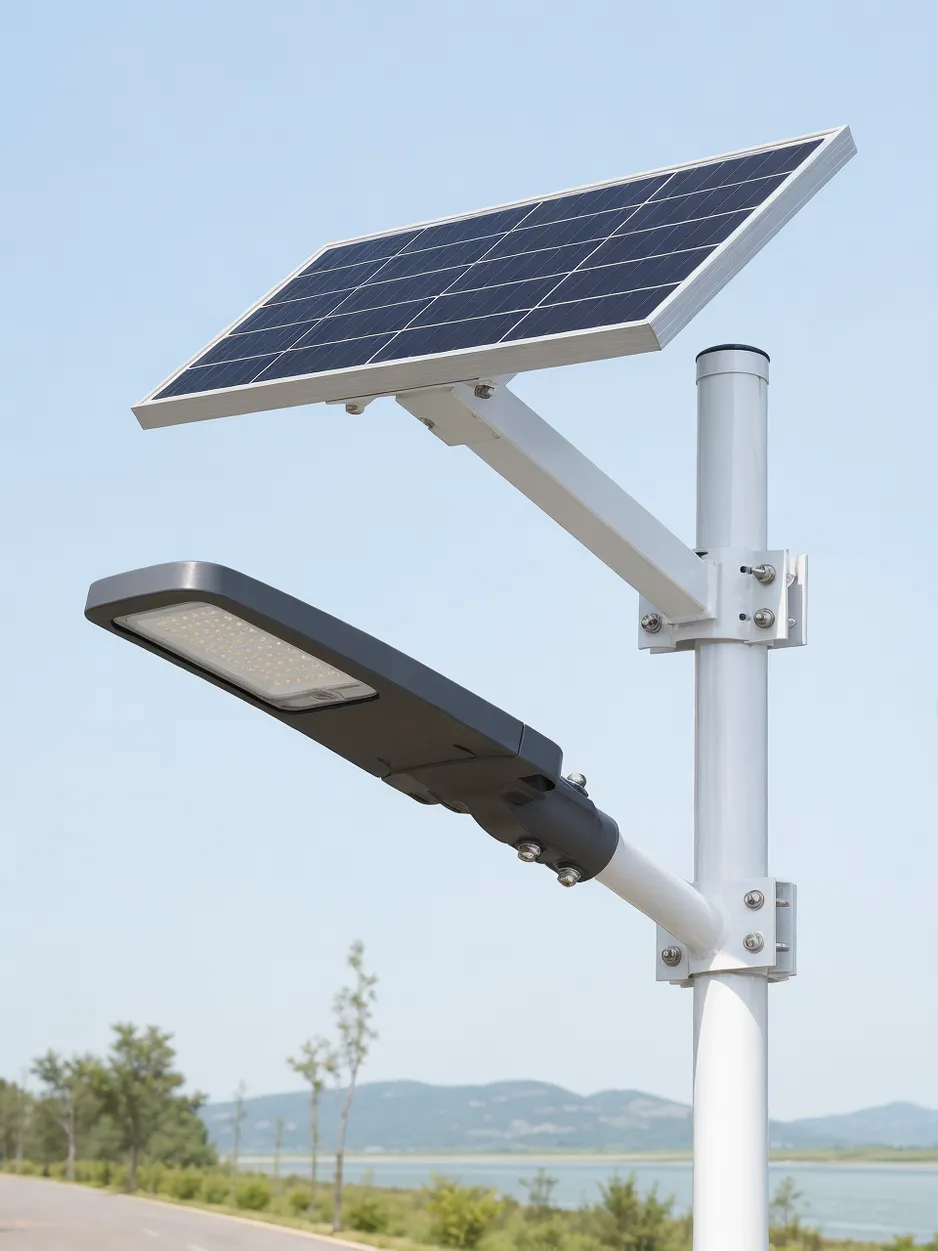
Split Solar Street Light for Larger Panel and Battery Flexibility
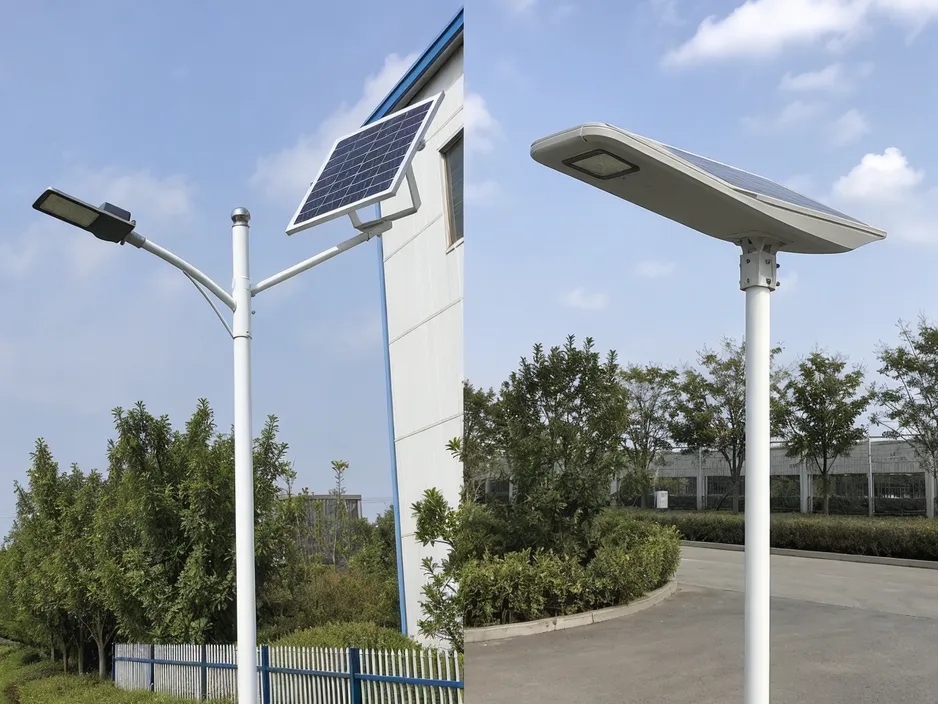
A split solar street light separates the solar panel from the lighting fixture. The panel mounts independently — typically on the pole arm or a dedicated bracket above the fixture — while the LED head, controller, and battery are housed in the fixture body or a separate battery box. That physical separation is the point: it removes the constraint that the panel must fit within the fixture housing, so the system can be sized for the project rather than sized for the housing.
For most standard road projects at mid-latitudes with reasonable solar irradiance, an all-in-one solar street light covers the requirement cleanly. The split type solar street light is the right starting point when the project brief calls for higher LED output, longer nightly operating hours, more autonomy days, or an installation location where winter irradiance is low enough that a larger panel is the only way to keep the battery charged through the season. We've been making both configurations since the early years — the split system is not a premium upsell, it's a different engineering answer to a different set of project constraints.
JXSOL has manufactured solar street lighting since 2012. Our in-house engineering team handles panel and battery sizing for split configurations, and every unit goes through 100% pre-shipment inspection before the container closes.
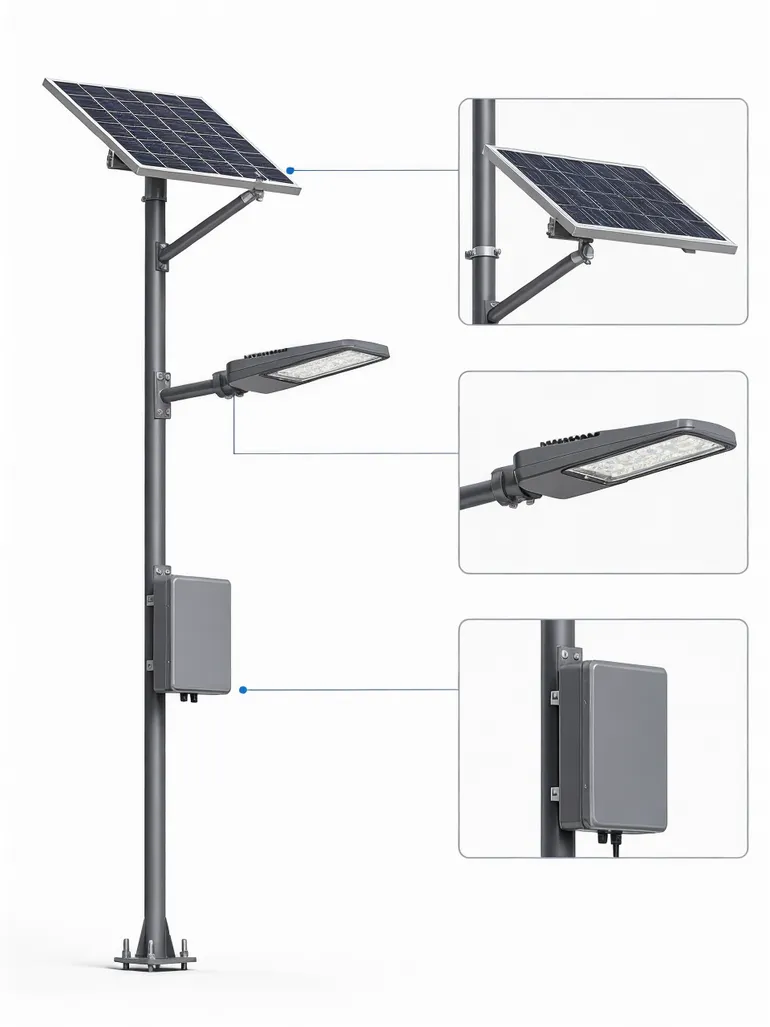
Independent Panel Sizing
Not limited by fixture housing
LiFePO4 Battery
Sized to project autonomy spec
When a Separate Panel Protects the Project Spec
The commercial case for a solar street light with separate panel comes down to one question: can the panel and battery fit inside the fixture housing and still meet the project's performance requirements? When the answer is no, the split architecture is not a preference — it's the only configuration that works.
Here's where that line typically falls in practice. All-in-one fixtures can accommodate panels up to roughly 100–150W and batteries sized for 3-day autonomy at moderate latitudes. Push beyond those parameters — 200W+ LED output, 5-day autonomy, installations above 45°N or below 20°N with low winter sun angles, or sites with heavy cloud cover during the rainy season — and the panel and battery sizing required simply doesn't fit in an integrated housing without compromising the structural design or the thermal management of the LED module.
The separate panel also solves an orientation problem that buyers in certain markets run into. On a standard pole arm, the fixture angle is set by the road geometry — the beam needs to point down the road. But the optimal panel angle for maximum solar harvest is set by the latitude and the sun's path, which is often a different angle entirely. With an all-in-one fixture, you're making a compromise between lighting performance and charging performance. With a split system, the panel bracket can be set independently, so both are optimized. (We've had buyers in Southeast Asia and the Middle East specifically request this configuration for east-west road orientations where the all-in-one panel angle was losing 15–20% of potential daily harvest.)
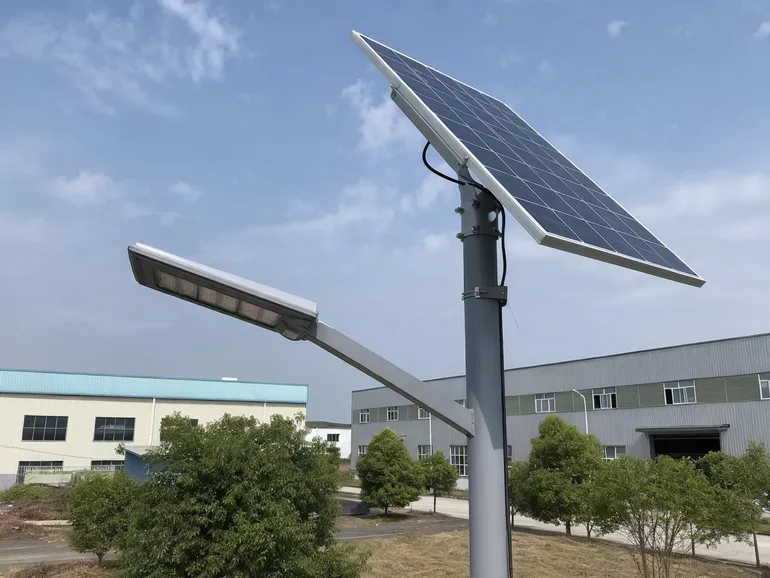
Where the All-in-One Ceiling Falls and Split Takes Over
| Parameter | All-in-One Ceiling | Split System Range |
|---|---|---|
| Panel Wattage | Up to ~100–150W | 200W+ (no housing constraint) |
| Battery Autonomy | ~3 days at moderate latitudes | 5+ days (separate battery box) |
| LED Output | Moderate (thermal limit in housing) | 200W+ LED (thermal management separated) |
| Installation Latitude | Mid-latitudes with good irradiance | Above 45°N / below 20°N / heavy cloud cover |
| Panel Orientation | Compromised by fixture angle | Independent bracket — both optimized |
For Distributors
The split type solar street light opens a higher-spec product tier. The per-unit cost is higher than an all-in-one, but so is the selling price, and the differentiation from commodity integrated fixtures is clear and defensible in a tender or a distributor catalog. Buyers who can explain the panel sizing logic to their customers — why this system performs through the rainy season when cheaper alternatives don't — have a margin argument that doesn't depend on being the lowest price.
For Project Contractors
The split configuration is often the only way to meet a project specification that defines autonomy days, lux levels, and operating hours simultaneously. A spec that requires 5-day autonomy at 30W LED output in a region with 4 peak sun hours per day in the worst month is a math problem, and the math often points to a panel and battery combination that only fits in a split system.
Not sure whether split or all-in-one fits your market?
Send Us Your Project Parameters — We'll Run the ConfigurationSplit System Specification Range for RFQ Comparison
The table below covers the typical specification range for our split solar street light product line. Values marked "project-dependent" are sized during the engineering review based on your installation location, road spec, and autonomy target — they are not fixed catalog values because the right number depends on inputs we need from you.
| Specification | Typical Range / Value | Notes |
|---|---|---|
| LED Power | 30W – 300W | Confirmed against road width, pole height, and required lux level |
| Lumen Output | 3,000 lm – 36,000 lm | Tested at module assembly stage; confirmed at final inspection |
| Solar Panel Wattage | 60W – 400W monocrystalline | Sized to battery capacity and daily operating hours; project-dependent |
| Panel Type | Monocrystalline silicon | Standard across the range; higher efficiency per area than polycrystalline |
| Battery Type | LiFePO4 (lithium iron phosphate) | Standard across the range — 2,000+ cycle life, wide operating temperature |
| Battery Capacity | 30Ah – 200Ah | Sized to autonomy days and operating hours; project-dependent |
| Battery Placement | Integrated in fixture body or separate battery box | Separate box available for larger capacity configurations |
| Autonomy Days | 3 – 7 days | Depends on battery capacity, panel wattage, and daily operating hours |
| Charging Time | Typically 6–8 hours full sun | Varies with panel wattage and battery capacity |
| Operating Hours | 8 – 14 hours/night | Configurable with dimming schedule |
| Color Temperature | 3000K – 6500K | 4000K–5000K standard for road applications; 3000K available for park/pedestrian |
| Beam Angle | 60° – 150° | Matched to road width and pole height; asymmetric optics available |
| Controller Modes | Full power / 50% dim / motion-activated / scheduled dimming | Smart network integration available on request |
| Sensor Options | PIR motion sensor standard; time-control available | Custom sensor logic for OEM/ODM orders |
| Pole Height Compatibility | 5m – 15m | Confirm pole height and arm length before specifying beam angle |
| Cable / Accessory Set | Panel cable, connectors, mounting brackets, fasteners, installation guide | Accessory pack checked against packing list before carton sealing |
| Housing Material | Die-cast aluminum, powder-coated | Standard colors: silver grey, black, dark green |
| IP Rating | IP65 / IP67 | IP67 available for flood-prone or coastal installations |
| Working Temperature | -30°C to +60°C | LiFePO4 chemistry maintains performance across this range |
| Warranty Support | 3 years | Covers LED module, battery, and controller |
| Certifications | ISO 9001:2015, CE, RoHS, IP65/IP67, IEC 62124 | Documentation provided with order |
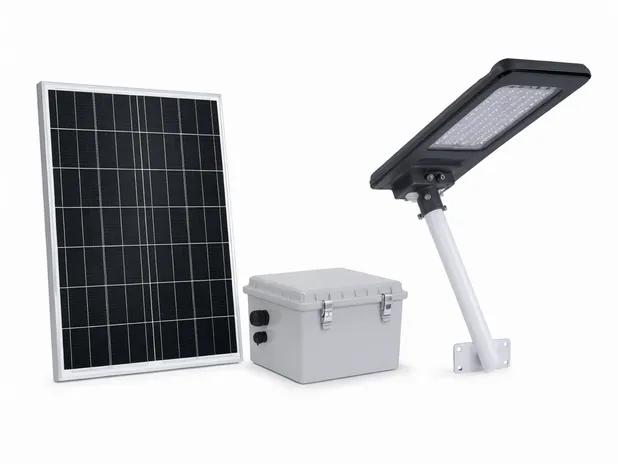
Key Takeaways for RFQ
- LED power range 30W–300W confirmed against road width and lux requirement
- LiFePO4 battery standard — 2,000+ cycle life, -30°C to +60°C operating range
- Panel and battery capacity are project-dependent — sized during engineering review
- IP65/IP67, CE, RoHS, IEC 62124 certified with documentation
- 3–7 day autonomy with 8–14 hour nightly operation and configurable dimming
Specifications shown are typical values for this product line. Final specifications depend on installation location, road classification, pole height, required lux level, operating hours, and autonomy target. Contact us for a project-matched data sheet.
Battery, Panel, and Runtime Sizing Before You Quote the Project
Sizing is where split solar street light projects succeed or fail before a single fixture is installed. The most common procurement mistake we see is treating panel wattage as the primary performance indicator — buyers compare 200W panel vs. 150W panel and assume the larger panel means better performance. It doesn't, unless the battery capacity is matched to it.
The Panel-Battery Mismatch Problem
A 200W panel charging a 60Ah battery will waste most of its daily harvest because the battery fills before the panel stops producing. A 150W panel matched to a 100Ah battery with a 5-day autonomy target is a more useful system for a project in a low-irradiance region.
We've seen projects where the buyer specified a 300W panel because it sounded like the highest-performance option, then found the battery was undersized for the autonomy requirement. The panel was oversized and the battery was undersized. Both numbers were wrong for the project.
The Inputs That Actually Determine the Right Configuration
The inputs that actually determine the right configuration for a solar street light with separate panel are:
Installation location or latitude
Determines peak sun hours per day in the worst month of the year, which is the design constraint, not the annual average
Required LED output and operating hours
Sets the daily energy demand the battery must supply
Target autonomy days
Sets the minimum battery capacity; 3 days is standard, 5 days is common for variable-irradiance regions, 7 days for critical infrastructure
Dimming schedule
A 50% dim profile after midnight can reduce daily energy demand by 20–30%, which directly affects battery and panel sizing
Pole height and road width
Determines the beam angle and lumen output required to meet the lux specification at road level
How We Size Every Split System Order
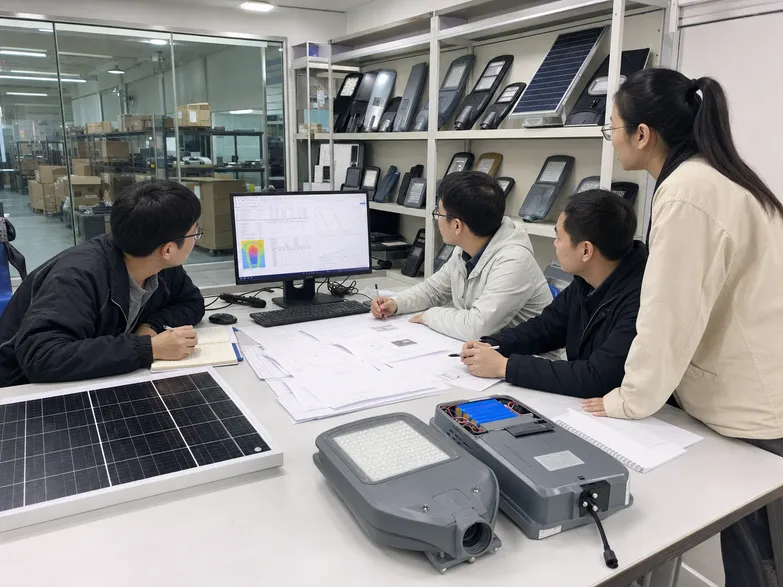
We run this calculation as part of the engineering review for every split system order. The output is a confirmed panel wattage, battery capacity, and operating profile that meets the project spec — not a catalog selection that approximates it.
You send location & project parameters
We run worst-month sizing calculation
Confirmed spec sheet with matched components
The Lowest-Irradiance Month Matters Most
The second common mistake is ignoring the lowest-irradiance month. A system that performs well in summer but runs the battery flat in December is a warranty claim waiting to happen.
We ask for the installation location specifically because we size the panel against the worst-month peak sun hours, not the annual average.
For buyers in Northern Europe, Canada, or high-latitude markets, this is the number that drives the panel size — and it's often larger than buyers expect.
Related Resource
For deeper guidance on photometric planning and system layout, see our solar street lighting design planning resource.
Why the Panel Is Separate from the Fixture — and Why That Matters for Your Project
The defining characteristic of a split solar street light is that the solar panel mounts independently from the LED fixture. This isn't a design preference — it's an engineering decision that solves specific installation problems that all-in-one units cannot address.
Installation Problems the Split Design Solves
Tree Canopy and Shading Obstructions
When the fixture must be positioned under tree cover or near buildings, the panel can be mounted on a separate arm or bracket that reaches unshaded sky. An all-in-one unit in the same position would lose 40–70% of its charging capacity to shade.
Panel Orientation Independence
The LED fixture faces the road. The panel faces the equator. These are rarely the same direction. A split system lets you optimize both angles independently — the fixture tilted for beam distribution, the panel tilted for maximum solar harvest.
Wind Load Distribution
Mounting a large panel on top of the fixture creates a significant wind sail at the highest point of the pole. A split configuration distributes the wind load — the panel can be mounted lower on the pole or on a separate shorter mast, reducing the bending moment on the main pole.
Higher Wattage Without Fixture Bulk
All-in-one units are physically constrained by the fixture housing size. A split system can use a 200W, 300W, or even 400W panel without making the fixture larger or heavier. This is why split systems dominate in high-output roadway applications above 60W LED.
Independent Component Replacement
If the panel is damaged by debris or hail, you replace the panel. If the LED driver fails, you replace the fixture. Neither event requires removing the entire system from the pole. Maintenance cost per event is lower and downtime is shorter.
When to Choose Split vs. All-in-One
Decision Framework
Choose split when LED output exceeds 60W
The panel and battery capacity required for high-output fixtures makes all-in-one housings impractically large
Choose split when shading is present at fixture height
Panel can be repositioned to clear obstructions
Choose split when autonomy requirement exceeds 3 days
Larger battery banks are easier to house in a separate ground-level or pole-base enclosure
Choose split when pole height exceeds 8m
Wind load at height becomes a structural concern with large integrated panels
Choose split for road classifications requiring photometric compliance
Split fixtures use standard road-lighting optics with Type II, III, or V distributions
Consider all-in-one when simplicity and speed matter most
Pathways, parks, residential streets under 6m pole height with no shading — all-in-one is faster to install and lower cost per unit
If your project parameters point toward an all-in-one solution, see our all-in-one solar street light range for integrated options from 20W to 120W.
LiFePO4 Battery Technology and Why It's the Only Chemistry We Use
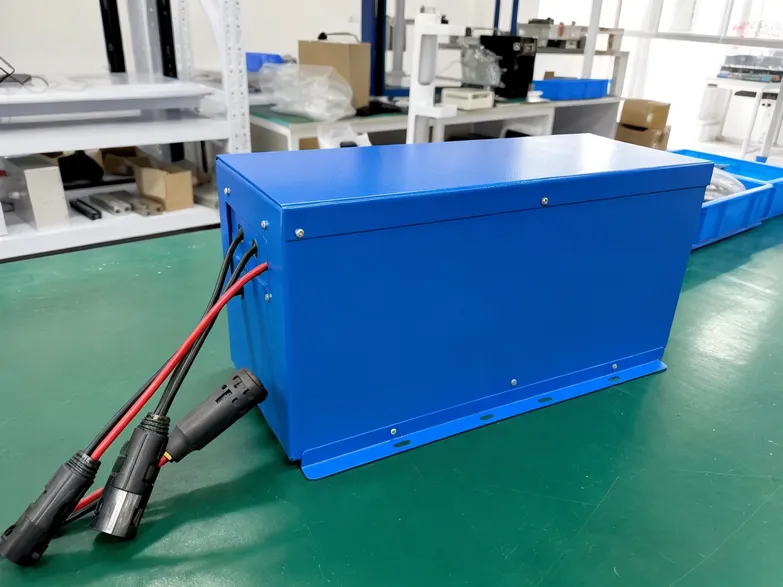
Every split solar street light we manufacture uses lithium iron phosphate (LiFePO4) batteries. This isn't a marketing preference — it's a technical decision based on the operating conditions solar street lights face: daily deep cycling, extreme temperature exposure, and a 5–8 year minimum service life requirement with no scheduled battery replacement.
Battery Chemistry Comparison for Solar Street Lighting
Why LiFePO4 outperforms alternatives in outdoor solar applications
| Parameter | LiFePO4 | Lead-Acid (Gel) | Ternary Lithium (NMC) |
|---|---|---|---|
| Cycle Life (80% DoD) | 2,000–3,500 | 300–500 | 800–1,200 |
| Operating Temp Range | -20°C to +60°C | -10°C to +40°C | -20°C to +45°C |
| Thermal Runaway Risk | Negligible | None (but gassing risk) | Moderate |
| Weight (per kWh) | ~12 kg | ~30 kg | ~10 kg |
| Usable Capacity (DoD) | 80–90% | 50% | 80% |
| Expected Service Life | 8–10 years | 2–3 years | 4–6 years |
| Replacement Cost Over 10 Years | 0–1 replacement | 3–4 replacements | 1–2 replacements |
The Total Cost of Ownership Argument
Lead-acid batteries cost less per unit at purchase. But a gel battery in a solar street light application will need replacement every 2–3 years. Over a 10-year project lifecycle, you'll buy 3–4 batteries per fixture. The LiFePO4 battery costs more upfront but lasts the full project lifecycle with zero or one replacement.
For a 100-fixture project, the difference in battery replacement labor alone — sending a crew with a bucket truck to each pole — typically exceeds the upfront cost difference between LiFePO4 and lead-acid across the entire order.
Why LiFePO4 for Outdoor Solar
Thermal stability: No thermal runaway risk means no fire hazard mounted on a pole above pedestrians
Deep cycle tolerance: Designed for daily 80% discharge without accelerated degradation
Flat discharge curve: Maintains consistent voltage throughout the discharge cycle, so LED output doesn't dim as the battery depletes
Cold weather performance: Operates down to -20°C without the capacity collapse that affects lead-acid below 0°C
No maintenance: No water topping, no equalization charging, no corrosion management
Integrated BMS Protection
Every battery pack includes a battery management system (BMS) that provides overcharge protection, over-discharge protection, short circuit protection, and cell balancing. The BMS communicates with the charge controller to optimize charging profiles based on battery temperature and state of charge.
MPPT Charge Controller and Intelligent Power Management
The charge controller is the component that determines how efficiently the solar panel's output reaches the battery — and how intelligently the battery's stored energy is delivered to the LED fixture. We use MPPT (Maximum Power Point Tracking) controllers exclusively because the efficiency difference over PWM controllers is not marginal — it's 20–30% more energy harvested from the same panel.
MPPT vs. PWM: The Efficiency Gap
A PWM (Pulse Width Modulation) controller connects the panel directly to the battery and regulates by switching on and off. It forces the panel to operate at the battery voltage, which is rarely the panel's optimal operating point.
An MPPT controller continuously tracks the panel's maximum power point — the voltage-current combination that produces the most watts — and converts that to the battery's charging voltage. The result is 20–30% more energy harvested, especially in:
- Cold weather (panel voltage rises, MPPT captures the extra voltage)
- Partial shading (MPPT finds the new maximum power point)
- Early morning and late afternoon (low-light conditions where every watt matters)
- Higher-voltage panels (36V or 48V panels charging 12V or 24V batteries)
What This Means in Practice
For a split solar street light with a 150W panel in a location with 4 peak sun hours in the worst month:
PWM Controller
~420 Wh
daily harvest
MPPT Controller
~540 Wh
daily harvest
That 120Wh difference is the margin between a system that makes it through 5 cloudy days and one that doesn't.
Intelligent Control Features
Our MPPT controllers do more than charge efficiently. They manage the entire power system:
Programmable Dimming Profiles
Set time-based or motion-triggered dimming schedules. Example: 100% from dusk to 11pm, 60% from 11pm to 5am, 100% from 5am to dawn.
Adaptive Energy Management
Monitors battery state of charge and automatically reduces output during extended cloudy periods to preserve autonomy days.
Automatic Dusk/Dawn Detection
Uses panel voltage to detect sunset and sunrise — no photocell needed. Eliminates a common failure point in traditional street lights.
Temperature-Compensated Charging
Adjusts charging voltage based on battery temperature to prevent overcharging in summer and undercharging in winter.
Comprehensive Protection
Reverse polarity, overload, short circuit, lightning surge (up to 4kV), and over-temperature protection built into every unit.
Optional Remote Monitoring
For large-scale deployments, our controllers support optional IoT connectivity via 4G/NB-IoT modules. This enables:
- Real-time battery voltage, current, and temperature monitoring
- Remote dimming profile adjustments without site visits
- Fault alerts (panel disconnection, battery degradation, LED failure)
- Energy production and consumption analytics for performance verification
High-Efficiency LED Fixtures Designed for Solar
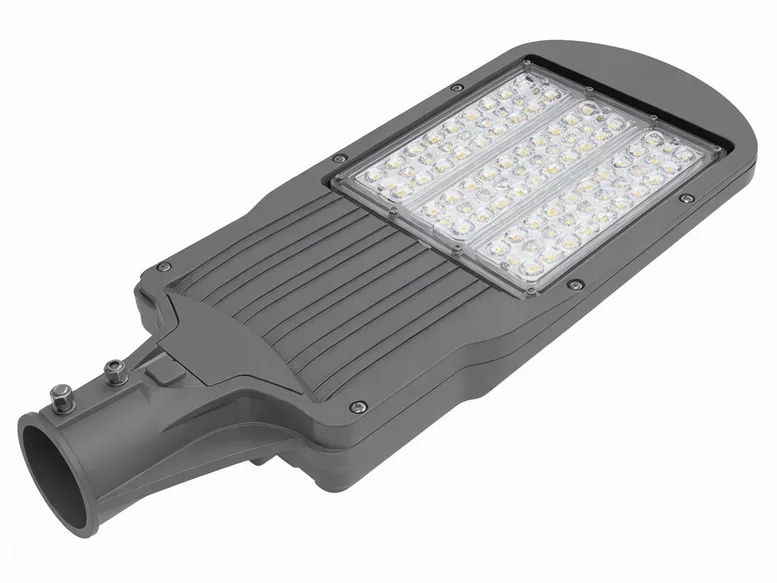
The LED fixture in a solar street light isn't just any LED luminaire — it needs to be specifically optimized for DC power input, maximum lumens per watt, and precise optical distribution. Every watt saved at the fixture means a smaller panel and battery, which compounds into significant cost savings across a project.
LED Chip Selection
We use Lumileds (Philips) 3030 or 5050 series chips rated at 170–200 lumens per watt at the chip level. After optical losses and driver efficiency, our fixtures deliver 140–160 lumens per watt at the system level. This matters because:
160
lm/W system efficacy
vs. 80–100 lm/W for budget fixtures
50%
less energy needed
for the same illumination level
A fixture that delivers the same lux at the road surface using half the watts means you can use a smaller solar panel and battery — or achieve more autonomy days with the same system size.
Precision Optical Design
Light that doesn't hit the road surface is wasted energy. Our fixtures use Type II, III, or V distribution patterns (per IESNA classification) with individual lens arrays on each LED chip to control exactly where the light goes.
Type II Distribution
For narrow roadways and walkways. Lateral throw of 1.0–1.5x mounting height.
Type III Distribution
For wider roads and parking areas. Lateral throw of 1.5–2.75x mounting height.
Type V Distribution
For intersections, roundabouts, and open areas. Symmetrical circular pattern.
Proper optical design means achieving IES RP-8 roadway lighting standards with 30–40% less total lumens compared to fixtures with poor optical control that spill light into the sky and adjacent properties.
Standard Fixture Specifications
Native DC Operation
Our fixtures operate directly on 12V or 24V DC from the battery — no AC inverter needed. This eliminates the 10–15% conversion loss that occurs when converting DC battery power to AC and back to DC at the LED driver. It also removes a common failure point.
Pole and Mounting Infrastructure
The pole isn't just a support structure — it's an engineered system that must handle wind loads from the solar panel, provide secure mounting for all components, resist corrosion for decades, and meet local structural codes. Split systems offer flexibility in pole selection that all-in-one systems cannot match.
Pole Options and Specifications
We supply purpose-designed poles or adapt our systems to existing pole infrastructure. Standard options include:
Hot-Dip Galvanized Steel
Most common for roadway applications. Q235/Q345 steel, 3–4mm wall thickness, hot-dip galvanized per ASTM A123 (minimum 86μm zinc coating). Available in 4m–12m heights. Tapered or straight designs.
Aluminum Alloy
For coastal or high-corrosion environments. 6063-T6 aluminum, naturally corrosion-resistant without coatings. Lighter weight reduces foundation requirements. Available in 4m–8m heights.
Decorative/Architectural
For parks, campuses, and residential areas where aesthetics matter. Cast aluminum or steel with powder coating in custom RAL colors. Fluted, tapered, or ornamental designs. 3m–6m heights.
Wind Load Engineering
The solar panel adds significant wind load to the pole. A 150W panel presents approximately 1m² of surface area at the top of the pole — essentially a sail. Our structural calculations account for:
- Design wind speed (typically 150 km/h or per local code requirements)
- Panel tilt angle and resulting drag coefficient
- Pole height and resulting moment at the base
- Foundation size and depth for the soil conditions
We provide stamped structural calculations for projects that require them, and can design for hurricane-rated wind zones (Category 3+).
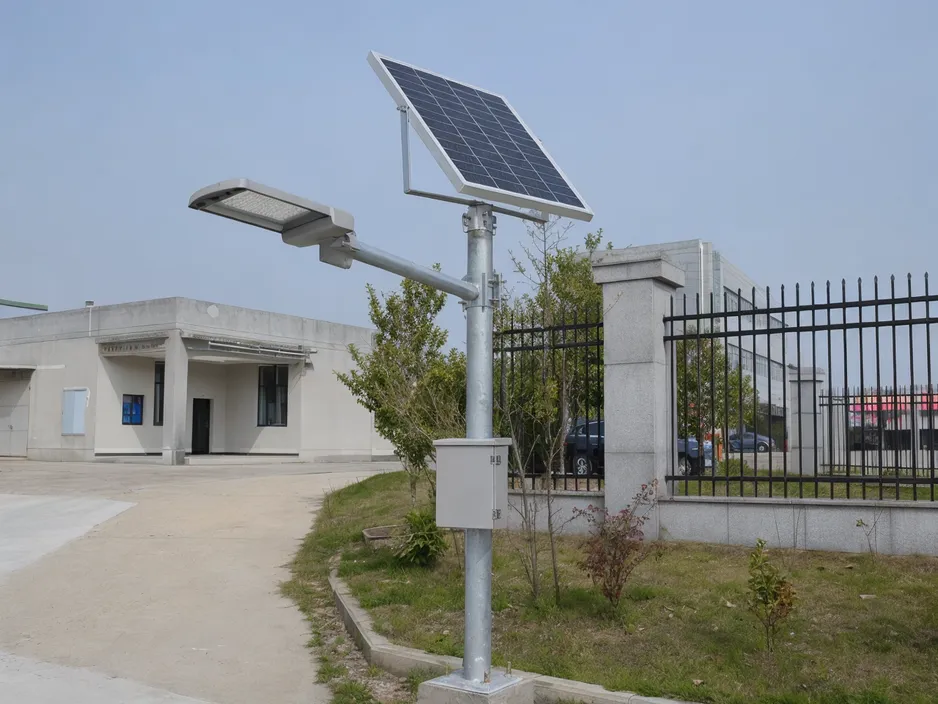
Component Mounting Details
Panel Bracket
Adjustable tilt angle (15°–45°) with stainless steel hardware. Designed for tool-free angle adjustment during installation to optimize for latitude.
Battery Enclosure
Mounted mid-pole or at the base depending on security requirements. IP65 aluminum enclosure with ventilation and anti-theft locking mechanism.
Fixture Arm
Single or double arm options. 60mm slip-fitter or direct-mount adapters. Arm length and angle selected based on road width and required setback.
Wiring
All wiring runs inside the pole with weatherproof MC4 connectors at junction points. No exposed wiring. Cable glands at entry points rated IP68.
Retrofit Existing Poles
Split systems can be retrofitted onto existing poles — converting grid-powered street lights to solar without replacing the pole infrastructure. We provide adapter brackets for common pole-top configurations and structural assessments to verify the existing pole can handle the added wind load from the solar panel.
Project Segments Where Split Type Solar Street Light Sells Cleanly
Each segment below represents a market where the split configuration's panel and battery flexibility translates directly into commercial value — fewer warranty claims, stronger tender compliance, or a defensible price premium over commodity all-in-one fixtures.
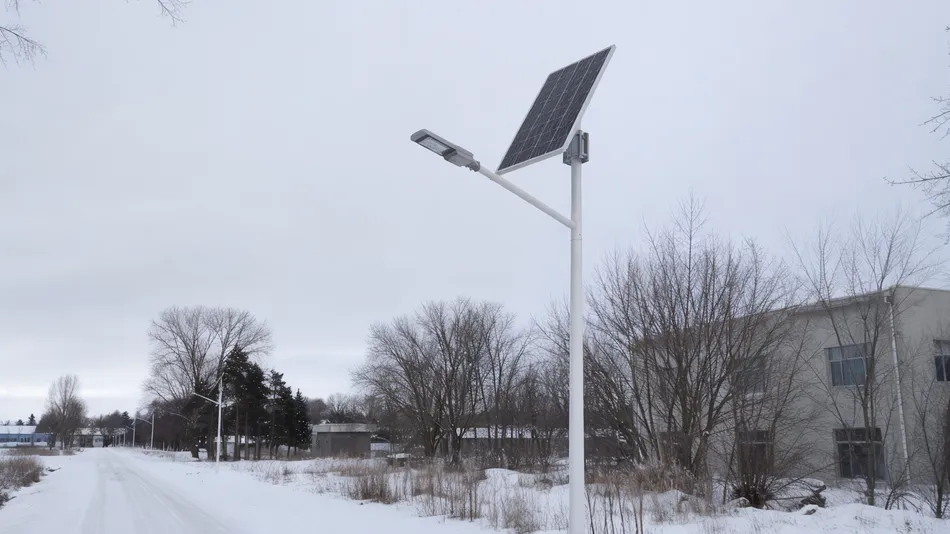
High-Latitude and Low-Irradiance Markets
Northern Europe, Canada, northern China, and similar markets have winter peak sun hours that can drop to 2–3 hours per day. An all-in-one fixture sized for mid-latitude performance will underperform or fail to maintain autonomy through the winter months.
A split type solar street light with a panel sized for the worst-month irradiance and a battery bank sized for 5-day autonomy is the only configuration that delivers consistent performance year-round.
Distributor Advantage
- Distributors who can demonstrate winter performance data have a clear competitive advantage over suppliers offering standard all-in-one fixtures
- Per-unit cost is higher, but so is the margin
- Warranty claim rate is lower than commodity all-in-one fixtures
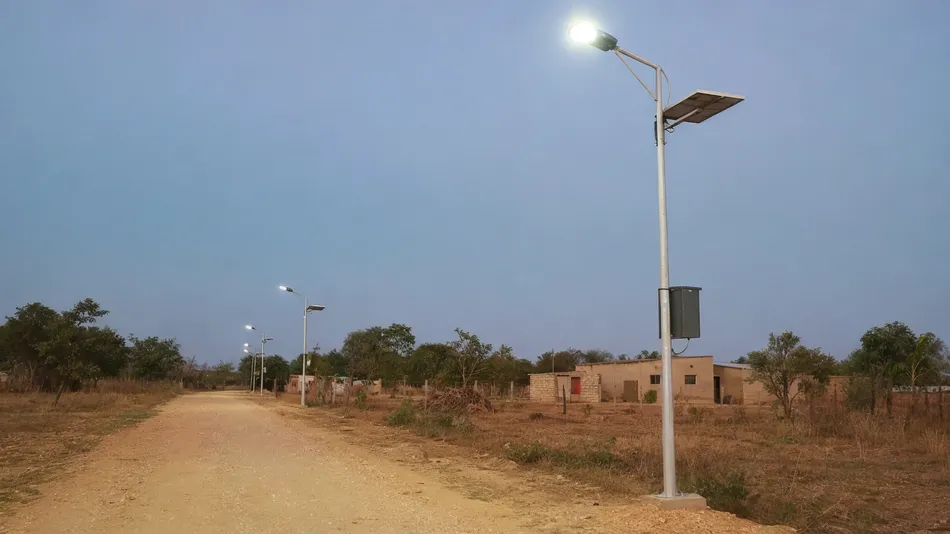
Rural and Off-Grid Roads
Rural roads, village access roads, and off-grid infrastructure projects in Africa, Southeast Asia, and parts of the Middle East are a high-volume segment for split solar street lights. Grid infrastructure is absent or unreliable, maintenance access is infrequent, and the consequence of a system going dark is significant.
Buyers in this segment specify longer autonomy — 5 to 7 days — and need a battery bank that can sustain operation through extended cloudy periods.
Configuration & Volume
- Separate battery box mounted at a serviceable height on the pole — simplifies battery replacement without requiring a lift truck
- Order volumes for rural electrification programs can run from a few hundred to tens of thousands of units
- Repeat orders follow as the program expands
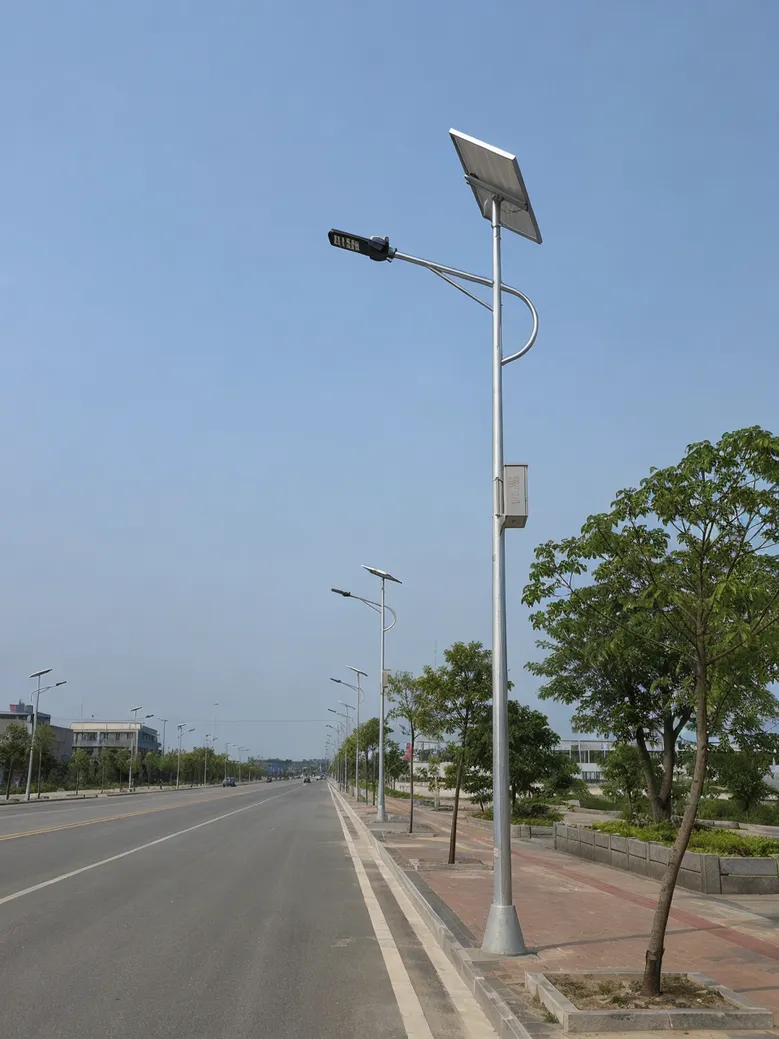
Municipal and Infrastructure Tenders
Municipal procurement offices and infrastructure project managers work from road classification standards that specify lux levels, pole heights, pole spacing, and operating hours. A solar street light with separate panel is often the only configuration that can meet a high-spec tender requirement — particularly when the tender specifies 5-day autonomy, 200W+ LED output, or installation in a region with variable solar irradiance.
The split architecture also makes it easier to document the system design in a tender submission: panel wattage, battery capacity, and autonomy calculation are separate line items that can be verified independently. CE, IEC 62124, and IP certification documentation are standard requirements for regulated market entry, and we provide them with every order.
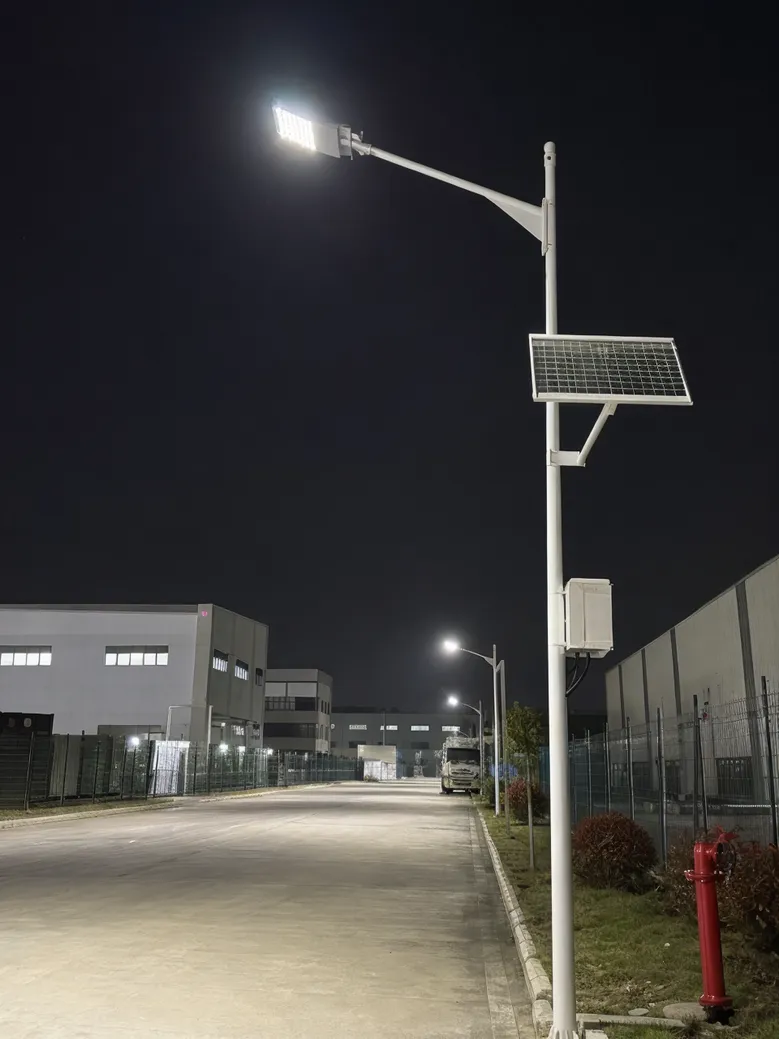
Industrial Roads and Logistics Access Lanes
Industrial parks, port access roads, logistics facility perimeters, and mining site roads require higher lumen output and longer nightly operating hours than standard residential streets. A 150W–300W LED fixture running 12–14 hours per night needs a panel and battery combination that only a split system can accommodate.
These projects are typically specified by a facilities engineer or project contractor who works from a photometric plan — they need a manufacturer who can confirm fixture performance against the plan before production. Order volumes are moderate (50–500 units per project) but the per-unit value is higher, and the projects tend to repeat as the facility expands.
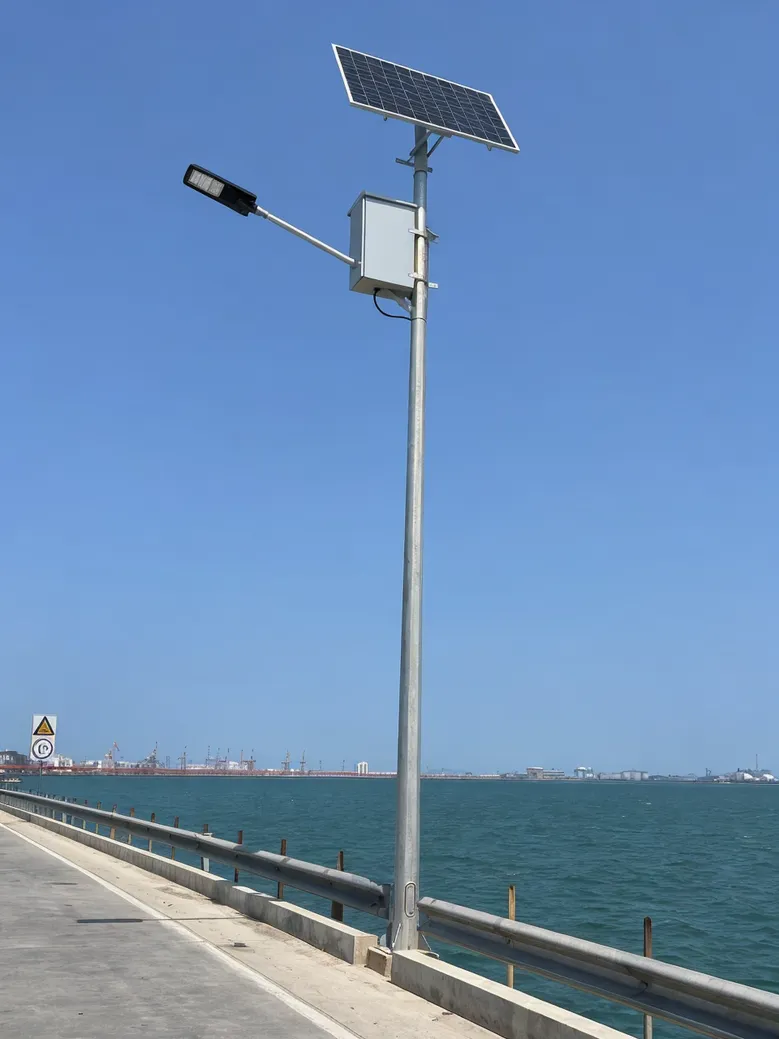
Coastal and Flood-Prone Installations
Coastal roads, port perimeters, and flood-prone areas present two specific risks for solar street lighting: salt spray corrosion and water ingress during flooding. IP67 rating — tested for temporary immersion — is the right specification for these sites, and the separate battery box configuration allows the battery to be mounted above the flood line rather than inside the fixture head at road level.
For distributors supplying coastal markets, the ability to specify IP67 and a separate battery box is a risk-reduction argument that justifies a higher unit price and reduces warranty exposure from their downstream customers.
Tell Us Your Target Segment and Annual Volume
We'll recommend the right split system configuration for your project type, climate zone, and tender requirements.
Get Configuration RecommendationInstallation Scope, Accessory Control, and After-Sales Cost
A split solar street light requires more installation discipline than an all-in-one fixture. That's not a reason to avoid it — it's a reason to confirm the accessory pack and installation documentation before the container closes, not after the fixtures are on site.
Full Installation Scope
Each step has a failure mode if done incorrectly — a poorly sealed connector will cause intermittent charging failure within one wet season.
- Panel bracket mounting and angle setting
- Fixture head mounting on the pole arm
- Cable routing from panel to fixture (through pole or along arm with weatherproof conduit)
- Waterproof connector assembly at both ends
- Battery box mounting where applicable
- Controller configuration for dimming schedule and sensor logic
- Final function check before the pole is raised
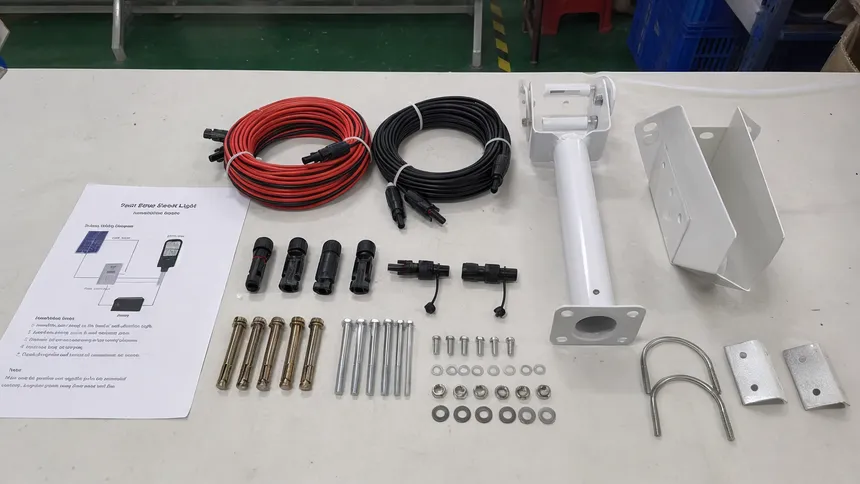
Complete Accessory Pack
Checked against a packing list before the carton is sealed — missing accessories are one of the most common causes of installation delays on project sites.
- Panel cable cut to the specified length
- IP-rated waterproof connectors
- Panel mounting bracket
- Fixture mounting hardware and fasteners
- English-language installation guide with wiring diagram
Panel Angle: The Most Underestimated Variable
The bracket should be set to the latitude-optimized tilt angle for maximum annual harvest, not to whatever angle is convenient on the pole.
For projects where the pole arm orientation is fixed by road geometry, we supply adjustable-angle brackets that allow the panel to be set independently of the arm angle.
High-Latitude Impact
At 50°N, the difference between a flat-mounted panel and a correctly tilted panel can be 20–25% of annual energy harvest.
Anti-Theft Options for Remote Sites
For rural or remote installations where component theft is a known risk, we offer:
- Panel cable with steel-reinforced sheathing
- Tamper-resistant fasteners on the panel bracket
These are not standard on every order but are worth specifying for sites where theft risk is identified.
OEM/ODM Split Configurations Without Guessing the Bill of Materials
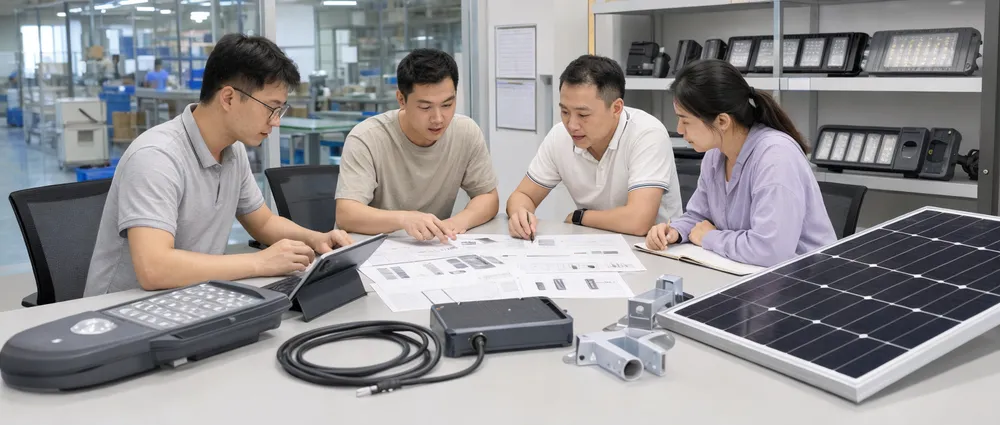
Split solar street lights are more frequently customized than all-in-one fixtures because the panel and battery sizing is project-specific by nature. Our in-house engineering team of 15+ optical and electrical engineers handles the configuration review for every OEM/ODM split system order.
Why Engineering Review Exists
Changing the panel or battery size affects the bracket, the cable length, the carton dimensions, and the cost. Those dependencies need to be confirmed before component procurement — not to add process overhead, but because spec mismatch costs more time to resolve during production than the review takes.
Customization Dimensions for Split Type Solar Street Light Orders
| Dimension | Options | Notes |
|---|---|---|
| LED Wattage | 30W – 300W | Confirmed against road spec and lux requirement |
| Lumen Output | Adjusted within LED module design range | CCT and lumen bin confirmed at module assembly |
| Solar Panel Wattage | 60W – 400W | Sized to battery capacity and installation latitude |
| Battery Capacity | 30Ah – 200Ah LiFePO4 | Sized to autonomy days and operating hours |
| Battery Placement | Integrated or separate battery box | Separate box for larger capacity; mounting height configurable |
| Color Temperature | 3000K – 6500K | 4000K–5000K standard for road; 3000K for park/pedestrian |
| Beam Optics | Standard symmetric / asymmetric road optics | Custom optics available for specific road width and pole spacing |
| Controller Modes | Full power / dim / motion / scheduled / smart network | Custom dimming profiles for OEM orders |
| Sensor Logic | PIR standard; time-control; multi-level dimming | Custom sensor configuration for project requirements |
| Housing Color | Silver grey, black, dark green standard | Custom RAL colors on runs of 100+ units |
| Logo and Branding | Custom logo on fixture and panel frame | Private-label packaging and labeling available |
| Carton and Packaging | Standard export carton or custom branded carton | Packing list and batch code labeling standard |
| Accessory Kit | Panel cable, connectors, brackets, fasteners, guide | Cable length confirmed to pole height and routing |
| Certifications | CE, RoHS, IP65/IP67, IEC 62124 documentation | Provided with order; additional market certifications on request |
MOQ and Engineering Review
MOQ for standard catalog split models starts at 100 units.
OEM/ODM orders with custom panel wattage, battery capacity, or housing modifications go through an engineering review before production — the review confirms the configuration is achievable, locks the spec before component procurement, and prevents spec mismatch that costs more time to resolve during production than the review takes.
Configuration Limitations — Stated Clearly
Not every panel and battery combination fits every pole and housing configuration.
Extreme autonomy targets (7+ days) with high LED output (200W+) may require a structural review of the pole arm and battery box mounting. We flag these cases during the engineering review rather than after production.
Component QC for Split Systems Before the Container Closes
Split solar street lights have more components than all-in-one fixtures, and more components means more failure points if QC is not applied at each stage. The risks specific to split systems are: panel output mismatch, cable and connector errors, battery capacity inconsistency, and waterproof connector failure at the panel-to-fixture junction — the most exposed connection point in the system.
We address each of these at the production stage, not at the warranty claim stage.
Solar Panel Electrical Testing
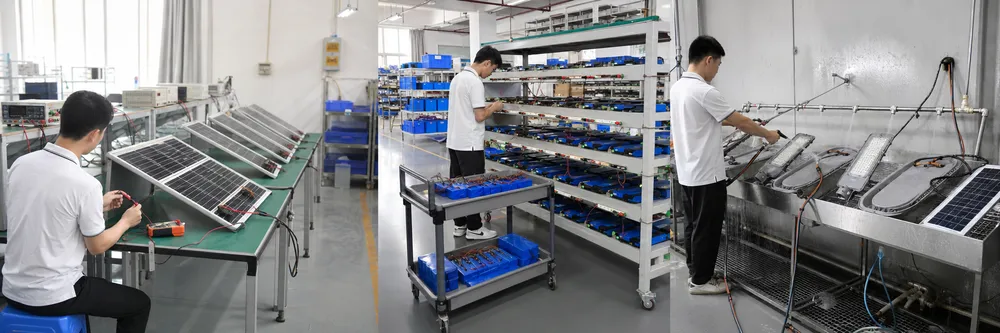
Every panel is tested for open-circuit voltage, short-circuit current, and maximum power output before it leaves the panel assembly area. Panels that don't meet rated output within tolerance are pulled.
We've seen incoming panel batches from component suppliers where 3–5% of units were below rated output. Without panel-level testing, those units ship and underperform from installation day one.
Battery Cell Matching & Pack Testing
Cells are sorted by capacity and internal resistance before pack assembly. Mismatched cells are not assembled together — the weaker cell discharges faster and degrades faster, pulling down the whole pack within one or two seasons.
Every completed pack goes through a full charge/discharge cycle test on aging racks before final assembly. This is not a continuity check — it's a full cycle under load, confirming the pack holds its rated capacity within tolerance.
LED Module Lumen Binning & Confirmation
LED chips are sorted by lumen output and color temperature bin before module assembly. Lumen output is confirmed at the module level before the module moves to final assembly.
This is the step that keeps your batches consistent across reorders — your customer expanding a road project in phases expects the new fixtures to match the ones already installed.
Controller & Sensor Function Testing
Every controller is tested for charging logic, dimming function, PIR sensor response, and lighting mode switching before installation in the fixture. Controllers that fail function tests are pulled before final assembly.
IP65/IP67 Waterproof Inspection
Every unit goes through waterproof structure inspection on our own IP inspection equipment. For split systems, this includes the fixture head, the battery box where applicable, and the cable entry points. IP67 units are tested for temporary immersion.
This is 100% inspection — not a sample check.
100% Pre-Shipment Outgoing Inspection
Every unit, every carton, every accessory pack, every label is checked before the container is sealed. Accessory packs are verified against the packing list. Batch codes are confirmed on carton labels.
Certifications & Documentation
JXSOL holds ISO 9001:2015, CE, RoHS, IP65/IP67, and IEC 62124 certifications. Documentation is provided with every order.
Packing, Labeling, and Site-Ready Accessory Packs
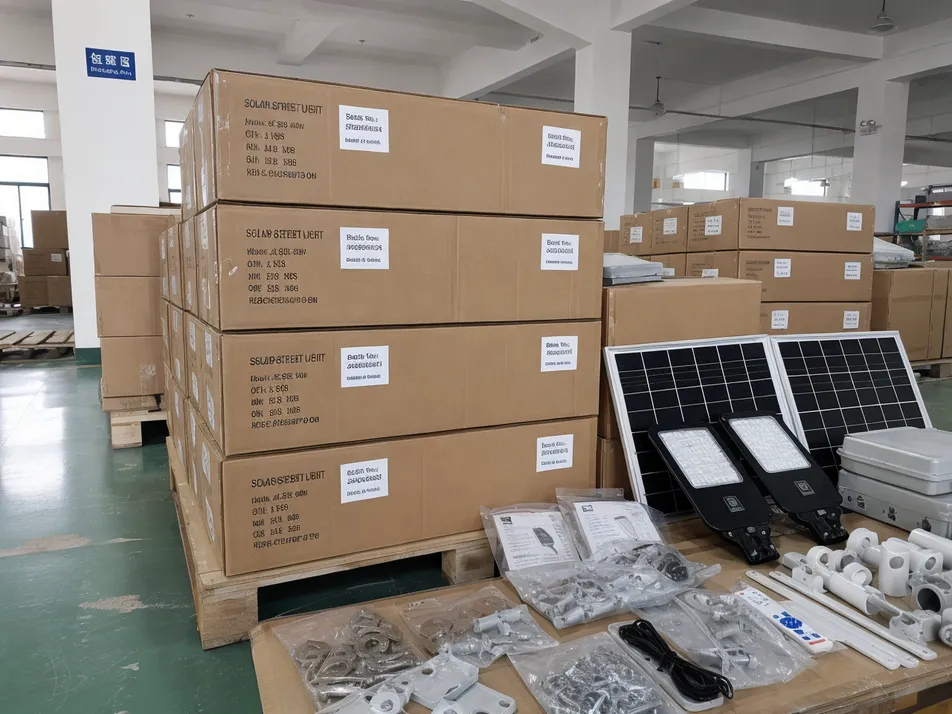
Split solar street lights ship in multiple cartons per unit: the fixture head, the solar panel, the battery box where applicable, and the accessory pack. Each carton is labeled with the product model, batch code, and carton contents. Mixed-SKU orders are organized by product family and labeled by batch code so your receiving team can sort and verify without unpacking everything.
Split System Accessory Pack Contents
The accessory pack for a split system is more complex than for an all-in-one fixture. Every accessory pack is checked against a packing list before the carton is sealed.
- Panel cable — cut to the specified length for the pole height and routing
- IP-rated waterproof connectors
- Panel mounting bracket
- Fixture mounting hardware and fasteners
- Remote control (where applicable)
- English-language installation guide with wiring diagram
Missing accessories on a project site cause installation delays that cost more than the accessories themselves — we check them before the container closes.
Batch Traceability
Batch codes on every carton trace back to the production run, component lot, and QC records. If a field issue surfaces after installation, the batch code lets us identify the production window and pull the relevant inspection records.
For buyers running large project deployments, this traceability is the foundation of any warranty claim process.
Private-Label Carton Printing
Custom carton printing and SKU labeling available for distributors building a branded solar lighting line.
Pallet Configurations
Palletized delivery available for warehouse receiving or project site logistics. Configurations confirmed during quotation based on model and spec.
Container Loading Details
Exact carton dimensions and container loading quantities are confirmed during quotation based on the specific model and configuration.
Choose Split, All-in-One, Smart, Road, Highway, or Pole-Matched Systems
The split solar street light is the right configuration when panel and battery flexibility matters more than installation simplicity. If your project or catalog requirement falls outside that description, the table below maps the other product families to their primary buying scenarios.
Split Solar Street Light
Projects requiring larger panel or battery than an integrated housing allows — higher latitudes, longer autonomy, higher output.
Solar Street Lights
Broad standard model selection for residential and secondary roads; distributor stock SKUs.
View ProductsCommercial Solar Street Lights
Commercial developments, business parks, and private road projects requiring higher lumen output.
View ProductsAll-in-One Solar Street Light
Simpler installation, compact SKUs, standard road projects at mid-latitudes up to ~150W.
View ProductsSmart Solar Street Light
Remote monitoring, scheduled dimming, fault reporting, IoT integration for municipal projects.
View ProductsSolar Road Lights
Road-width and pole-height layout requirements; arterial and collector roads.
View ProductsSolar Highway Lights
High-speed roads and expressways; high-mast configurations, wide beam distribution.
View ProductsSolar Park Lighting
Pedestrian paths, parks, and recreational spaces; lower pole heights, decorative housing.
View ProductsSolar Street Lighting Pole
Pole-matched projects sourcing poles alongside fixtures.
View ProductsFAQ for Split Solar Street Light Procurement
What is the difference between a split solar street light and an all-in-one solar street light?
An all-in-one solar street light integrates the solar panel, battery, LED module, and controller into a single housing. A split solar street light separates the panel from the fixture — the panel mounts independently on the pole or a dedicated bracket, while the LED head, controller, and battery are in the fixture body or a separate battery box.
The practical difference is sizing freedom: a split system can accommodate a larger panel and a larger battery than an integrated housing allows.
For standard road projects at mid-latitudes with moderate irradiance, an all-in-one is simpler and sufficient. For higher output, longer autonomy, higher latitudes, or sites where panel orientation and fixture orientation need to be set independently, a split system is the right choice.
When should I choose a solar street light with separate panel?
Choose a solar street light with separate panel when any of the following apply:
- The project requires 200W+ LED output
- The installation is above 45°N or below 20°N latitude where winter irradiance is low
- The project specifies 5 or more autonomy days
- The road orientation means the fixture angle and the optimal panel angle are different
- The battery capacity required for the project exceeds what fits in an integrated housing
If none of those conditions apply, an all-in-one fixture is likely the more cost-effective choice.
Not sure which system fits? Send us the installation location, required lux level, operating hours, and autonomy target — we'll run the configuration and tell you which system fits.
How many autonomy days should a split type solar street light support?
Three days is the standard minimum for most road lighting applications — it covers a typical sequence of overcast days without the system going dark. Five days is common for projects in regions with variable solar irradiance, monsoon seasons, or high-latitude winters where consecutive low-irradiance days are more frequent. Seven days is specified for critical infrastructure or locations where maintenance access is difficult.
The trade-off is direct: more autonomy days require a larger battery bank, which increases unit cost.
Sizing inputs we ask for first
We size battery capacity against your target autonomy days, daily operating hours, and installation latitude as part of the configuration process — it's one of the first inputs we ask for.
Most road lighting applications
Monsoon, high-latitude winters
Difficult maintenance access
Can the battery box be mounted separately from the light fixture?
Yes. For larger battery capacity configurations, we offer a separate battery box that mounts on the pole at a serviceable height — typically 1.5–2.5m above ground — rather than inside the fixture head.
This configuration is common for rural electrification projects where battery replacement needs to be done without a lift truck, and for coastal or flood-prone installations where the battery should be above the flood line.
Battery box is IP65-rated, connected to the fixture and panel by weatherproof cables.
Typically 1.5–2.5m above ground for serviceable access without a lift truck.
Included in the 100% pre-shipment inspection. Cable lengths and bracket configuration are matched to your pole height.
Order note: Confirm the battery box requirement at order placement so the cable lengths and bracket configuration are matched to your pole height.
What IP rating and certifications should I confirm for split solar street lights?
IP65 is the minimum for any outdoor solar street lighting application. IP67 is worth specifying for flood-prone areas, coastal locations with heavy salt spray, or any site where standing water is a regular condition.
For split systems, confirm that the IP rating applies to the fixture head, the battery box, and the cable connectors — the connector junction between panel and fixture is the most exposed point in the system and the most common waterproof failure point.
JXSOL Certifications
JXSOL holds CE, RoHS, IP65/IP67, and IEC 62124 certifications, with documentation provided per order.
Market-Specific Requirements
- European market entry: CE and IEC 62124 are the primary requirements.
- North American projects: Confirm whether CE is accepted or whether additional documentation is required for the specific application.
What information does JXSOL need to quote a split solar street light project?
The most useful inputs are:
With those inputs, we can confirm the panel wattage, battery capacity, LED output, and operating profile, provide a detailed quote, and flag any spec considerations before production.
If you're earlier in the process — comparing configurations or evaluating us as a supplier — send what you have. We'll work from there.
Ready to specify your split solar street light project?
Send your site parameters and we'll confirm the configuration.
Send the Inputs That Actually Decide the Configuration
The configuration of a split solar street light is determined by your project parameters, not by a catalog selection. Provide the inputs below and our engineering team confirms the panel wattage, battery capacity, LED output, and operating profile — then sends back a detailed quote with the confirmed specification.
Inputs That Matter
- Installation country or latitude
- Road width, pole height, pole spacing
- Required lux level or target lumen output
- Operating hours per night and dimming schedule
- Target autonomy days
- Destination market
- Order quantity
- Any branding or private-label requirements
What You Get Back
With those inputs, our engineering team confirms the panel wattage, battery capacity, LED output, and operating profile — and sends back a detailed quote with the confirmed specification.
Standard Catalog Split Models
Available from 100 units
OEM/ODM Orders
Custom panel sizing, battery capacity, or housing modifications go through an engineering review before production.
If you're comparing configurations or evaluating JXSOL as a supplier, send what you have. We'll work from there.
Phone / WhatsApp
+8613627818806Address
9th Floor, Houda Industrial, No. 65 Pinghe Road, Guzhen Town, Zhongshan, Guangdong, 528421, China
Explore Related Solar Street Lighting
All-in-One Solar Street Light
Integrated panel, battery, and LED in one unit
Smart Solar Street Light
IoT-enabled dimming and remote monitoring
Solar Road Lights
Designed for road-grade illumination standards
Solar Highway Lights
High-output systems for highway corridors
Solar Street Lighting Pole
Pole systems matched to split and integrated heads
Solar Park Lighting
Landscape and pathway lighting for parks
Commercial Solar Street Lights
Commercial-grade systems for estates and campuses
All Solar Street & Roadway Lights
Browse the full category