South Africa's load-shedding environment has turned battery autonomy from a marketing spec into a non-negotiable sourcing criterion. Your solar security lights must run 8–12 hours nightly without grid fallback — not dim to half-brightness after four hours, not fail after two rainy weeks. That requirement changes how you evaluate suppliers: lumen output alone doesn't tell you whether a light will still operate at 2 AM during stage 6, and an impressive Alibaba product page doesn't confirm the battery was actually tested before the container shipped.
This article walks through the supplier evaluation framework that matters for South African off-grid and commercial projects, presents 10 verified manufacturers and distributors across factory-direct and local sourcing channels, and explains when each route protects your margin better. We verify suppliers through official company domains and disclosed production capacity — not through marketplace badges or unverifiable listicle rankings.
Why Load-Shedding-Ready Battery Specs Matter More Than Lumens for SA Solar Security Projects
Most Chinese solar security light manufacturers spec their products for equatorial or grid-backup markets where 4–6 hour runtime is sufficient. That configuration fails in South Africa's off-grid reality. Load shedding means your security lights operate as the primary illumination source with no grid fallback — a light that dims to 30% brightness after five hours creates a security gap, and a battery that depletes before sunrise leaves your site unprotected during the highest-risk hours.
Battery autonomy is the watt-hours your battery can deliver at the light's rated lumen output over the target runtime. A 2000-lumen flood light drawing 20W needs at least 160Wh of usable battery capacity to run 8 hours — but that assumes 100% depth of discharge (DoD), which shortens battery life. Practical configurations use 80% DoD on lithium batteries, so you need 200Wh nominal capacity minimum. The mistake most buyers make: they compare lumen specs across suppliers without verifying the battery capacity that sustains those lumens through the night.
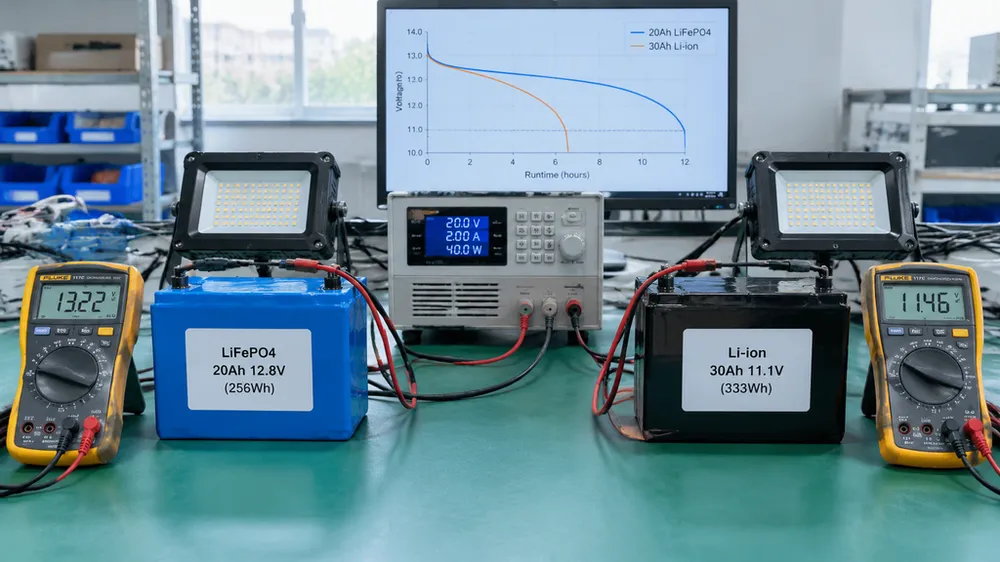
High-lumen products with undersized batteries look identical on a spec sheet but perform differently in the field. A 3000-lumen security light with a 20Ah LiFePO4 battery (256Wh at 12.8V nominal) can sustain full brightness for 8+ hours. The same lumen rating with a 15Ah lithium-ion battery (54Wh at 3.6V nominal per cell, 4S configuration = 216Wh) might only deliver 6 hours before voltage sag dims the output. That two-hour gap is the difference between reliable perimeter security and a warranty claim three months after installation.
What to verify before you order:
- Battery capacity in Ah and Wh — Ah alone doesn't tell you energy storage without knowing voltage; request Wh or calculate it yourself (Ah × nominal voltage)
- Charge controller type — MPPT controllers extract 15–25% more energy from the solar panel than PWM controllers in low-light conditions, which matters during Cape Town's winter months
- Discharge depth rating — lithium batteries can handle 80% DoD; if the supplier doesn't specify DoD or uses lead-acid chemistry (50% DoD max), you need double the nominal capacity
- Runtime test reports — ask for a discharge curve showing voltage vs. time at your target load; this confirms the battery sustains output through the claimed runtime
The B2B value: distributors avoid warranty returns when lights perform as specified through winter, and project contractors eliminate site revisits to replace undersized units. A 200Wh battery costs 15–20% more than a 150Wh unit at factory level, but it prevents a 100% product replacement cost six months into deployment.

Supplier Evaluation Checklist: Factory vs Trading Company vs Local Distributor
The South African solar security light market splits into three supplier types, each with different risk profiles and economics. Understanding which type you're dealing with prevents surprises at the specification, warranty, and reorder stages.
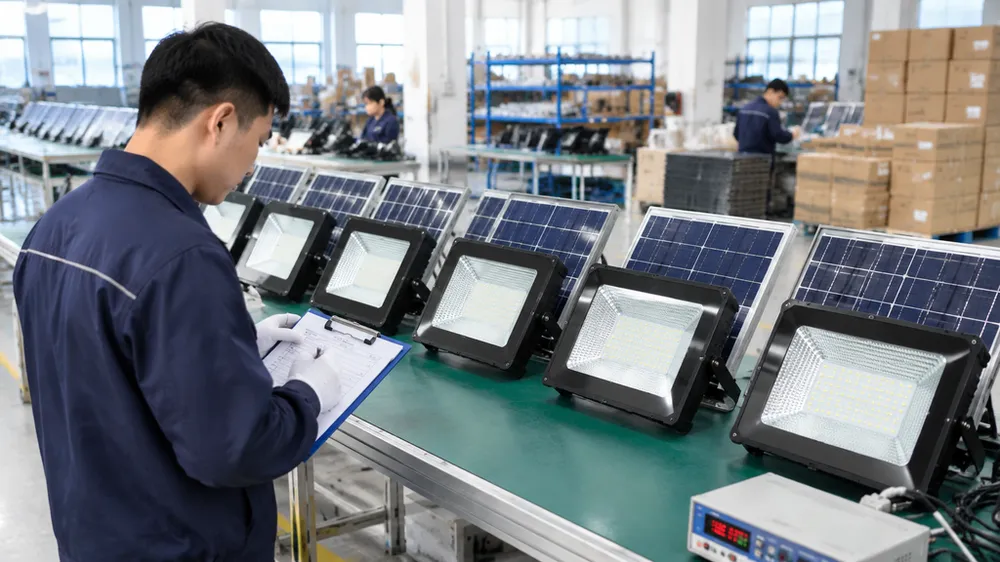
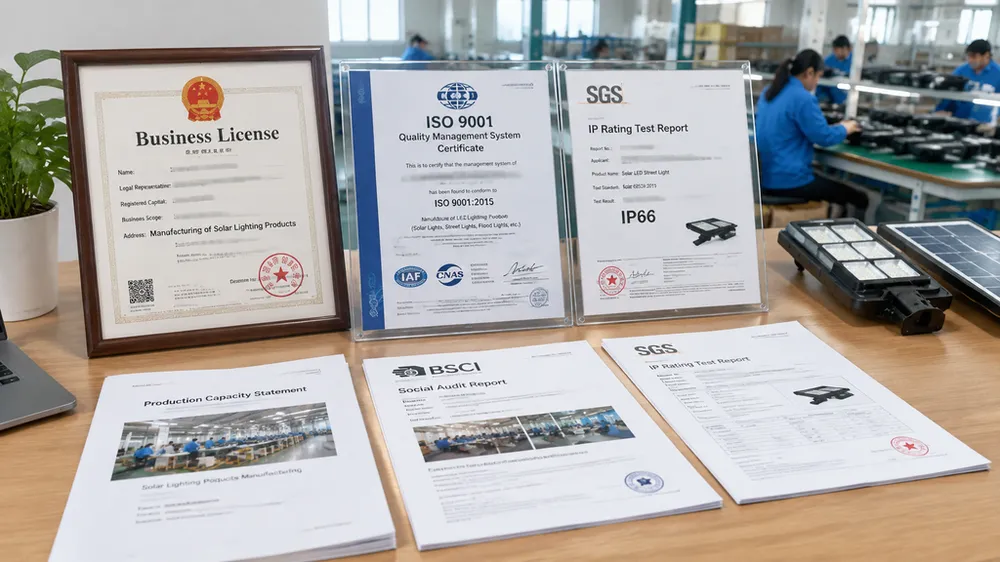
Factory-direct manufacturers own production lines and engineering teams. They're based in China (primarily Guangdong and Jiangsu provinces) or occasionally in regional hubs. Verification signals include: business license with manufacturing scope listed, production floor photos showing assembly lines and testing equipment, third-party audit reports (ISO 9001, BSCI, or SA8000), and export customs data showing FOB shipment history. These suppliers can customize battery sizing, adjust lumen output, and handle OEM packaging — but they require container-level MOQs (typically 100–500 units) and 25–35 day lead times including sea freight to Durban or Cape Town.
Trading companies act as sourcing intermediaries. They don't manufacture anything — they consolidate orders from multiple buyers and place them with factories they may or may not control. Red flags: Alibaba "Gold Supplier" badge without a disclosed factory address, product photos that appear across multiple unrelated supplier listings, inconsistent product ranges (solar lights, power tools, consumer electronics all from one "manufacturer"), and certificates "available on request" that never materialize with third-party lab letterhead. The risk: you can't verify who actually made your product, reorders may come from a different factory with different specs, and warranty claims route through a middleman with no engineering access.
South African importers and distributors buy container volumes from Chinese factories (or traders) and break bulk for local delivery. Value-add includes: Johannesburg or Cape Town warehouse stock for 5–10 day delivery, Rand pricing that eliminates forex risk, local warranty support, and simplified VAT documentation. The trade-off: 30–50% markup over factory-direct landed cost, limited SKU selection (you get what they stocked, not what the factory can make), and minimal customization capability. Verify that your SA distributor discloses the original manufacturer — if they won't name the factory, you have no reorder protection if they switch suppliers or go out of business.
Certification hierarchy that matters for SA projects:
IEC 62124 (solar module performance) sits at the top — it confirms the solar panel meets photovoltaic output and durability standards under the IEC framework that most SA commercial and municipal buyers reference. IP65/IP67 ingress protection ratings must come with third-party test reports showing dust-tight performance and water-jet or temporary-immersion resistance — not just a checkmark on a spec sheet. CE and RoHS are export-market baselines that confirm electrical safety and restricted substance compliance for EU-destined product; they're useful for SA buyers importing from China but don't replace IP or IEC verification.
Avoid "certificates available on request" without follow-through. If a supplier won't provide ISO 9001, IP test reports, or IEC 62124 documentation with the quote, they either don't have them or they're sourcing from unverified subcontractors.
What to request during supplier evaluation:
- Factory business license showing manufacturing scope (not just trading scope)
- Production capacity statement (annual output, number of lines)
- Third-party IP rating test reports with lab letterhead and date
- Battery cycle-life test data (500+ cycles at 80% DoD for lithium-ion, 1000+ for LiFePO4)
- Sample unit for your own field testing before container order
The factory-direct route gives you lower MOQ than you'd expect (100 units is achievable with serious manufacturers), faster customization, and 30–40% cost advantage over local distributors. The distributor route gives you speed (days vs. weeks), local warranty support, and eliminates import documentation burden. Your choice depends on order volume, urgency, and whether you need standard catalog product or custom battery/panel sizing.
IP Rating Reality Check for Coastal and High-Humidity SA Environments
South Africa's installation environments punish inadequate waterproofing faster than most export markets. Cape Town and Durban coastal zones deliver salt spray and year-round humidity that corrodes powder-coated steel housings within 18 months if the IP rating is decorative rather than verified. Highveld summer humidity (Gauteng, Free State) creates condensation inside poorly sealed battery compartments, shorting control boards after the first rainy season. Free State and Northern Cape mining and farm sites generate dust ingress that clogs heat sinks and degrades LED thermal management, cutting lumen output by 40% within a year.
IP ratings decode as two digits: first digit = solid particle protection (dust), second digit = liquid ingress protection (water). IP65 means dust-tight (first digit 6) plus protection against low-pressure water jets from any direction (second digit 5). IP67 adds temporary immersion protection (second digit 7) — the unit survives 30 minutes submerged at 1 meter depth. For SA outdoor security applications, IP65 is the baseline for inland sites; coastal installations should specify IP67 to handle storm-driven rain and salt spray.
The spec sheet rating doesn't matter if the construction weak points weren't tested. Three failure zones in solar security lights:
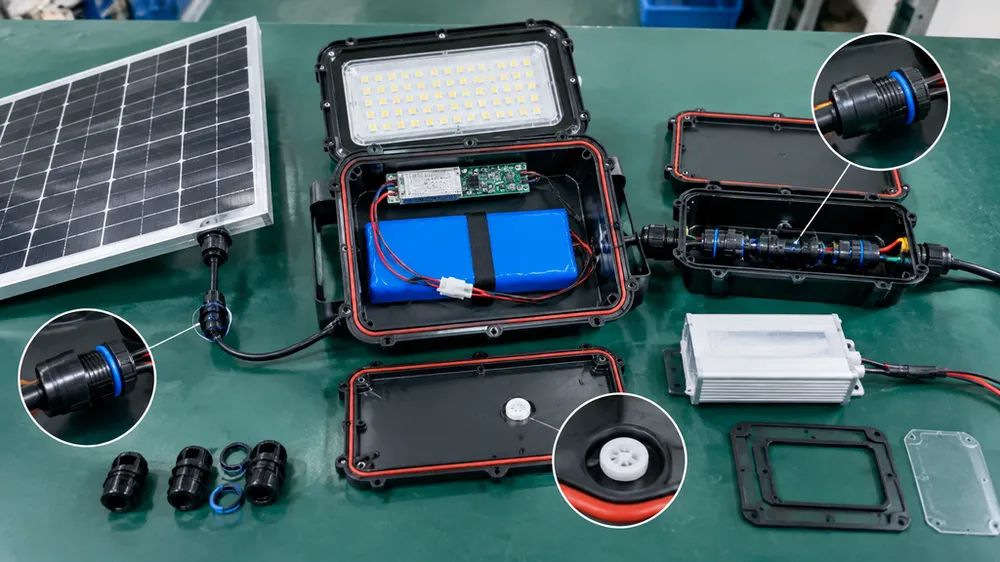
Cable glands connect the solar panel cable to the fixture body. Cheap glands use single O-ring seals that compress unevenly, creating water ingress paths along the cable. Reliable construction uses double O-ring glands with compression nuts — you should see two distinct seal surfaces when you inspect the gland.
Solar panel junction boxes house the bypass diodes and cable terminations. Poor-quality junction boxes use friction-fit covers without gaskets; rainwater pools inside and corrodes connections. Verify the junction box has an IP67-rated connector or a potted (sealed with epoxy resin) connection — the latter is more reliable for permanent installations.
Battery compartments fail when vents are missing or improperly sized. Lithium batteries off-gas during charging; without a pressure relief valve, internal pressure can rupture seals. The compartment needs a waterproof vent membrane (ePTFE or similar) that allows gas escape but blocks liquid water and dust — ask if this component is specified.
Housing material affects long-term corrosion resistance independent of IP rating. Marine-grade aluminum (5000-series or 6000-series alloys with higher magnesium content) resists salt spray corrosion better than powder-coated mild steel. If your supplier offers powder-coated steel housings for coastal projects, ask about the coating thickness (60–80μm minimum) and salt spray test results (500+ hours per ASTM B117). Steel housings are fine for inland Gauteng installations but risky for Durban or Cape Town without verified corrosion protection.
Request third-party IP test reports during the quote stage. The report should show the lab name, test standard (IEC 60529), date, and pass/fail results for the specific model you're buying. If the supplier says "all our products are IP67" without model-specific documentation, treat the claim as unverified.
The commercial value: IP67-rated units with marine-grade housings deliver 5+ year coastal service life vs. 18–24 month failure windows for IP44 or unverified "IP65" units. That difference eliminates one to two full replacement cycles over a typical SA commercial project lifespan, cutting total cost of ownership by 40–60% even when the verified unit costs 20% more upfront.
10 Solar Security Light Manufacturers and Suppliers Serving SA Projects
We verified these suppliers through official company websites and disclosed production or distribution capabilities. Suppliers are grouped by type: China factory-direct manufacturers who ship FOB from Shenzhen or Shanghai ports, South African importers/distributors with local warehouse stock, and regional manufacturers with assembly operations serving Southern African markets. This is not a theatrical ranking — the grouping reflects sourcing trade-offs (cost vs. speed, MOQ vs. customization, factory access vs. local support) that matter more than arbitrary numerical order.
China Factory-Direct Manufacturers
1. JXSOL (Zhongshan Century Juxing Optoelectronics) Zhongshan, Guangdong | Factory-direct
JXSOL operates 12,000 m² of in-house production in Guzhen Town (China's lighting manufacturing center) with six dedicated solar lighting lines. The factory focus since 2012 is solar-powered outdoor lighting — street, parking, flood, security, and garden products — with engineering support for battery and panel sizing specific to buyer latitude and seasonal irradiance. For South African buyers, that means you can request battery autonomy configurations calculated for Johannesburg's winter insolation (June–August) rather than accepting a generic equatorial spec that fails during SA's low-sun months.
MOQ starts at 100 units for standard catalog models, low enough to test SKU performance with your customers before committing to container volumes. OEM/ODM available for custom lumen output, color temperature, battery capacity, and branded packaging. Certifications include ISO 9001:2015, CE, RoHS, IP65/IP67, and IEC 62124 with documentation provided per order. The factory runs 100% pre-shipment inspection — every unit, every carton — which adds production time but eliminates the risk of discovering a defective batch after it's cleared customs in Durban.
SA-relevant capability: in-house R&D team (15+ optical and electrical engineers) can size solar panels and batteries for load-shedding autonomy requirements, and the testing lab verifies battery charge/discharge cycles and IP waterproof performance before shipping. Lead time 25–35 days FOB Shenzhen for repeat orders, 35–45 days for OEM configurations.
2. Shenzhen Baiqixing Solar Technology Shenzhen, Guangdong | Factory-direct
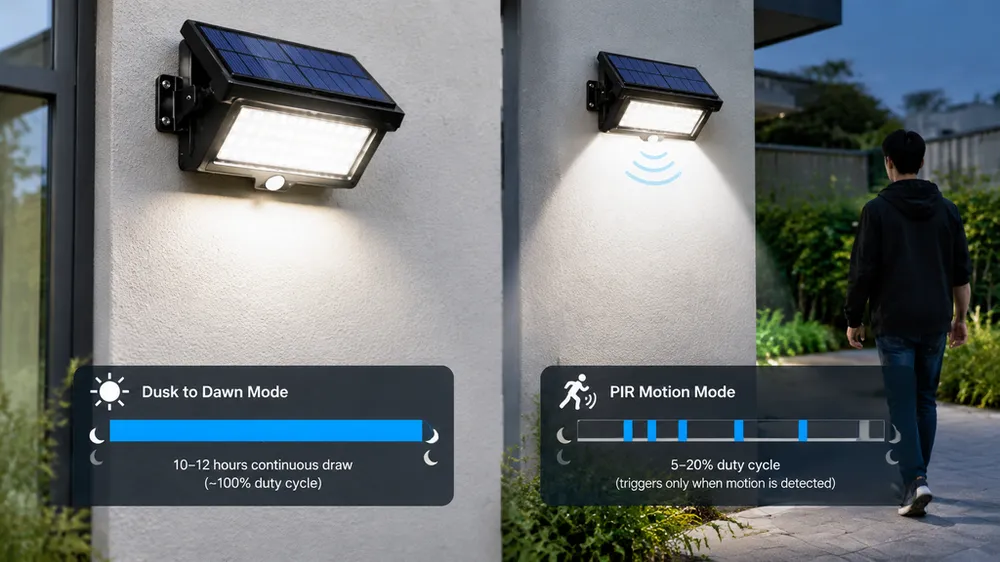
Baiqixing manufactures integrated solar street lights and all-in-one security lights with focus on export markets including Southern Africa. The factory positions around high-lumen output (3000–5000 lumen range) for commercial and perimeter security applications. Product range includes PIR motion sensor variants and dusk-to-dawn configurations.
Certifications listed: CE, RoHS, IP65. MOQ typically 200–300 units for standard models. Official site confirms factory production but limited English-language technical documentation. Lead time 30–40 days FOB Shenzhen.
SA consideration: High-lumen configurations suit large commercial sites (warehouses, industrial yards, parking structures) but verify battery capacity supports the output through 8-hour runtime — high-wattage fixtures need proportionally larger battery and panel sizing for SA winter conditions.
3. Yangzhou Bright Solar Solutions Yangzhou, Jiangsu | Factory-direct
Bright Solar operates in Jiangsu province's solar lighting cluster with production lines for split-type and all-in-one solar security lights. The factory supplies distributors and project contractors across Africa and Middle East export markets. Product catalog includes motion sensor flood lights (20W–100W range) and commercial area lighting with remote solar panel configurations for shaded installation sites.
Certifications: ISO 9001, CE, IP65/IP66. MOQ 150–500 units depending on model complexity. The company lists OEM capability for private-label programs and custom battery pack assembly.
SA-relevant note: Split-type configurations (separate solar panel and fixture) work well for installations where the security light mounts under eaves or overhangs with limited sun exposure — you can position the panel in full sun while the fixture stays in the target location. Verify the cable run length between panel and fixture meets your site geometry (standard offerings typically include 5m cable; longer runs need custom configuration).
4. Leadsun (Jiangsu Naite Lighting) Jiangsu | Factory-direct
Leadsun manufactures solar street lights and commercial flood/area lighting with focus on autonomous operation for off-grid markets. The factory's product positioning emphasizes battery management systems (BMS) with overcharge/overdischarge protection and temperature compensation — features that matter for SA's temperature variation between coastal zones and interior highveld regions.
Certifications: CE, RoHS, IP65, IEC listings. MOQ 100–200 units. The factory offers LiFePO4 battery options (longer cycle life than standard lithium-ion, better thermal stability) at higher unit cost — worth evaluating for projects where 5+ year battery service life reduces replacement frequency.
SA application: LiFePO4 chemistry handles temperature extremes better than lithium-ion, relevant for Northern Cape summer heat (40°C+) and Free State winter cold. If your deployment includes temperature-exposed installations (pole-mounted fixtures without shade), request LiFePO4 with BMS documentation.
5. Fonroche Lighting (Guangzhou office, French parent) Guangzhou, Guangdong | Factory-direct / International
Fonroche is a French solar lighting company with manufacturing operations in China (Guangzhou) and assembly/distribution in multiple regions. The product line focuses on smart solar street and area lighting with IoT control options, aimed at municipal and large commercial projects. Higher price positioning than typical Chinese manufacturers but includes remote monitoring systems and extended warranty support (5-year options available).
Certifications: ISO 9001, CE, IP66/IP67, IEC 61215 (solar module certification). MOQ higher than standard Chinese suppliers (300–500 units typical for project orders). The company maintains engineering offices in Europe and Africa for project specification support.
SA consideration: Suitable for municipal smart-city projects or large commercial deployments where remote monitoring justifies the cost premium. The smart-control features allow battery-level monitoring and dimming schedules via cellular connection — useful for maximizing autonomy during load-shedding periods by reducing output during low-traffic hours (midnight–5 AM).
South African Importers and Distributors
6. Solar Africa (Cape Town) Cape Town, Western Cape | Importer/Distributor
Solar Africa distributes solar-powered lighting products including security flood lights and motion sensor fixtures to the SA retail and commercial markets. The company stocks container imports from Chinese manufacturers and breaks bulk for smaller order volumes. Warehouse locations in Cape Town and Johannesburg enable 5–10 day delivery for in-stock SKUs.
Product range includes 20W–50W flood lights with PIR sensors, aimed at residential security and small commercial applications. The distributor provides local warranty support (typically 2-year) and handles VAT documentation for SA buyers. Pricing in Rand eliminates forex risk.
Trade-off: MOQ as low as 10–20 units makes this channel suitable for installation contractors testing a new product line or filling emergency replacement orders. Unit cost runs 30–50% higher than factory-direct import due to distributor margin, but speed and local support offset the premium for sub-100-unit orders or buyers without import/clearance infrastructure.
7. Current Automation (Johannesburg) Johannesburg, Gauteng | Importer/Distributor
Current Automation supplies solar lighting and automation products to the SA commercial and industrial markets, with focus on access control, perimeter security, and energy-management systems. The solar flood and security light range includes motion sensor and dusk-to-dawn configurations stocked for project contractor sales.
Distribution model: Johannesburg warehouse with technical support for system integration (solar lights + access control + CCTV + intercoms as packaged security solutions). The company's installer network provides post-sale support across Gauteng and neighboring provinces.
SA application fit: Useful for security system integrators who bundle solar lighting with access control or CCTV projects — the single-vendor sourcing simplifies procurement and consolidates warranty. Unit pricing includes distributor markup but eliminates the need to manage multiple suppliers for a security system deployment.
8. Solar Electric Supply (Stellenbosch) Stellenbosch, Western Cape | Importer/Distributor
Solar Electric Supply distributes solar components including off-grid lighting, panels, batteries, and charge controllers to the SA renewable energy market. Product range covers residential and commercial solar security lights with emphasis on battery-capacity transparency (Wh ratings disclosed, not just Ah).
The distributor stocks units from multiple Chinese factories and labels them by application (coastal IP67 rated, high-lumen commercial, residential motion sensor) rather than by brand. Warehouse in Western Cape serves Cape Town metro and Garden Route installation markets.
Trade-off: Multi-factory sourcing means you can compare different battery/panel configurations within one distributor relationship, but reorder consistency depends on whether the same factory stock is available — confirm part numbers and factory source if you need identical replacements for a phased project.
Regional Manufacturers (Southern Africa)
9. Raylux (Johannesburg) Johannesburg, Gauteng | Regional assembly
Raylux operates as a South African lighting manufacturer with local assembly of solar security and flood lights using imported components (Chinese solar panels, batteries, LED modules) combined with SA-made housings and fixtures. The company positions around local content for SA government and parastatal tenders that require minimum local manufacturing percentages.
Product range includes solar flood lights (30W–100W) and motion sensor security lights with marine-grade aluminum housings designed for coastal corrosion resistance. The assembly operation allows customization of housing finish, bracket configuration, and cable lengths for specific SA project requirements without overseas lead times.
SA tender value: Products may qualify for local-content scoring on government RFPs and BBBEE procurement policies, relevant for municipal and parastatal projects. Lead time 15–25 days for standard configs, 30–40 days for custom housing/bracket specs. Pricing sits between Chinese factory-direct and full SA distributor markup (typically 15–25% above FOB import cost, 10–20% below pure distributor pricing).
10. Ulti Group (Harare/Johannesburg) Harare, Zimbabwe / Johannesburg office | Regional manufacturer
Ulti Group manufactures solar lighting products in Zimbabwe with distribution across Southern African markets including South Africa, Botswana, Zambia, and Mozambique. Product focus includes solar street lights and security flood lights sized for off-grid rural and peri-urban applications. The factory emphasizes robust construction for harsh installation environments (dust, temperature extremes, limited maintenance access).
Certifications: ISO 9001, regional electrical safety standards. The company supplies government rural electrification programs and mining/agricultural projects across Southern Africa.
Regional advantage: Familiarity with SA and neighboring countries' seasonal irradiance patterns, installation practices, and off-grid performance requirements. Products are spec'd for the regional market from the design stage rather than adapted from global/equatorial configurations. Lead time shorter than China imports (15–25 days regional freight) but MOQ and unit cost sit between Chinese factory-direct and SA distributor channels.
SA application: Suitable for projects spanning multiple Southern African countries where a single regional supplier simplifies cross-border procurement and warranty. Also relevant for buyers who prefer to avoid Chinese import documentation or who need rapid reorder capability for scattered rural installations.
MOQ and Lead Time Realities: When to Order Direct vs Through a Distributor
The factory-vs.-distributor decision hinges on three variables: order volume, delivery urgency, and customization need. Each sourcing route has a break-even point where its cost structure makes commercial sense.
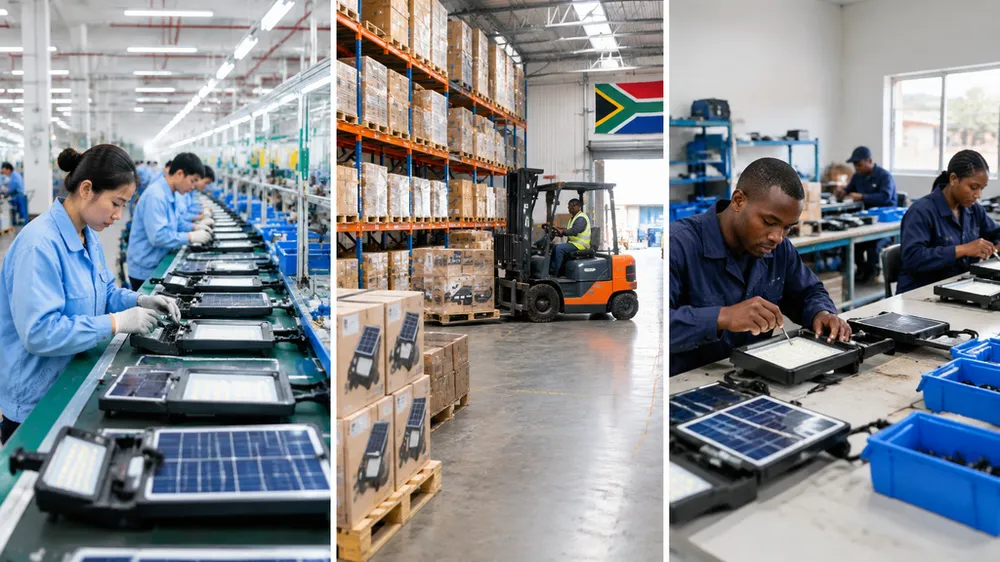
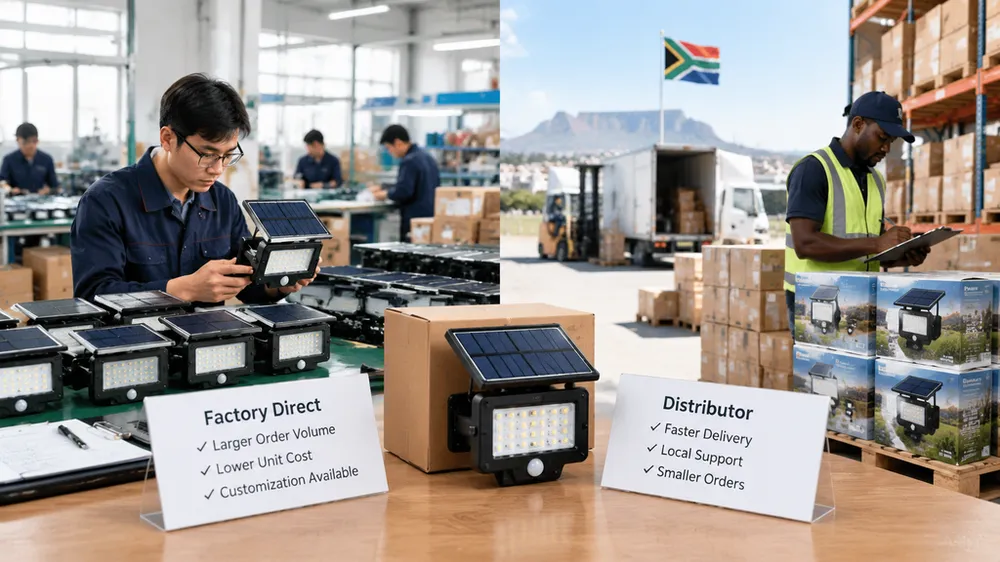
Factory-direct from China requires 100–500 unit MOQ depending on manufacturer (serious solar lighting factories start at 100 units; trading companies and smaller operations push 300–500). Lead time runs 25–35 days for repeat orders (10–15 days production, 15–20 days sea freight Shenzhen to Durban or Cape Town, plus customs clearance). Unit cost lands 30–40% below SA distributor pricing because you're eliminating two markup layers (Chinese domestic distributor + SA importer). You handle import documentation, customs clearance, and container delivery logistics yourself (or through a freight forwarder), and warranty support requires direct communication with the factory — expect 12-hour time-zone gaps and occasional English-language friction.
Factory-direct makes sense when: you're a distributor placing a first order for a new catalog SKU (100–200 unit test buy to validate market demand), a project contractor with multi-phase deployment (500+ units annual volume across 3–5 sites), or a buyer with established import infrastructure (customs broker relationship, container receiving capability, freight forwarder on retainer). The 30–40% cost advantage offsets the lead time and documentation burden at these volumes.
SA distributor model accepts 10–50 unit MOQ because they're breaking bulk from container stock they've already imported. Delivery runs 5–10 days ex-Johannesburg or Cape Town warehouse for in-stock SKUs. Pricing includes 30–50% markup over factory-direct landed cost (distributor's import cost + their margin + working capital cost for carrying inventory). You get Rand pricing that eliminates forex risk, local warranty support (phone call to Johannesburg, not email to Guangzhou), and simplified VAT documentation (local invoice, local supplier).
Distributor channel makes sense when: you have a single-project order under 100 units, urgent delivery requirement (less than 2 weeks), or lack import license / customs broker relationships. Speed and local support offset the cost premium for these scenarios. Also useful for installation contractors who need emergency replacement units (lightning strike, theft, vandalism) where the alternative is leaving a site unlit for 4–6 weeks while a factory order ships.
OEM and customization capability splits clearly: factory-direct required for custom battery sizing (you want 300Wh instead of the standard 200Wh configuration), lumen/CCT changes (you need 4000K instead of 5000K color temperature, or 2500 lumen instead of 2000), or branded packaging (your company logo on the box and fixture label). Distributors stock what they stock — you can't get custom specs without going upstream to the factory, and most SA distributors won't facilitate OEM orders under 500 units (not worth the factory coordination effort for small volumes).
The hidden third option: hybrid sourcing. Order 2–5 sample units from an SA distributor (fast delivery, test with your customers, validate field performance under actual load-shedding conditions). If the samples perform and demand validates, place a 100–200 unit factory-direct order for the next batch. You pay the distributor premium on samples only (20–100 ZAR extra for 2–5 units), then capture factory-direct economics at scale. The distributor may complain when you bypass them for the production order, but the commercial logic is sound — you used their inventory for validation speed, then sourced cost-effectively for volume.
Lead time planning for project schedules: If you're bidding a commercial or municipal security lighting project with a fixed installation deadline, work backward from the deadline: 25–35 days factory-direct lead time + 5–10 days customs/inland transport + 10–15 days installation buffer = 40–60 days minimum from PO to site commissioning. Distributor route shortens this to 15–30 days total (5–10 delivery + 10–15 installation buffer) but costs more per unit. The schedule-vs.-cost trade-off is project-specific: a municipal tender with a fixed budget might absorb the time risk to capture 30% cost savings, while a private commercial site with security urgency pays the distributor premium for speed.
How to Size Solar Panels and Batteries for SA Latitude and Seasonal Irradiance
Most Chinese solar lighting factories spec their products for equatorial markets or northern-hemisphere mid-latitudes (30°N–40°N). Those configurations fail in South Africa's winter months because the seasonal irradiance variation at 22°S–34°S latitude doesn't match the factory's default assumptions. A security light spec'd for year-round 5.5 kWh/m²/day average insolation (typical equatorial) will underperform when Johannesburg's June–August average drops to 3.2–3.8 kWh/m²/day — the solar panel doesn't generate enough daily charge to refill the battery after an 8-hour discharge, leading to progressive battery depletion and failure after two to three weeks of winter operation.
South Africa's latitude effects on solar panel performance: SA's major metros span 22°S (Polokwane) to 34°S (Cape Town), putting most installations in the 26°S–29°S range (Johannesburg, Pretoria, Durban). At these latitudes, winter solar insolation drops 35–45% compared to summer peaks. June–August solar radiation in Johannesburg averages 3.5 kWh/m²/day vs. 6.2 kWh/m²/day in December–January. That 43% seasonal swing means a solar panel sized for summer conditions will deliver only 57% of rated output during winter — insufficient to recharge the battery if you're running 8-hour nightly loads.
The factory trap: many manufacturers size solar panels based on "average annual irradiance" across all seasons. That works for grid-connected systems with battery backup, but fails for pure off-grid security lighting where the battery must sustain loads every night without grid fallback. You need to size for worst-case conditions (winter) plus a safety margin for consecutive cloudy days.
What to request from manufacturers:
- Panel watt-hours vs. load calculation sheet — the factory should show daily energy generation (panel wattage × effective sun hours × system efficiency) vs. nightly load consumption (fixture wattage × runtime hours). For SA winter sizing, use 3.5–4.0 effective sun hours for Gauteng inland, 3.0–3.5 for Western Cape coastal, 4.5–5.0 for Northern Cape. If the factory's calculation uses 5.5+ hours, it's spec'd for equatorial markets and will underperform in SA winter.
- Battery DoD rating and cycle life — depth of discharge determines how much of the nominal battery capacity you can actually use. Lithium-ion batteries typically rate 80% DoD (you can use 80% of capacity before recharge, preserve the remaining 20% to extend cycle life). If your load needs 160Wh nightly and your battery is 200Wh nominal at 80% DoD, you're using exactly 100% of the usable capacity every night — that works, but leaves zero margin for cloudy days. Better sizing: 250–300Wh nominal (200–240Wh usable at 80% DoD) gives you 1.5× load capacity, so one cloudy day doesn't kill the system.
- Charge controller efficiency — MPPT (Maximum Power Point Tracking) controllers extract 15–25% more energy from solar panels than PWM (Pulse Width Modulation) controllers under low-light and partial-shading conditions. That efficiency difference matters during SA winter months and highveld cloudy seasons. Request MPPT for any configuration intended for year-round SA operation; PWM controllers only make sense for cost-sensitive applications where summer-only operation is acceptable.
Custom sizing value: Factories with in-house engineering teams (like JXSOL, Leadsun, and similar serious manufacturers) can recalculate panel and battery for your specific latitude and worst-case irradiance. You provide: installation latitude (Johannesburg = 26°S, Cape Town = 34°S), target runtime (8–12 hours), fixture wattage (20W, 30W, 50W), and required autonomy days (1 day = recharge every day, 2 days = survive one fully cloudy day, 3+ days = extended backup for rainy weeks). The factory engineering team sizes panel wattage and battery capacity to meet those requirements and provides a calculation sheet showing the math.
This custom sizing avoids two failure modes: over-specification (panel/battery larger than needed, unnecessary cost) and under-specification (winter failures, warranty claims, site revisits). The B2B value: correctly sized systems eliminate winter performance complaints and protect your installed project reputation. A 60W panel + 300Wh battery costs 20–25% more than a 40W panel + 200Wh battery at factory level, but that upfront increment prevents a 100% product replacement after the first winter — the ROI is obvious.
Regional sizing guidance for SA provinces:
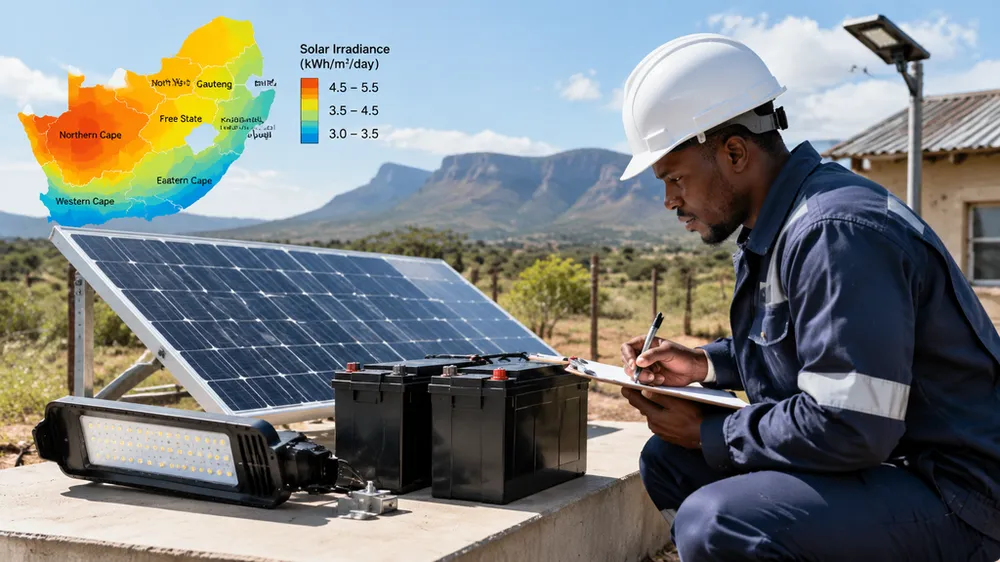
- Northern Cape / North West (high irradiance zone): 4.5–5.5 kWh/m²/day winter average — standard factory specs often work here with minor adjustment; focus on dust ingress protection (IP6X first digit) and high-temperature battery performance (40°C+ summer peaks).
- Gauteng / Free State / KZN inland (medium irradiance zone): 3.5–4.5 kWh/m²/day winter average — most standard configurations need 15–25% larger solar panels for reliable winter operation; verify panel watt-hours exceed nightly load by 1.4–1.6× to handle consecutive cloudy days.
- Western Cape / Eastern Cape coastal (lower coastal irradiance zone): 3.0–3.5 kWh/m²/day winter average — standard equatorial configurations will fail; request winter-specific sizing with 1.5–2.0× panel capacity vs. nightly load, and consider LiFePO4 batteries (better low-temperature performance) for installations above 500m elevation where winter frost occurs.
The load-shedding context amplifies these requirements: when grid power isn't available as fallback, your solar security lights must operate reliably every night regardless of season or weather. That makes worst-case sizing a sourcing requirement, not an optional upgrade.
Send Your Specifications for Factory-Direct Comparison
If you're evaluating suppliers for a current project or building a solar security light catalog for your distribution business, send us your target specifications and we'll respond with a configuration sized for South African latitude and seasonal conditions. Include in your RFQ: target lumen output (1500–5000 lumen typical for security applications), required runtime hours (8–12h for load-shedding environments), installation environment (coastal IP67 required, inland IP65 sufficient), and order volume (determines whether factory-direct or distributor route makes sense).
We size battery capacity and solar panel wattage for SA winter worst-case irradiance, not equatorial averages — that's the difference between a system that works year-round and one that fails after the first Cape Town winter. Our in-house engineering team provides panel-vs.-load calculation sheets with your quote so you can verify the configuration before ordering, and our testing lab runs 100% pre-shipment inspection (battery charge/discharge verification, IP waterproof test, lumen output confirmation) before the container leaves Zhongshan.
MOQ from 100 units for standard catalog models. Lead time 25–35 days FOB Shenzhen to Durban or Cape Town. Request Quote or review our full Solar Flood & Security Lights Manufacturer catalog for technical specifications and application guidance.